

“When the righteous are in authority, the people rejoice; but when the wicked rule, the people groan.” — Proverbs 29:2

On Easter Sunday morning, the President of the United States issued a stream of public threats toward Iran, filled with language that once would have been unthinkable from the office he holds.
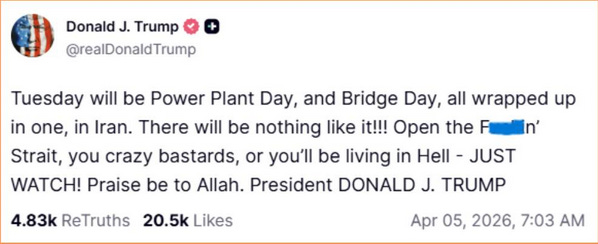
The words themselves matter (he is threatening war crimes), but so does what they reveal. Leadership is not only about policy or position. It is about presence, restraint, and the capacity to hold power without being consumed by it. We are watching what happens when that capacity fails.
When leaders lose their grounding, the consequences move outward. They shape the tone of public life. They destabilize relationships between nations. They introduce volatility into systems that depend on a measure of steadiness. Other leaders begin to calculate differently. In short, trust narrows. Risk expands.
The biblical tradition knows something of this pattern. It records, with striking honesty, what happens when power detaches from wisdom.
King Saul begins with promise and ends in unraveling. The text describes a mind that grows increasingly agitated, suspicious, and unable to discern reality clearly. His fear turns inward and outward at the same time, and he begins to lash out at those closest to him. David, who once soothed him, becomes a target. The kingdom fractures under the strain of a leader who can no longer govern himself.
King Nebuchadnezzar, in the book of Daniel, builds an empire and then loses his grip on what is real. He is described as living like an animal, his mind untethered, his power intact but unusable. The story is not subtle. It names the danger of authority without humility, power without limits, leadership without self-knowledge.
These stories are diagnostic for this time. They describe what happens when a human being is given power that exceeds their capacity to carry it.
James Baldwin once observed that “the most dangerous creation of any society is the man who has nothing to lose.”1 There is a similar danger in a leader who believes they cannot be held accountable, who no longer recognizes limits, who confuses impulse with authority.
Buddhist teacher, Pema Chödrön, teaches that when we are overwhelmed by fear, we either grasp for control or push away what we cannot tolerate.2 When that pattern takes hold in someone with immense power, it does not remain a personal struggle. It becomes public consequence.
We are not only dealing with political decisions. We are dealing with the interior life of leaders. That may be the harder truth to face. It means the stability of nations can hinge, in part, on whether those entrusted with power have done the work to remain human under pressure.
The prophets understood this. They did not only critique policies. They paid attention to the posture of the king, the condition of the court, the ways in which power insulated itself from correction. They knew that once a leader surrounds themselves with voices that echo rather than challenge, the descent can accelerate.
There is a moment, in every system, when people begin to see clearly what is happening. The question is what they do with that clarity.
Some will normalize it. They will explain it away, adjust their expectations, and continue.
Others will begin to tell the truth about what they are witnessing, even when it carries a cost.
This is where leadership widens beyond a single office. Leadership becomes collective.
Howard Thurman wrote about the “growing edge” of a society, the place where new life is possible because people refuse to accept what diminishes human dignity.3 That edge is not held by those in power alone. It is held by communities, by individuals, by those who choose to remain grounded when the systems around them begin to lose their balance.
We cannot control the interior life of those who hold high office. We can decide how we will live in response.
We can refuse to mirror instability with instability. We can resist the pull toward fear-driven thinking. We can stay rooted in relationships that hold us accountable and keep us connected to reality.
This is the work of disciplined, mature leadership. It is the work of remaining human in a moment when power itself seems to forget what that means.
The biblical witness does not promise that such moments resolve quickly. It does insist that they do not have the final word, because power that loses its mind eventually collapses under its own weight.
What remains, and what rebuilds, are the communities that learned how to live with clarity, courage, and care in the midst of it.
We are in this together,
Cameron
Reflection Questions
Where do you see instability in leadership affecting the wider world right now?
How do you notice fear or reactivity shaping your own responses?
What practices help you remain grounded and clear when the systems around you feel unsteady?
A Prayer for the Day
A Prayer for Steadiness in Unsteady Times
God of wisdom,
You who see clearly when we cannot,
steady us in this moment.

When power becomes unmoored,
anchor us in what is real and life-giving.

Keep us from being pulled into fear or reaction.
Give us the clarity to see,
the courage to speak,
and the discipline to act with integrity.

Hold us in community with one another,
so that we do not lose ourselves
in the confusion of these days.

Amen.
Spiritual Practice
Staying Grounded in Reality
Today, choose one grounding practice that reconnects you to what is real. It might be stepping outside and noticing the physical world, calling someone you trust for an honest conversation, or writing down what you are seeing without exaggeration or minimization.
As you do, ask yourself:
What is actually happening?
What am I adding out of fear?
What remains true regardless of the noise?
Return to these questions throughout the day. This is how we keep our footing when power begins to lose its own.
Upcoming Events That Might Be of Interest…
My team and I launched a new experiment we are calling “The Commons.” It’s an online space centered around communities of practice: groups of people who share a common concern, set of problems, or passion for a topic, and deepen their knowledge and expertise by interacting on an ongoing basis. Join the community here.
TONIGHT!!!! April 7, 2026, 7-8:30pm ET - Rev. Dr. Matthew Fox and I are hosting another 4-part series on “Visions for the Common Good.” This series includes sessions with David Abram (cultural ecologist), Lynne Twist (global activist), Randy Woodley (Cherokee scholar and wisdom-keeper), and yours truly! All sessions are recorded, and you will get the link if you can’t make it. Learn more here.
NEW!!! April 14, 2026, 11am ET - FREE WEBINAR - I will be joined by Rev. Shawna Bowman, an amazing artist and pastor of Friendship Presbyterian Church, for a conversation about art as resistance and what it means to show up as a creative individual in a world in need of justice. Shawna will be leading a community of practice starting in April on the Commons. If you want to learn more, register here.
NEW!!! On July 19-24, 2026, I’ll be leading a Women’s Wellness Retreat in the Wind River Mountains of Wyoming, and I’d love to extend the invitation to you. We’ll spend five days off the grid, riding horses through wide open landscapes, sharing meals, and creating space to slow down enough to hear ourselves think again. This retreat is about returning to yourself, settling your nervous system, letting go of what you’ve been carrying, and getting clearer about what matters now. The group will be small (no more than 10 women), and we’ll move at a steady, spacious pace, with plenty of room for both conversation and quiet. I hope you’ll consider joining us.
I drafted a Strategic Framework for Congregations as we move into the coming years of increased authoritarianism around the world. If interested, you can download it here.
Fun Things My Friends Are Up To…
I get to work with such amazing, creative people. This section is my way of celebrating them—no paid promotions, just joy in what they’re creating.
The Convergence Music Project has scheduled the fall conference on October 7-10, 2026 in Louisville, Kentucky. We will sing new community songs created specifically for this time in our history and explore together how the songs we sing in worship (and beyond) can empower and encourage us as we live out the biblical call to “do justice, love kindness, and walk humbly with our God.” Learn more here.
If you are a leader or member of a congregation looking for consulting support in visioning, planning, hiring or staffing, please consider Convergence.
Baldwin, James. The Fire Next Time. New York: Vintage International, 1993, p. 130.
Chödrön, Pema. When Things Fall Apart. Boston: Shambhala, 1997, p. 21.
Thurman, Howard. Jesus and the Disinherited. Boston: Beacon Press, 1949, p. 11.
I really appreciate your framing. The fact that those in power are losing their grounding should drive us to seek our own grounding in faith and community.
Once unthinkable...
war crimes threats through obscene words.
From a president.
...
Public consequence...
“Trust narrows. Risk expands,” far.
How will we respond?
...
May we stay rooted,
linked to what’s real, to the soil,
to each other’s souls.