

“The truth does not change according to our ability to stomach it.” — Flannery O’Connor
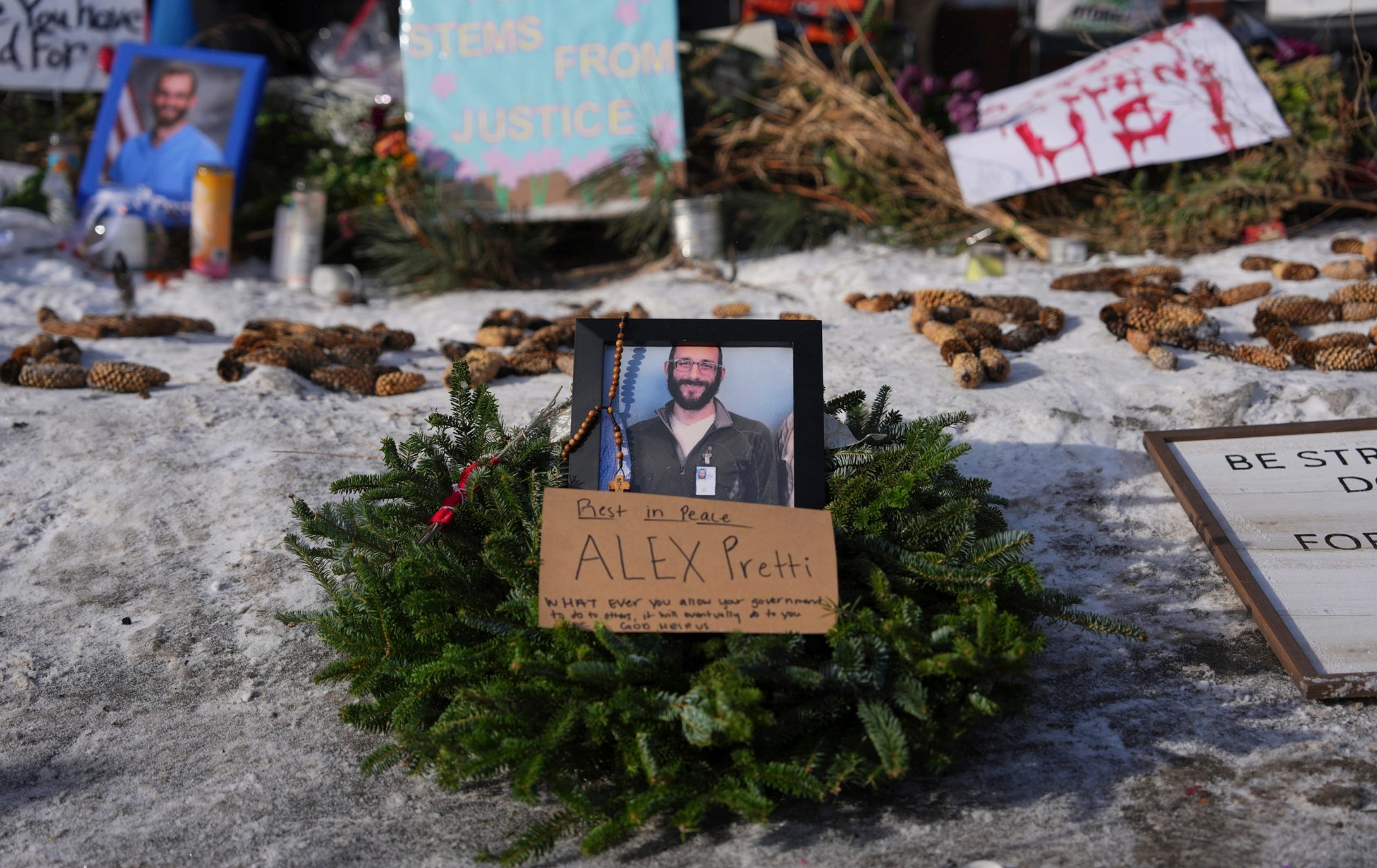
I keep thinking about how quickly a human life can be stolen, turned into a headline, and then into a talking point, and then into something we are expected to “move on” from. The pace of harm is accelerating, and the pace of processing is not. Some days it feels like we are asked to absorb moral injury the way we absorb weather: another storm, another death, another official statement insisting that what we saw with our own eyes is not what happened.
The murder of Alex Pretti has landed in that part of me that does not know how to file grief away neatly. It is a heartbreaking story on its own terms, because a man is dead. But it is also a story that exposes something about the world we are living in now, something about how power behaves when it no longer expects to be held accountable.
Alex was an ICU nurse. He lived a life built around caring for people in crisis. When he stepped forward in Minneapolis to witness what federal agents were doing, he did what many of us hope we would do if we saw a neighbor being treated as disposable. He tried to make what was happening visible. He tried to hold a line of accountability with his own body and his own attention.
Then, in front of bystanders, agents pepper-sprayed him, forced him to the ground, and shot him. The videos do not show a terrorist. They show a man trying to document federal power in motion. They show fear, force, escalation, gunfire, and a body collapsing. They show the shattering moment when a life ends.
I have found myself returning to the scene, not because I want to watch violence, but because the mind does this when reality becomes unstable. When something unbearable happens and then the story about it is manipulated, we replay the evidence as if repetition will anchor us. We watch again because we need to be able to trust what we know. We watch again because some part of us senses that the fight is not only over what happened to Alex, but over whether the truth of what happened will be allowed to exist.
That second violence came quickly.
The administration labeled him a domestic terrorist. They framed the killing as self-defense. They issued statements that conflicted with the footage. They began building a narrative meant to accomplish something very specific: not simply to defend their agents, but to make moral grief look irrational. The label does not just describe; it reorganizes perception. “Terrorist” is a word designed to shut down sympathy, to erase complexity, to authorize whatever comes next.
This is where many of us feel the deeper nausea. Not only that Alex is dead, but that the Trump Administration is trying to take his humanity with him. Not only that violence occurred, but that unreality is being installed over it like a lid.
This is how authoritarian power consolidates itself in ordinary life. It does not always need grand spectacle. It needs repetition. It needs discipline. It needs people to become uncertain about what they saw and tired of insisting on what they know. It needs the public to lose confidence in its own moral perception. When officials can say “terrorist” and large parts of the system repeat it or tolerate it or treat it as one more partisan claim, something critical shifts. A society starts learning how to live without truth as a shared ground.
That is why the conversations about “better training” feel so hollow.
I understand why people reach for that explanation. If this is a training problem, then it remains fixable within the systems we already have. If it is a mistake, then we can keep believing in the basic goodness of the structure. But that is not what this moment is revealing. Training does not change the moral purpose of a system. Training does not make kidnapping tender. Training does not make disappearance humane. Training does not make terror ethical by teaching it to speak more softly.
Alicia T. Crosby’s question1 haunts me because it is so plain. Do people truly believe that the machinery of detention, deportation, and erasure can become “trauma informed”? Do they think the harm is accidental, and not intrinsic? The wish for better training can become a way of avoiding the more frightening truth: that the cruelty is not a glitch. It is a feature of a political imagination that has decided certain people do not belong, and that the rest of us can be managed through fear.
That is the grief underneath the grief.
We are grieving Alex Pretti, because a good man is dead, and he should be alive. We are grieving the way his story is being re-written, because we recognize the tactic. We are grieving the message being sent to anyone who dares to witness or intervene: keep your head down, do not record, do not name, do not resist.
We are also grieving the bigger rupture, the one that spreads outward like a crack in glass. When the federal government kills someone in public and then asks us to accept a false story about it, the state is not only attempting to evade accountability. It is attempting to reorganize reality. It is attempting to teach us that power gets to decide what is true, and that the rest of us exist inside that decision.
This is now existential. It changes what it feels like to live here.
It changes what it feels like to send our children to school, to gather in public, to protest, to speak, to hope. It changes the tone of the air. It makes the body brace. It makes the spirit tired. It makes communities suspicious and tender and angry all at once. It makes people ask whether the basic promises we inherited—due process, equal protection, truth in public life—still operate, or whether they have become ceremonial language masking a different regime.
I do not want to overstate this. I also do not want to understate it. Our situation contains both danger and responsibility. The danger is that we acclimate to unreality. The danger is that we learn to live with public killing as background noise. The danger is that we accept the rewriting of victims into threats as a normal part of the news cycle.
The responsibility is smaller and harder than outrage. The responsibility is to keep our moral perception intact. The responsibility is to tell the truth without turning it into performance. The responsibility is to refuse the disappearance of a human being into a label. The responsibility is to grieve in a way that does not collapse into numbness, and to act in a way that does not collapse into despair.
The Hebrew prophets understood something about this. They did not only condemn bad policies; they warned about regimes that distort reality itself—regimes that train people to call evil good and good evil, regimes that punish truth-tellers, regimes that need lies in order to keep violence “justified.” The prophet’s work is not to be dramatic. It is to remain sane in a world that rewards delusion.
So we say his name: Alex Pretti.
We remember what he did before he died. He tried to witness. He tried to keep something human intact in a moment of state force. We refuse to let the state’s label become the last word over his life.
And we tell the truth about what this moment is asking of us. It is asking whether we will surrender our shared reality to propaganda. It is asking whether we will let fear govern our imaginations. It is asking whether we will normalize what should never be normal.
I cannot offer an easy ending here. I do not trust easy endings anymore.
But I do trust this: grief can be a form of moral loyalty. It can be the part of us that insists a life mattered, that truth matters, that reality matters, that belonging matters. Grief can also become fuel—not the hot fuel of vengeance, but the steady fuel of courage, the kind that keeps showing up when the story gets rewritten and the pressure to look away grows stronger.
We live in a time that will test the strength of our attention.
So today, I am asking us to do one thing that feels almost embarrassingly simple, and yet is increasingly rare: stay with what is true. Stay with what the videos show. Stay with the humanity of the person who died. Stay with the grief that proves your heart has not been trained into indifference. Stay with one another, because isolation is where unreality spreads fastest.
This is what authoritarian systems want most: for us to stop trusting ourselves, and then to stop trusting each other.
We do not have to give them that. Grief is not weakness. It is moral clarity. Lament is not resignation. It is resistance. Telling the truth — plainly, together — is how repair begins.
Finally, I want to share two signs of grace and hope. The first is a remarkable event in Minneapolis at Hennepin Ave UMC, where 1400 people gathered to “Sing Resistance.”
The second is a beautiful song written by Barbara McAfee, a resident of Minnesota, who is living in this moment and gifting us a way forward.
Keep the faith, good people.
We are in this together,
Cameron
Reflection Questions
Where do you feel the grief of Alex Pretti’s death in your body, and what does that grief reveal about what you still care about in this moment?
What happens inside you when you notice the state trying to rewrite reality, and how does that pressure affect your willingness to trust your own moral perception?
What would it mean for you, concretely and relationally, to “stay with what is true” in the weeks ahead, even when it feels costly or exhausting?
A Prayer for the Day
A Blessing for Staying Human in an Inhuman Time
God of truth,
we come to you carrying grief that does not know where to rest.
We carry the name of Alex Pretti in our hearts.
We carry the images we cannot unsee.
We carry the ache of watching a human life erased twice — once by violence, and again by lies.

We confess how tired we are.
We confess how tempting it feels to look away, to numb ourselves, to accept unreality as the price of survival.
But we do not want to become people who can live comfortably inside false stories.
We do not want to become people who mistake silence for peace.

Strengthen our moral perception.
Keep our hearts soft when fear tries to harden them.
Give us the courage to tell the truth without turning it into performance,
and the tenderness to grieve without collapsing into despair.

Teach us how to remain human in systems that reward indifference.
Teach us how to remain faithful to one another when power tries to isolate us.
Teach us how to remain grounded in reality when lies grow louder than facts.

We place Alex’s life into your care.
We place our grief into your hands.
We place our shared future into your mercy.

And we ask for the grace to stay —
with what is true,
with one another,
with the work of repair that still calls to us.

Amen.
Spiritual Practice
The Practice of Staying With What Is True
This is not a productivity exercise. It is an attention practice.
Sometime today or tomorrow, choose ten uninterrupted minutes. Put your phone away. Sit somewhere you can be physically still.
Speak Alex Pretti’s name out loud. Then say, slowly: “A human life mattered here.”
Notice what rises in you — grief, anger, fear, numbness, confusion, tenderness.
Do not try to fix any of it. Do not turn it into analysis. Stay with the sensation of it in your body.
Then say: “I trust what I know.”
And: “I will not surrender my moral perception.”
If you can, light a candle or place a stone, leaf, or small object in front of you as a marker of this moment. Let it remain there today as a quiet refusal to normalize what should never be normal.
This practice is not about changing the world. It is about keeping your humanity intact inside it.
Upcoming Events That Might Be of Interest…
February 5, 2026 - Margaret Wheatley and and I are launching a new online course called “Leading with Spirit,” a six-session journey into soul-grounded leadership designed to deepen your trust in guidance, nurture perseverance, and rekindle imaginal wisdom for our fractured world. Take a look at the course outline. We are really excited and hope you can join! Scholarship are available if needed. Learn more here!
February 11th and 25, 2026 - Join Our “Building a Culture of Leadership Within Congregations” Cohort facilitated by Rabbi Benjamin Ross and me! A two-session course for ministers and faith leaders ready to strengthen how their congregations and ministries identify, develop, and support leaders. Learn more here.
July 19-24, 2026 - Join me on retreat in the back-country of beautiful Wyoming. The Art of Wilding is a 5-Day Expedition for Women Leaders. We will spend the week reconnecting to nature, exploring our inner landscapes for change, and engage the wisdom of spiritual teachings. Click here to learn more.
I drafted a Strategic Framework for Congregations as we move into the coming years of increased authoritarianism around the world. If interested, you can download it here.
Fun Things My Friends Are Up To…
I get to work with such amazing, creative people. This section is my way of celebrating them—no paid promotions, just joy in what they’re creating.
The cool folks over at Spiritual Wanderlust are launching a new program called “Night School.” It’s a twelve-month journey through the Dark, offering the rituals, practices, and companionship humans have long relied on in times of deep transformation. You will be accompanied by elders and teachers who have walked this terrain deeply, including James Finley, Barbara Brown Taylor, and Ronald Rolheiser. I think this looks amazing.
Randy Woodley is offering a 15-part series on his Substack which is teaching me so much about how democracy does and doesn’t work for people. Randy is a Cherokee descendant recognized by the Keetoowah Band, a recovering academic, and a storyteller. You should check out his work.
If you are part of a congregation, you should check out the great resources at Church Anew. They produce ready-made resources and formation materials. Amazing stuff.
If you are a leader or member of a congregation looking for consulting support in visioning, planning, hiring or staffing, please consider Convergence.
https://www.facebook.com/share/p/1aQSjnZtLB/
Thank you. Again thank you, for a grief that permeates, for a truth ….. bared for all to feel.
Before I read your message…….. after my early morning contemplative prayer time…… I lit three candles. One candle for Nicole….. one for Alex ….. and one for my wife. I needed the presence, the presence that loved ones provide. I am not the “enemy from within.” I am a liberal, environmentalist. I accept that I am not “right” …… that other viewpoints matter….. that loving my neighbor is a tall order, yet what we are called to do. I believe that nonviolence is a courageous calling.
My grief right now is palpable….. my sadness profound.
Like individual separation and death - an unfolding reality we all face individually, and which some of us continue to avoid confronting until it's upon us - this existential crisis was always there. I am grateful for those like Cameron+ and other respondents in this campfire vigil who realize what Arthur Miller had Linda Loman say to her sons: 'He was a human being. Attention must be paid.' Lament is a part of the cycle of life and love that counter exile and death and entropy; only a part. Expressions of shock and outrage are not solutions, nor to be scorned. We are all in This together - Craig's response, just below as I type, is also mine: palpable grief, profound sadness. We/they distinctions are useful for analysis, worthwhile messengers, terrible mistakes as ending places. Love and gravity alone transcend time/space; that compound of love and attraction wins; it is never a walkover.