

“Returning violence for violence multiplies violence, adding deeper darkness to a night already devoid of stars.” — Martin Luther King, Jr.
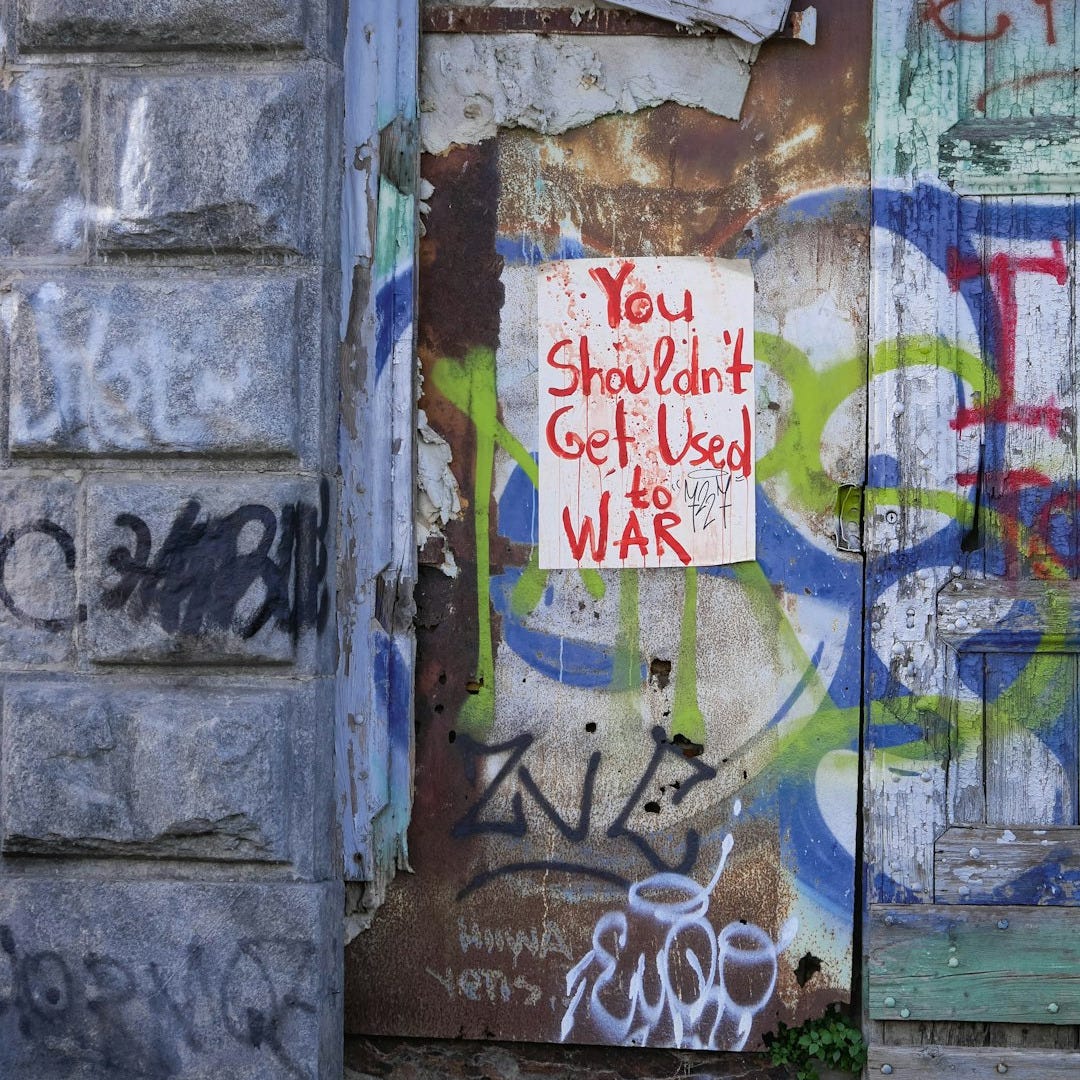
Every generation hears the same promise: War will bring peace.
Leaders rarely say it quite so plainly, but the logic is always the same. If we strike hard enough, remove the right enemies, destroy the right targets, then stability will follow. Violence becomes the doorway through which peace will supposedly enter.
We are hearing that promise again now.
War with Iran is being explained as necessary. Strategic. Preventive. The language is familiar because it has been repeated for generations. Each war is described as the one that will finally secure safety.
Beneath all the policy language is the belief that violence can redeem the world. If we destroy enough of targets, something better will emerge.
Theologians have a name for this. They call it the myth of redemptive violence.
It is not really a strategy. It is a story we tell ourselves about how the world works.
The story says evil can be located in certain people or nations. Remove them and the world becomes safer. It says violence is neutral, just a tool that can be used wisely by the right hands. It says history can be reset by decisive force. There will be a clear “before” and “after.”
But this story requires something from us. It requires distance from the human reality of violence. We invent phrases like “collateral damage.” We speak of “targets” and “assets.” We say “strategic strike.”
These words are not descriptions. They are anesthetics. They protect us from seeing what violence actually does. Bodies are torn apart. Families lose children. Grief spreads across generations. The earth absorbs the toxins of war. Fear becomes the air people breathe.
Violence does not stay contained. It ripples outward through the entire field of life.
Right now we are watching that ripple spread across the Middle East. Hundreds dead in Iran. Funerals interrupted by air raid sirens in Israel. Civilian casualties rising in Lebanon and Gaza. US service members killed. Fear tightening across an entire region.
Peace through war requires believing those ripples can be controlled. It requires believing we can decide where the suffering will stop.
History tells a different story.
Violence rarely produces the world its architects promise. The myth persists because it offers something seductive: the promise that destruction can purify the world. That devastation can open the door to a better future.
This is not only political thinking. It is theological thinking, even when people do not realize it. It echoes an ancient temptation: that the world can be saved by force.
Jesus rejected that temptation.
When his disciples reached for swords, he told them to put them away. He understood that violence does not heal the world. It multiplies the wounds the world already carries.
Peace is not something that emerges from domination. Peace is a quality of relationship. It grows where justice grows. It grows where dignity is honored. It grows where people learn how to live together without turning one another into enemies.
You cannot bomb relationship into existence.
You cannot kill your way to connection.
You cannot destroy your way to safety.
War always promises resolution. In reality it spreads grief. That grief matters. Feeling it matters. Refusing to numb ourselves to it matters. When we lose the capacity to feel the suffering of others, the myth of redemptive violence becomes easier to believe.
The spiritual task in times like this is not to pretend the world is simple. Nations face real dangers. Conflict is real. Evil is real.
But we must refuse the lie that violence will redeem us.
Our calling is harder than that. We are called to protect life. We are called to tell the truth about suffering. We are called to resist the stories that make war sound clean.
Peace will not come through destruction. It will come through the slow and difficult work of rebuilding relationships that violence has shattered.
We are in this together,
Cameron
Reflection Questions
Where do you hear the language of “peace through war” in the public conversation right now?
What helps you stay connected to the human reality behind the abstractions of war?
How might faith communities resist the myth that violence can redeem the world?
A Prayer for the Day
A Prayer for Clear Seeing
God of peace,

When nations rush toward violence, steady our hearts.

Help us resist the stories that make destruction sound righteous.
Give us courage to see clearly the suffering war creates.

Keep compassion alive within us when fear and anger tempt us to turn away.

Teach us to become people who protect life,
who tell the truth about violence,
and who work patiently for the fragile work of peace.

Amen.
Spiritual Practice
Refuse the Anesthetic
Today, pay attention to the language used to describe war. Notice the words that soften reality: “collateral damage,” “targets,” “strategic strikes.”
When you hear them, pause and translate them back into human terms.
Remember that every statistic represents a life.
Every casualty represents a family.
Every act of violence sends ripples through generations.
Resisting the myth of redemptive violence begins with refusing to numb ourselves to what violence actually does.
Upcoming Events That Might Be of Interest…
My team and I launched a new experiment we are calling “The Commons.” It’s an online space centered around communities of practice: groups of people who share a common concern, set of problems, or passion for a topic, and deepen their knowledge and expertise by interacting on an ongoing basis. At the moment, I am leading a book study on Brian McLaren’s book, Life After Doom, on Tuesdays. Join the community here.
March 17, 23, 31 and April 7, 2026, 7-8:30pm ET - Rev. Dr. Matthew Fox and I will be hosting another 4-part series on “Visions for the Common Good.” This series will include sessions with David Abrams, Randy Woodley and Lynne Twist! All sessions are recorded, and you will get the link if you can’t make it. Learn more here.
March 26, 2026, 7–8:30pm ET – FREE WEBINAR - I’ll be joined by Ruth Dearnley, OBE, Founder and President of Stop the Traffik (London), for “Stop the Exploitation of Children: Disrupting Human Trafficking at Its Source.” As Board Chair of Stop the Traffik USA, this work is deeply personal to me. We cannot rescue our way out of trafficking; we must prevent exploitation by disrupting the systems and financial flows that profit from vulnerability—and congregations can play a powerful role in building community resilience. Ruth will share how technology and data are exposing trafficking networks globally, and how congregations can lead local awareness and prevention campaigns that reduce vulnerability and protect children. I hope you’ll join us. Learn more and register here.
March 28, 2026 - No Kings Protest! We are marching again. Mark your calendars and find the nearest protest site. Make your protest signs. Knit your red hats. Get your water bottles and sunscreen ready. We head back into the streets for peaceful protest on behalf of a more just world. I'll see you out there. Register here.
I drafted a Strategic Framework for Congregations as we move into the coming years of increased authoritarianism around the world. If interested, you can download it here.
Fun Things My Friends Are Up To…
I get to work with such amazing, creative people. This section is my way of celebrating them—no paid promotions, just joy in what they’re creating.
I have just discovered the coolest group! The All We Can Save Project grew out of the powerful climate anthology All We Can Save and has become a growing network of people committed to climate courage and community leadership. Their work reminds us that responding to the climate crisis isn’t only about policy or technology; it’s also about cultivating the relationships, imagination, and moral courage needed to protect and restore the living world. Check them out here: https://www.allwecansave.earth/
The International Union of Superiors General (UISG), the Catholic organization representing more than 1,900 congregations of consecrated women religious present on six continents has convened an international moment of prayer for Friday, March 6, at 9:30 am (Eastern time), to be livestreamed and open to the faithful and all people of goodwill.
From my friend, Logan Bennett: With The Revolutionary Love Project, I’m hosting an immersive weekend retreat at La Foret in Colorado Springs (my ministry site). This isn’t a conference. It’s not protest training. It’s formation—the kind that helps us stay human and spiritually grounded while still being clear-eyed and brave. Rooted in the practice of Revolutionary Love (from the Revolutionary Love Project / Valarie Kaur’s work), this weekend is for people who want to meet rising authoritarianism, polarization, and overwhelm without losing our softness, our courage, or our joy. Link: https://www.laforet.org/events/adults/revolutionary-love-in-an-age-of-uncertainty
The need for us to persevere and contribute grows ever more challenging as the horror and cruelty escalates, created by leaders with “malevolent incompetence.” Dr. Margaret Wheatley is offering a “Bundle for Good” for shipping within the U.S. She will send you seven copies of Perseverance, and one copy of her book of poems, Opening to the World as It Is. She’s including the poetry book as another means to support you personally. You can learn more here.
If you are a leader or member of a congregation looking for consulting support in visioning, planning, hiring or staffing, please consider Convergence.
Thank you for the wonderful work you are doing.
Thank you for teaching us through chickens, teaching us through war. Violence, numbing. denial, destruction of any life diminishes us all. Thank you for teaching us to stand in our deeper knowing, of truth, of connection with the earth and each other, and remembering this dark time is a tremendous opportunity to lean into knowing we can’t help others or heal by our own strength alone. 💗Darla