

“It’s the little things citizens do. That’s what will make the difference.” — Wangari Maathai
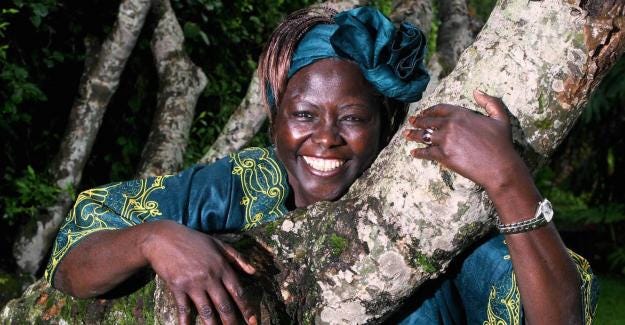
Novel Peace prize winner, Wangari Maathai, did not begin with a movement. She began by listening.
Women in rural Kenya told her they were walking farther each day for firewood. Their crops were failing. The soil was eroding. The water was disappearing. What looked like an environmental crisis was, in their lives, a daily grind of exhaustion and hunger. So she started with something small and practical. She told them to plant trees.
That decision did not stay small.
As the trees took root, so did something else. Women began organizing. They earned income. They reclaimed land. Very quickly, the work became political, because it had to. You cannot restore land in a system that is actively destroying it.
When the Kenyan government tried to take Uhuru Park and build a massive development, Maathai stood in the way. She wrote letters. She organized protests. She showed up in public when it would have been safer to stay quiet. She was beaten by police. She was arrested. She was called a threat to the nation.
At one point, she and other women gathered in the park to demand the release of political prisoners. They planted trees as an act of protest. When the police came, they did not come gently. The women were attacked. Maathai herself was beaten.
She kept going.
She knew something most of us are still learning. Political corruption, oppression, ecological protection and human dignity are not separate issues. They are one struggle. If you address one honestly, you will eventually have to face the others.
Over time, what began with a handful of seedlings became a movement that planted tens of millions of trees and helped reshape the political imagination of a country.
But the real story is not the number of trees. The real story is that she refused to stop.
She once said, “It’s the little things citizens do. That’s what will make the difference.”1
I want to encourage us to remember Maathai’s story when we are tired and discouraged. Change rarely comes through dramatic gestures or single moments that resolve everything overnight. It comes through repeated acts, carried out over time. It’s the work that continues when no one is watching. The choice is to build something that may not fully take shape in your lifetime.
This is the kind of courage we need now.
We are living in a time when large systems are unstable. The scale of the problems in front of us can make individual action feel insignificant. It is easy to believe that unless something is immediate and sweeping, it does not matter.
That is not how change has ever worked.
Margaret Mead, who spent her life studying how cultures form and change, once observed that a small group of thoughtful, committed citizens can change the world. In her words, it is the only thing that ever has.2
The movements that endure are built slowly. They are sustained by people who stay with the work, even when the outcome is uncertain. They are rooted in practices that restore life in tangible ways. They are midwives of hope for a more just and generous world.
Planting a tree does not solve everything. But it does something real. It restores soil. It holds water. It creates shade. It becomes part of a larger system that supports life. When enough people do that kind of work, something begins to shift, slowly but surely.
The question for us is not whether we can fix everything that is breaking.
We cannot.
The question is whether we will commit to the kind of work that restores what is possible.
Where are the places in front of you that need tending?
Where can you plant something that will outlast this moment?
Where can you contribute to life in a way that is concrete, relational, and sustained?
We do not need to see the whole future to begin. We need to know where to put our hands. And then we need to keep going.
We are in this together,
Cameron
Reflection Questions
What is one small, concrete action you can take that contributes to life around you?
Where are you tempted to dismiss your contribution as too small to matter?
What would it look like to stay committed to something over time, even without the assurance of a certain outcome?
A Prayer for the Day
A Prayer for the Courage to Keep Planting
God,
give us the patience to do small work well.

When the problems feel too large,
show us what is ours to tend.

Strengthen us to keep going
when the results are slow,
and the work feels unseen.

Help us trust that what is planted in care
can grow into something that sustains life.

Amen.
Spiritual Practice
Plant Something Real
Do one tangible act today that contributes to life.
Plant something.
Support someone who is building something good.
Repair something that has been neglected.
Choose something that requires your attention, not just your opinion. Then return to it. This is how endurance is formed.
Upcoming Events That Might Be of Interest…
My team and I launched a new experiment we are calling “The Commons.” It’s an online space centered around communities of practice: groups of people who share a common concern, set of problems, or passion for a topic, and deepen their knowledge and expertise by interacting on an ongoing basis. Join the community here.
NEW!!! April 14, 2026, 11am ET - FREE WEBINAR - I will be joined by Rev. Shawna Bowman, an amazing artist and pastor of Friendship Presbyterian Church, for a conversation about art as resistance and what it means to show up as a creative individual in a world in need of justice. Shawna will be leading a community of practice starting in April on the Commons. If you want to learn more, register here.
NEW!!! On July 19-24, 2026, I’ll be leading a Women’s Wellness Retreat in the Wind River Mountains of Wyoming, and I’d love to extend the invitation to you. We’ll spend five days off the grid, riding horses through wide open landscapes, sharing meals, and creating space to slow down enough to hear ourselves think again. This retreat is about returning to yourself, settling your nervous system, letting go of what you’ve been carrying, and getting clearer about what matters now. The group will be small (no more than 10 women), and we’ll move at a steady, spacious pace, with plenty of room for both conversation and quiet. I hope you’ll consider joining us.
I drafted a Strategic Framework for Congregations as we move into the coming years of increased authoritarianism around the world. If interested, you can download it here.
Fun Things My Friends Are Up To…
I get to work with such amazing, creative people. This section is my way of celebrating them—no paid promotions, just joy in what they’re creating.
The Convergence Music Project has scheduled the fall conference on October 7-10, 2026 in Louisville, Kentucky. We will sing new community songs created specifically for this time in our history and explore together how the songs we sing in worship (and beyond) can empower and encourage us as we live out the biblical call to “do justice, love kindness, and walk humbly with our God.” Learn more here.
A group of faith leaders joined MPR News host Angela Davis for a North Star Journey Live event at our studios in downtown St. Paul on Thursday, March 26, to talk about what they experienced on the front lines of the immigration enforcement surge and how their faith both compelled and comforted them. Listen here.
If you are a leader or member of a congregation looking for consulting support in visioning, planning, hiring or staffing, please consider Convergence.
If you want to learn more about Wangari Maathai and the work she began, visit the Green Belt Movement (greenbeltmovement.org) or read her memoir Unbowed.
Margaret Mead, Culture and Commitment: A Study of the Generation Gap (1970)
Cameron these meditations are what is keeping me going. My act is to go from free to being a paid subscriber. You earn that every day!!! Thank you for keeping me sane. The stories you tell are so life giving for me like the trees.
I am happy to say that Wangari Maathai and I were both proud graduates of Mt St Scholastica College in Atchison, KS. ( now Benedictine College).
The Benedictine Sisters there were dedicated to preparing young women to go out and engage with their world. The back story of the Sisters themselves, coming to the U.S. in the 19th c. to educate immigrants, is undoubtedly the root source of the creativity and steadfastness they passed on to their students.Their cemetery is filled with the twenty- year old Sisters who died from tuberculosis in the early tough years. Yet, they persisted; putting flesh onto the values of Listening, Stability and persistence in community life which are at the heart of the Rule of St. Benedict.
Maathai learned well. She listened, she persisted, she suffered, she stayed. She was one of the Mounts most public and revered alumna.
May the memory of her remarkable life, which you have resurrected for us today, be a tribute to the Sisters who taught her and a hopeful call to action for the rest of us.
Thank you so much for this beautiful and empowering reflection.