

“Now a new king arose over Egypt, who did not know Joseph.” — Exodus 1:8
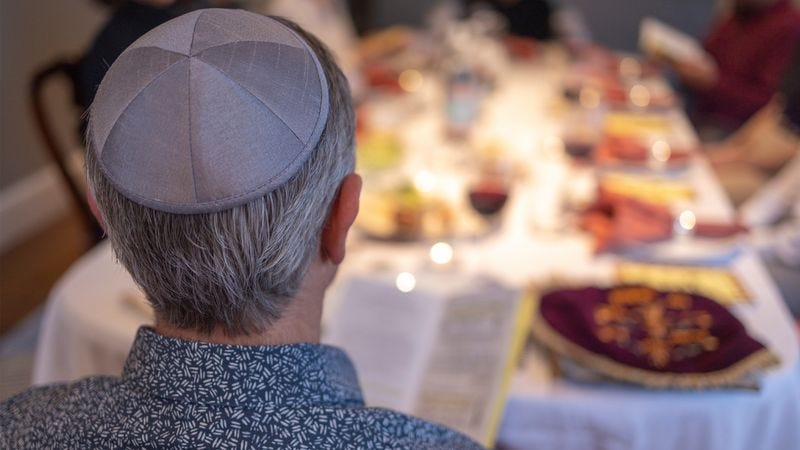
Last night, Jewish families sat at tables and told the story of leaving Egypt.
The Passover story opens with a line that is easy to overlook: “A new king arose over Egypt, who did not know Joseph.”
Joseph once saved Egypt. He interpreted Pharaoh’s dreams, set up grain storage, and helped the nation survive a famine. The whole economy had depended on him. But after that, there is silence. A generation later, the text says the new ruler “did not know Joseph.” This was not just ignorance. It was a choice to refuse.
Pharaoh enjoyed a system he did not create. He received stability, infrastructure, and wealth, but chose not to remember their source or who made them possible. Forgetting in this way makes exploitation possible.
When Joseph is forgotten, the people connected to him become expendable. Their work can be used, their lives controlled, and their presence seen as a threat instead of a contribution.
The story does not start with violence. It starts with a change in the story being told.
“With the Israelites, it was said: they are too many, too strong, too dangerous.”
This shift happens before the first brick is made without straw, before forced labor, before infanticide, and before oppression is obvious. It starts when society tells a new story about the same people.
This is the moment the story asks us to notice.
This kind of forgetting is not just Pharaoh’s problem. It happens again and again.
A group of people contributes, builds, and supports a nation. Their work becomes part of daily life. Over time, it is absorbed, taken for granted, and eventually forgotten. Once it is erased, it becomes easier to justify what comes next. Restrictions feel reasonable. Control feels necessary. Exploitation feels like management.
All of this depends on one idea: we do not know them, we do not owe them, they do not belong (sound familiar?!?).
The Passover story stops this pattern at its beginning.
It does not begin with freedom. It begins by calling out the lie that allowed oppression. The lie is not just that people are dangerous. The real lie is that we can forget what we owe each other and still be human.
The story rejects this idea. It puts memory at the center, not as nostalgia, but as a way to hold us accountable.
“You shall tell your child…”
The command is not just to remember suffering. Passover is a reminder to remember our relationships, our dependence, and how our lives are connected to people we might otherwise ignore.
Once that memory fades, everything else changes quickly. We start talking about people in ways that make it easier not to care about them. We accept things we once would have resisted. We get used to systems that make others pay the price.
The story understands this pattern. That is why it starts at this point.
It does not start at the Red Sea or in the wilderness. It starts when a ruler decides not to know the people who made his life possible.
Passover asks us to find that moment in our own lives.
Where has memory faded so much that it no longer challenges us? Where have we accepted stories about others that make their exclusion seem fair? Where do we benefit from systems we did not build, while choosing not to ask who paid for them?
These are not just abstract questions. They shape how society is organized. They decide who is protected and who is left out. They affect whether we see each other as connected or as expendable.
The story does not solve this for us. It shows us where to look and leaves us with the harder job: to remember in a way that changes how we live.
We are in this together,
Cameron
PS - We need to talk about that insane speech by DJT from last night…but that’s for tomorrow I suppose. God save us…
Reflection Questions
Where do you see “Pharaoh’s forgetting” at work in the world around you?
What have you inherited that you rarely stop to question?
Who becomes easier to dismiss when their story is no longer told?
A Prayer for the Day
A Prayer for the Work of Remembering What We Owe
God,

You who remember what we would rather set aside,
keep us from the kind of forgetting that diminishes others.

Do not let us live on the benefits of a story we refuse to name.
Do not let us accept distance where there is responsibility.

Give us the courage to remember honestly,
and the humility to let that memory change how we live.

Amen.
Spiritual Practice
Restoring the Story
Today, take one thing you rely on—your workplace, your neighborhood, a system that makes your life possible.
Ask yourself:
Who made this possible?
Whose labor, whose risk, whose sacrifice is hidden here?
Name them, even if only to yourself. Let that remembering interrupt the story you usually tell. Notice what it asks of you next.
Upcoming Events That Might Be of Interest…
My team and I launched a new experiment we are calling “The Commons.” It’s an online space centered around communities of practice: groups of people who share a common concern, set of problems, or passion for a topic, and deepen their knowledge and expertise by interacting on an ongoing basis. Join the community here.
April 7, 2026, 7-8:30pm ET - Rev. Dr. Matthew Fox and I are hosting another 4-part series on “Visions for the Common Good.” This series will include sessions with David Abram (cultural ecologist), Lynne Twist (global activist), Randy Woodley (Cherokee scholar and wisdom-keeper), and yours truly! All sessions are recorded, and you will get the link if you can’t make it. Learn more here.
NEW!!! On July 19-24, 2026, I’ll be leading a Women’s Wellness Retreat in the Wind River Mountains of Wyoming, and I’d love to extend the invitation to you. We’ll spend five days off the grid, riding horses through wide open landscapes, sharing meals, and creating space to slow down enough to hear ourselves think again. This isn’t about becoming someone new. It’s about returning to yourself, settling your nervous system, letting go of what you’ve been carrying, and getting clearer about what matters now. The group will be small (no more than 10 women), and we’ll move at a steady, spacious pace, with plenty of room for both conversation and quiet. I hope you’ll consider joining us.
I drafted a Strategic Framework for Congregations as we move into the coming years of increased authoritarianism around the world. If interested, you can download it here.
Fun Things My Friends Are Up To…
I get to work with such amazing, creative people. This section is my way of celebrating them—no paid promotions, just joy in what they’re creating.
My friends at the Center for Action and Contemplation are offering a fantastic program called “Have We Been Here Before? Ancient Wisdom for Days of Disruption.” At this live 90-minute online gathering, CAC Faculty Carmen Acevedo Butcher, Ph.D., James Finley, Ph.D., Fr. Richard Rohr, and guest teacher Kaitlin Curtice, will show you how ancient contemplative wisdom and traditions may support us in times of social, political, and spiritual instability. Sign up here!
The Benedictine Sisters of Erie are hosting a webinar with my friend, Fr. Adam Bucko and Katie Grodon April 14th. Katie and Adam will explore how new expressions of monastic community are bridging this ancient tradition to contemporary seekers in ways that enable more people to commit to lives of prayer, service, and transformation, in and beyond the monastery. Register for free to receive the zoom link.
Have you discovered Randy Woodley’s Substack yet? He is writing a 15 part series about democracy as an indigenous teacher and theologian. He just told me that next he is doing a 7 part series on AI. I can’t wait!
If you are a leader or member of a congregation looking for consulting support in visioning, planning, hiring or staffing, please consider Convergence.
Am sitting in a beautiful suburb of Munich - where many sacrificed their lives so that there is democracy here. Especially remember 'Die weisse Rose' group today (I and my grandchildren have studied at that same university downtown). Grateful for all who opposed the dictator and his regime here and for those opposing the 'descended' dictator and regime over there.
I have always believed that telling stories of MEMORY is HOLY and of the SACRED ,,,let us not forgetting to tell the STORY ...that we all belong and which these reflections always remind us THAT WE ARE IN THIS TOGETHER...Sacred Story Telling. Bless the Jewish people.