

“We are a people of many cultures, languages, and colors, yet bound together by a shared commitment to freedom and dignity.” — Martin Luther King Jr., The American Dream (1961)
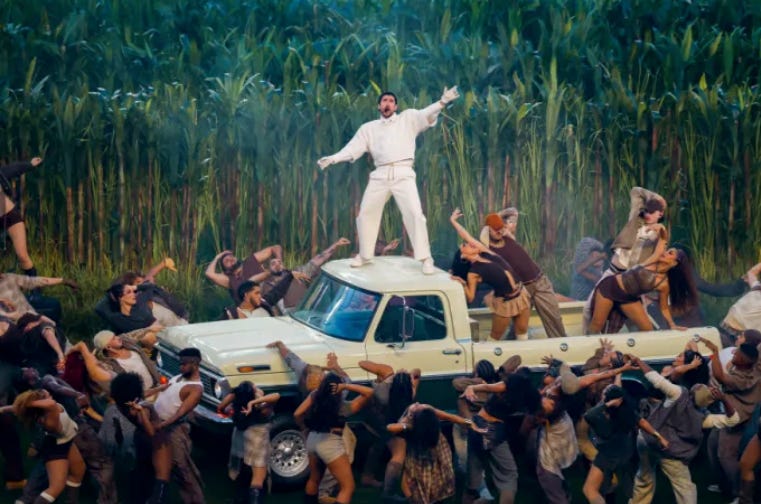
This Sunday, millions of people watched the Super Bowl. Along with the game, the halftime show once again became a moment when the country told a story about itself.
This year, the NFL chose Bad Bunny as the halftime performer. He is an artist from Puerto Rico. He sings mostly in Spanish. His presence made an unmistakable statement: people who speak Spanish, people who come from Puerto Rico, people whose bodies and cultures do not fit a white, English-speaking norm are Americans too.
The backlash was immediate. Trump supporters and MAGA-aligned organizations protested the choice. Turning Point USA staged a competing “halftime show” made up entirely of white, country musicians, promoted as “All-American.”1 Two visions of the nation stood side by side. One insisted that America is multilingual, multiracial, and already shaped by many cultures. The other insisted that America belongs, at its core, to white people who speak English and reflect a narrowly defined cultural identity.
This was not really about music; it was about who gets to belong without explanation.
Spanish has long been treated in this country as a problem to be managed rather than a language that belongs. It is framed as foreign even when it has been spoken on this land longer than English. When Bad Bunny performed in Spanish on one of the largest stages in American culture, he did not ask permission. He did not translate himself. He did not make the language smaller or safer. He simply occupied the space.
That is what made the reaction so intense.
Bad Bunny is from Puerto Rico, a U.S. territory shaped by a long history of colonial control. Puerto Ricans are American citizens, yet they are often treated as conditional members of the nation—useful, present, but never fully embraced. His body on that field carried that unresolved history into view. Without speeches or slogans, he made visible a reality that many would rather keep at the margins.
The counter-show tried to pull the story back into familiar lines. White faces. English lyrics. Country music framed as “real America.” It was an attempt to stabilize a shrinking definition of belonging and to present it as natural rather than constructed. The message was clear: this is what America is supposed to look and sound like.
What we are witnessing is not a disagreement about taste. It is a struggle over whether the country will face its own complexity or continue to deny it.
One story understands diversity as strength. It sees multiple languages, cultures, and histories as the source of vitality and resilience. The other story treats diversity as a threat that must be contained, policed, or erased. That second story always requires force. It needs borders, exclusions, and punishments to keep itself intact.
This is why these cultural moments matter. Stories about belonging do not stay symbolic. They shape policy. They justify violence. They decide whose grief counts and whose presence feels suspicious.
Scripture speaks to this moment with uncomfortable clarity. Again and again, the people of God resist the widening of the circle. They fear the loss of control more than they fear injustice. They reach for purity instead of trust. And again and again, the Spirit moves beyond those boundaries anyway.
Pentecost did not erase difference. It honored it. People did not suddenly speak one language. They spoke many, and understanding emerged without assimilation. The miracle was not sameness. The miracle was shared meaning without erasure.
That vision stands in direct contrast to the world the MAGA movement is trying to build.
Sunday night placed those two visions side by side. One was expansive, grounded in lived reality. The other was defensive, built on nostalgia and exclusion. The reaction told us how fragile the second vision has become.
This is where the grief lives for many of us. Not only in the anger, but in the exhaustion of watching the same argument replayed again and again. Who belongs. Who counts. Who gets to stand in the center without apology.
And yet, there is also hope here.
Because the backlash revealed how much has already changed. The old story has to shout now. It has to organize counter-events. It has to insist loudly on its own legitimacy. Meanwhile, the other story keeps showing up in bodies, languages, songs, and movements that refuse to disappear.
The future of this country will not be decided by a halftime show. But moments like this tell us where the fault lines are, and where the ground is shifting.
The question before us is not abstract. It is deeply personal. Which story will we live from? Which vision of belonging will shape how we treat our neighbors, our children, and ourselves?
The music is already playing. The country is already changing.
The only real question is whether we will have the courage to live into the truth that has been here all along.
We are in this together,
Cameron
Reflection Questions
As you watched the competing “halftime shows,” what emotions surfaced first—joy, grief, anger, relief, pride, fear? What might those feelings be telling you about what you love and what you fear losing?
What story of “America” did you inherit, and how is it being challenged right now? Which parts of that story feel truer than ever, and which parts no longer hold?
What kind of belonging do you want to help make possible?
A Prayer for the Day
A Prayer for a Country Learning to Tell the Truth
God of many tongues and many songs,
You know the stories we tell about who belongs
and the stories we tell to keep ourselves comfortable.

You know how fear tightens our grip on what feels familiar.
You know how power teaches us to confuse dominance with love.
You know how quickly we turn difference into threat.

So teach us again how to listen.
Teach us how to recognize one another as neighbors before we label one another as problems.
Give us the courage to tell a fuller story of our histories—
one that does not erase pain,
one that does not demand purity,
one that makes room for joy without permission.

When we are tempted to shrink the circle of belonging,
stretch our moral imagination.
When we are tempted to harden our hearts,
remind us that love has always been our unfinished work.

Amen.
Spiritual Practice
Listening for the Plural Song
Sometime this week, choose a song, poem, or story that comes from a culture, language, or community different from your own, especially one that is often dismissed or marginalized.
Do not analyze it. Do not translate it into something familiar. Simply listen.
Notice what arises in you: resistance, delight, confusion, grief, recognition.
Let that response teach you something about the boundaries you carry—and the ones you might loosen.
This is not about consumption. It is about practice. It is about training the heart to stay open when reality refuses to be singular.
Upcoming Events That Might Be of Interest…
February 10, 2026, 12pm ET - My team and I are launching a new experiment we are calling “The Commons.” It’s an online space centered around communities of practice: groups of people who share a common concern, set of problems, or passion for a topic, and deepen their knowledge and expertise by interacting on an ongoing basis. I will be leading a book study on Brian McLaren’s book, Life After Doom. Register here for the onboarding call and to learn more.
February 19, 2026 (next session) - On Feb 5, Margaret Wheatley and and I launched a new online course called “Leading with Spirit,” a six-session journey into soul-grounded leadership designed to deepen your trust in guidance, nurture perseverance, and rekindle imaginal wisdom for our fractured world. It’s not too late to join. Take a look at the course outline. We are really excited and hope you can join! Scholarship are available if needed. Learn more here!
March, 2026 - Join Our “Building a Culture of Leadership Within Congregations” Cohort facilitated by Rabbi Benjamin Ross and me! A two-session course for ministers and faith leaders ready to strengthen how their congregations and ministries identify, develop, and support leaders. Learn more here.
March 17, 23, 31 and April 7, 2026 - Mark your calendars! Matthew Fox and I will be hosting another 4-part series on “Visions for the Common Good.” We are finalizing details now, and the registration page will open soon.
I drafted a Strategic Framework for Congregations as we move into the coming years of increased authoritarianism around the world. If interested, you can download it here.
Fun Things My Friends Are Up To…
I get to work with such amazing, creative people. This section is my way of celebrating them—no paid promotions, just joy in what they’re creating.
The Convergence Music Project is hosting a songwriting event on March 19-21, 2026 in Nashville. No songwriting experience is required, so feel warmly welcome even if you've never written a song before. There will be plenty of content also to further educate, inspire, and develop the gifts of advanced songwriters as well. Learn more.
So many of us are inspired by all that is happening in Minneapolis, even if we are horrified by what the federal government has unleashed in that city. Here is a great article breaking down the “Blueprint for Resistance.”
Millions of people are seeking training in becoming Legal Observers for their communities vulnerable to ICE. Here is a recorded training that is helpful produced by the team at No Kings. If you know of other trainings, please post in the comments below.
The phenomenal team of “Singing Resistance” has gifted all of us a songbook of protest songs that groups are now using across the world. Here is the link. I am marching around my house singing these throughout the day. My dogs are very confused.
If you are a leader or member of a congregation looking for consulting support in visioning, planning, hiring or staffing, please consider Convergence.
https://www.npr.org/2026/02/08/nx-s1-5705980/kid-rock-conservative-halftime-show-turning-point-bad-bunny
May I be a bold (hopefully not smug) Canadian and suggest the US could look to Canada where we have institutionalized bilingualism and multiculturalism, where we are facing the truth of our colonialism and taking honest steps towards reconciliation with Indigenous peoples. Most of us really believe that in diversity is our strength.
So true, so true. But a bigger picture is missed, and one that hides itself so effectively. The money fuels and runs circles around all sides of this fight. Big tech, oil, and the arms industry all keep laughing all the way to the bank as they take the world and all of humanity down their sucking maelstrom. The real powers that be love the turmoil for its distraction. Yes to what was written. We are called to a single table, all in humility and willingness to love and serve one another. But the money.