

“I truly understand that God shows no partiality, but in every nation anyone who fears him and does what is right is acceptable to him.” — Acts 10:34–35
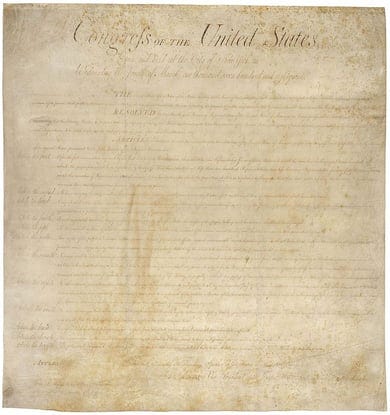
On June 8, 1789, James Madison stood before the House of Representatives and introduced a set of amendments that later became the Bill of Rights. The first freedom he wanted to protect was religious freedom.
The First Amendment starts with revolutionary idea: the government should not decide which faiths are legitimate and which are not. The founders saw what happened when governments set up official religions and treated other beliefs with suspicion. They knew that faith and force do not go well together.
I started thinking about that history after I read that the Department of Defense has greatly reduced the number of recognized faith groups and belief systems for military personnel. About 180 traditions were taken off the list. My own denomination, the United Church of Christ, is now listed as “Christian – Other.”1
This leaves me wondering: Who gets to decide which expressions of faith matter?
It is hard to miss the irony. Many of the people who helped shape America would not fit easily into today’s categories. Thomas Jefferson rejected key Christian beliefs like the Trinity and the divinity of Jesus. John Adams went to a Unitarian church. Benjamin Franklin often questioned Christian traditions. Some signers of the Declaration of Independence were Deists, believing in God but doubting organized religion and old creeds. No matter what you think of their beliefs, these were not outsiders. They helped build the nation.
The freedom they supported was never meant just for people who shared their beliefs. The brilliance of the First Amendment is that it made room for disagreement. Baptists, Catholics, Quakers, Jews, Unitarians, Deists, and later many others could live together without the government deciding whose beliefs were truly American.
We have always struggled with this. We like clear lines. We like categories. We like knowing who is included and who is not.
The Bible has many stories about these boundaries. One of the most important is in the Book of Acts. Peter spent his whole life thinking he knew who belonged in God’s community. Then he had a vision that challenged what he believed. The Spirit led him to Cornelius, a Gentile Roman officer. By all the usual standards, Cornelius was an outsider.
But Peter saw the Spirit at work among people he never thought would be included. His conclusion changed Christian history: “I truly understand that God shows no partiality.”2
The early church spent generations struggling with the question of who belongs. Could Gentiles belong? Could foreigners belong? Could people with different customs, languages, and backgrounds belong?
Again and again, the Spirit seemed more interested in expanding boundaries than protecting them. Sometimes I think the history of religion is people drawing circles and God crossing over them.
We are always tempted to draw smaller circles. Sometimes these circles are about theology. Sometimes they are political, racial, national, or cultural. We often tell ourselves that making the circle smaller will make us safer, stronger, or more faithful.
The Gospel points the other way. Jesus always moved toward people others saw as suspect, unworthy, foreign, or outside what was respectable. Tax collectors. Samaritans. Gentiles. Lepers. Outsiders. The question was never if they belonged to God. The real question was whether everyone else could see it.
On this anniversary of Madison’s proposal of the Bill of Rights, I am grateful for a freedom that is both constitutional and spiritual.
The freedom to choose my own religion (or none at all).
The freedom to disagree.
The freedom to seek truth without being forced.
And maybe most important, the humility to remember that God has always been bigger than our categories.
We are in this together,
Cameron
Reflection Questions
Where do you see people drawing smaller circles of belonging in our society today?
Have there been times in your life when someone expanded your understanding of who belongs?
What categories, labels, or assumptions might be preventing you from seeing the image of God in someone else?
A Prayer for the Day
A Prayer For Larger Circles
God of all,

We are quick to sort people into categories.

We decide who belongs and who does not.
Who is worthy of our trust and who is not.
WhoExamining the Circle

Take a sheet of paper and draw a circle in the center.

Inside the circle, write the names of the groups of people you naturally think of as “us.”

Then, outside the circle, write the names of groups you find more difficult to understand, trust, or relate to.

Do not judge yourself. Simply notice.

When you are finished, sit quietly for a few moments.

Choose one group that ended up outside your circle.

Ask yourself:

* Who taught me to see them this way?
* What assumptions am I carrying?
* Have I ever listened to their story?

Then pray for them.

Not as a project.
Not as an enemy.
Not as a category.

As fellow human beings.

The goal is not to erase differences.

The goal is to remember that belonging to God is always larger than belonging to our tribe. is familiar and who is foreign.

We draw lines and then forget that we drew them.

Forgive us.

Open our eyes to the ways your Spirit continues to move beyond our assumptions.

Give us the humility to recognize that your love is larger than our understanding.

Help us resist the temptation to make faith smaller, narrower, and more exclusive than you intended.

Teach us to honor the dignity of every person.

Teach us to protect the freedom of conscience that allows faith to flourish rather than be forced.

And when we are tempted to fear those who are different from us, remind us that your kingdom has always been larger than our categories.

Amen.
Spiritual Practice
Examining the Circle
Take a sheet of paper and draw a circle in the center. Inside the circle, write the names of the groups of people you naturally think of as “us.” Then, outside the circle, write the names of groups you find more difficult to understand, trust, or relate to.
Spend ten minutes with Peter’s words from Acts: “God shows no partiality.”
Read the sentence slowly several times.
Then ask: What would change in my life if I truly believed that?
Sit with whatever arises. Do not rush to answers. Let the question do its work.
Upcoming Events That Might Be of Interest…
My team and I launched a new experiment we are calling “The Commons.” It’s an online space centered around communities of practice: groups of people who share a common concern, set of problems, or passion for a topic, and deepen their knowledge and expertise by interacting on an ongoing basis. Join the community here.
June 9, 2026, 12:30-1:30pmET - Book Club in The Commons - FREE - We are starting our next book, The Glorians by Terry Tempest Williams. We will meet each Tuesday for 6 weeks. It’s such great fun. I hope you will be a part. All are welcome! RSVP HERE.
June 11, 18, 24, 2026, 12:30pm ET - I will be joining Jackie Sussman on The Commons for a three-part series on practicing eidetics as a part of our “Reclaiming the Power of Imagination” series. Jackie, a psychotherapist, author, and leading expert in Eidetic Image Psychology, has spent over forty years helping leaders and individuals unlock creativity, uncover hidden strengths, and move through limiting patterns. During these sessions, she will lead a live Eidetic process shaped by mythic imagery, offering a direct experience of the work. REGISTER HERE.
September 8, 2026, 7-9pm ET, ONLINE EVENT - I’ll be hosting a powerful online gathering on The Black Madonna: Sacred Wisdom for a World in Crisis with Matthew Fox, Alessandra Belloni, and Christena Cleveland. We will explore the Black Madonna as a symbol of resilience, liberation, sacred feminine wisdom, and healing in a fractured world through conversation, story, music, and spiritual reflection. If you feel drawn toward a deeper encounter with the Divine Feminine and the ancient traditions that continue to nourish movements for justice and wholeness, I hope you’ll join us. Learn more and REGISTER HERE.
October 18-21, 2026 - PREACH! 2026 Conference- I’ll be co-hosting PREACH in Minneapolis with Church Anew, a new gathering for preachers, storytellers, worship leaders, and spiritual communicators navigating what it means to speak with clarity, compassion, and courage in a changing world. If you’ve sensed that the preaching moment has changed and are longing for thoughtful community and renewed imagination for this work, I hope you’ll join us.
I drafted a Strategic Framework for Congregations as we move into the coming years of increased authoritarianism around the world. If interested, you can download it here.
Fun Things My Friends Are Up To…
I get to work with such amazing, creative people. This section is my way of celebrating them—no paid promotions, just joy in what they’re creating.
June 8, 2026, 12pm ET - ONLINE WRITING GROUP - My dear friend, Meryl Marshall-Daniels, is leading a writing group open to all. This is a simple and spacious writing circle for people who want time to listen inwardly and put words on the page without overthinking, performing, or polishing. Meryl offers a prompt designed to invite reflection, imagination, and attunement to what is already alive within you. The practice honors writing as a way of listening, of letting images, memories, questions, and insights surface in their own time. Learn more here.
June 16, 2026, 12pm ET - My friends at the Franciscan Federation are launching a new online community called “The Piazza.” This is a place for all Franciscan-hearted people to gather, connect with one another and build community together. They are launching the community on June 16. I hope you can be a part of their launch event. I will be there, for sure!
June 20, 2026 – ONLINE EVENT – Margaret Wheatley and Mary Daniels will lead a special three-hour online gathering titled Fierce Compassion: The Power of the Sacred Feminine. In a time marked by fragmentation, fear, and exhaustion, this program explores compassion not as passive kindness, but as a courageous force that protects life, tells the truth, and remains deeply rooted in love. Drawing from spiritual traditions, contemplative practice, and the imagery of fierce feminine wisdom figures such as Kali and Durga, they will reflect on what it means to stay human and spiritually grounded in difficult times. LEARN MORE + REGISTER.
JULY 12, 2026, 8AM–8PM ET in NYC - My friend Monika Son is helping lead a powerful Buddhist-led, interfaith pilgrimage across New York City titled “Day of Remembering Our Interdependence.” Inspired by the Buddhist monks’ 2,300-mile Walk for Peace and grounded in the wisdom of Thich Nhat Hanh, participants will gather for walking meditation, prayer, chanting, ceremony, and collective reflection across all five boroughs, including stops at the African Burial Ground and the Metropolitan Detention Center where ICE detainees are being held. The day will culminate in a joyful community gathering in Queens with music, poetry, movement, and food. Participants are welcome to join for the full pilgrimage or any portion of the day. LEARN MORE HERE.
If you are a leader or member of a congregation looking for consulting support in visioning, planning, hiring or staffing, please consider Convergence.
https://www.military.com/dod-officially-drops-180-faiths-from-militarys-recognized-religion-list
Acts 10:34–35, NRSVUE
beautiful and truly needed in these times. Thank you for sharing. As a person who is part of a non-Abrahamic tradition- I appreciate your invitation and teaching.
I am so grateful that God as Mystery crossed all boundaries and is bigger than my categories, theologies, and my religions affiliation ...a circle of LOVE that included everyone and everything...we continue to be within a learning curve for sure, hopefully it is being defined by the Circle of Love.