

“Learn to do good; seek justice; rescue the oppressed; defend the orphan; plead for the widow.” — Isaiah 1:17, NRSVUE
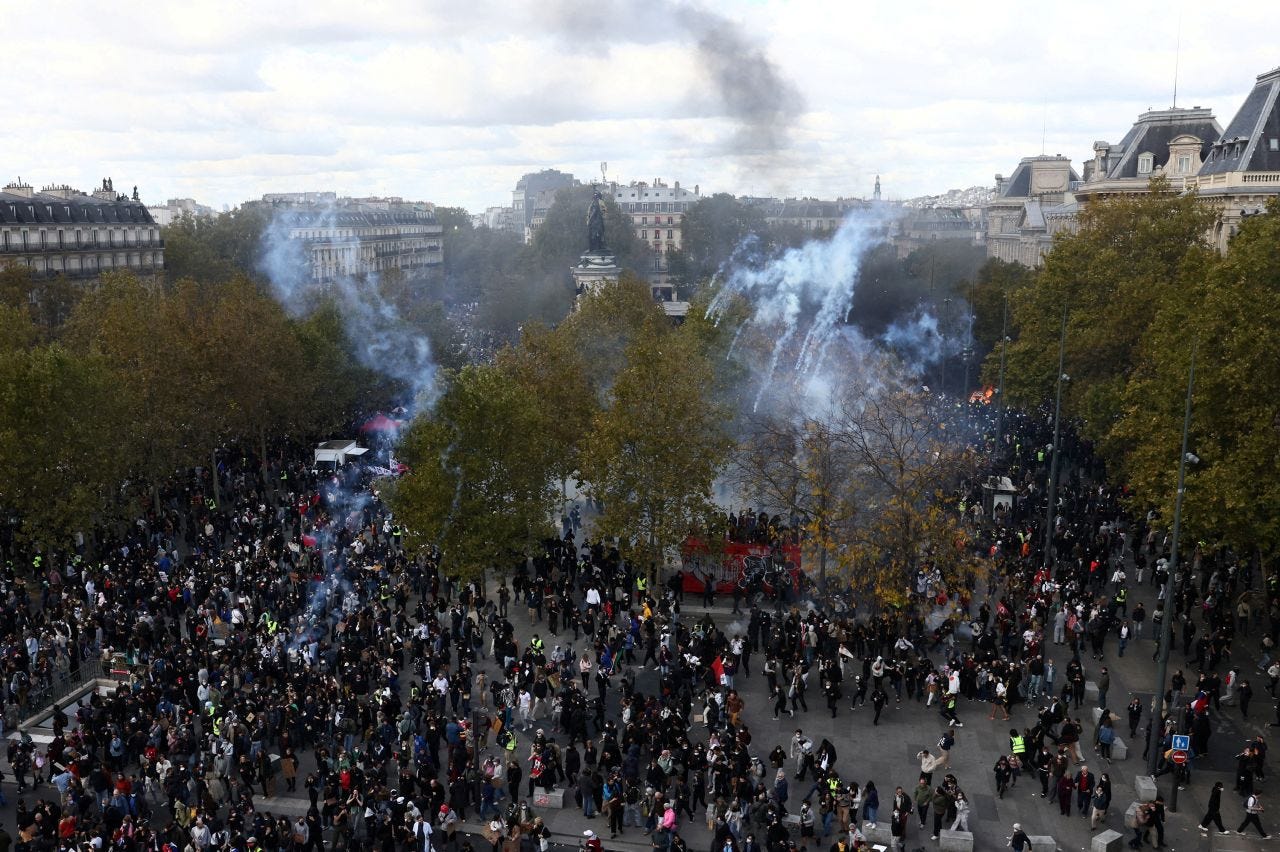
A few weeks ago, teenagers in working-class neighborhoods around Paris started protesting outside their schools. They were fed up with crowded classrooms, rundown buildings, and missing teachers who should have been helping them prepare for their futures. Some students had gone weeks without lessons in certain subjects. They wanted an education that matched the futures they hoped to create.
Their frustration quickly spread. Students at other schools started organizing protests too, and soon parents, teachers, and labor unions joined in. By Saturday, the Interior Ministry estimated that 550,000 people were marching across France, while organizers said the number was closer to 800,000.1 What started as a protest about education had grown into a much bigger outcry about rising living costs, economic inequality, and a government that many feel no longer listens.
The photos from the weekend are hard to see. Streets were filled with tear gas. Cars burned. Young people ran from police. Officers were hurt in violent clashes. Shops were looted and public buildings set on fire. In Paris, a protester died after a medical emergency during the demonstrations. A fifteen-year-old lost a hand after a stun grenade exploded near a school, and a sixteen-year-old lost sight in one eye after reportedly being hit by a police projectile.
There is much to condemn in the violence. Burning buildings and hurting people will not fix a school or bring back missing teachers. Still, I think about the teenagers who were hurt and wonder what it means for a society when kids asking for a better future end up facing the force of the state.
I wonder how their parents feel today. Some are probably proud of their children’s courage, even as they worry about their safety. Others might be angry that their sons and daughters are getting hurt while asking for things that should never have needed a protest. And I imagine some parents feel a deeper pain because they know they have also been struggling in a society where decision-makers seem more and more removed from the real consequences.
It is heartbreaking to see young people realize that so few adults seem willing to take responsibility for the world they will inherit. These kids did not create the economic problems that make their futures uncertain. They did not choose how schools would be funded, which neighborhoods would get investment, or whether struggling families’ needs would come before other political goals. Adults made those choices, many with a lot of power, knowing the consequences would hit those with the least influence the hardest.
I am not saying the world is just made up of irresponsible adults and innocent children. Parents, teachers, public servants, and community leaders are working very hard, often in tough situations, to help young people have a better future. Many adults marching with these students have spent years trying to change the problems that finally pushed their children to protest. But these protests reveal something troubling about power. Too many people hold authority without accepting the responsibilities that come with it.
The Jewish theologian Rabbi Abraham Joshua Heschel once wrote, “Few are guilty, but all are responsible.”2 He meant that moral responsibility goes beyond those who directly cause harm. We are all part of relationships and institutions shaped by decisions we may not have made, but whose effects we cannot ignore.
That idea is uncomfortable because it asks something of those of us who see ourselves as decent people. Maybe we never voted to cut a school budget or failed to replace a teacher. Maybe we have spent years working hard, raising families, and trying to do the right thing. Still, the world our children inherit is, in some way, a world we have helped keep going.
Heschel’s prophets were especially frustrated with people who mixed up personal innocence and moral responsibility. They knew that a society could get used to suffering so slowly that even good people stopped noticing what was happening around them.
I wonder if the young people marching in France are asking adults to regain that sense of responsibility. They want decision-makers to think about the lives affected by their choices. They are asking those who are comfortable with the status quo to see the real cost of that comfort.
Maybe this is part of what it means to be a true adult. It means taking responsibility for situations we did not fully create and for consequences we may never face ourselves. It means caring about the future of people whose lives will continue long after our own choices are forgotten.
The students in France should not have to bear that responsibility by themselves.
Martin Luther King Jr. once said that riots are the language of the unheard.3 He was describing the conditions that can lead to violence, not supporting violence as an answer. He knew that condemning anger without dealing with the suffering behind it leaves the real problem unsolved.
That difference is important here. We can mourn the injuries, condemn the destruction, and still see that hundreds of thousands of people are trying to say something about the lives they are working hard to build.
I think many of us feel the same longing. We hope our children and grandchildren will grow up in communities where they can thrive. We want them to have good jobs, safe homes, healthy land, trustworthy institutions, and enough freedom from fear to find out who they can become.
Maybe that longing is part of why the images from France are so painful. We see our own hopes and disappointments reflected in those young faces.
Tomorrow, students across France will go back to their classrooms, though some will still find their schools disrupted. Families will keep worrying about the cost of living. Injured protesters a
d police officers will have tough recoveries ahead. The debates about responsibility will go on. And somewhere, a teenager will sit at a desk, waiting for a teacher who might not show up.
I hope we can keep that image in mind along with the photos of burning streets. It reminds us why the protests started and what is still unresolved after the crowds leave.
The young people of France are asking if the society they have inherited is willing to make space for their future.
That question deserves a better answer than tear gas. It deserves the patient, hard work of building a world where young people can imagine growing old.
Maybe that is what it really means to be a grown-up.
We are in this together,
Cameron
Reflection Questions
When you think about the world today’s children are inheriting, what troubles you most? What gives you hope?
Abraham Joshua Heschel wrote, “Few are guilty, but all are responsible.” Where might you be called to accept responsibility for something you did not personally cause but have the power to help change?
Who were the adults who took responsibility for your future when you were young? What did their care make possible in your life, and how might you extend that gift to another generation?
A Prayer for the Day
A Prayer For the Children Who Inherit Our World
Merciful God,

Forgive us for the burdens
we have placed upon the young,
for the promises left unfulfilled,
and the suffering we have learned
to call inevitable.

Remember the children
who march because no one will listen,
and the parents who wait
in fear for their safe return.

Give wisdom to those entrusted
with the lives of others,
and courage to those
who must challenge their neglect.

Awaken in us the responsibility
that love requires.

May the world we leave behind
hold more possibility than fear,
more justice than indifference,
and enough hope
for every child to imagine a future.

Amen.
Spiritual Practice: A Promise to the Next Generation
Find a photograph of yourself as a child, preferably around the age of the young people protesting in France. Spend a few minutes looking at it. Remember what you hoped your life might become, what frightened you, and which adults made you feel that the future was a place worth growing toward.
Now imagine a young person living in your community today. Consider the world they are inheriting, including the possibilities available to them and the difficulties they will face through no choice of their own.
Place the photograph somewhere you can see it and ask yourself what you would want the adults of your childhood to have protected on your behalf.
Then make one small promise to the next generation. Perhaps you will support a teacher, mentor a young person, speak up about a decision affecting children, or help create a place where young people feel heard and valued.
Write your promise on a piece of paper and place it beside the photograph.
Leave both there for the week.
The practice is an invitation to remember that adulthood carries responsibilities beyond our own survival. We are entrusted, for a time, with helping shape a world that others will inherit.
Upcoming Events That Might Be of Interest…
My team and I launched a new experiment we are calling “The Commons.” It’s an online space centered around communities of practice: groups of people who share a common concern, set of problems, or passion for a topic, and deepen their knowledge and expertise by interacting on an ongoing basis. Join the community here.
October 20, 2026 - 12:30 - 1:30pm ET - ONLINE BOOK CLUB - For the next 3 weeks, I am hosting a book club where we will read Fr. Gregory Boyle’s “Cherished Belonging: The Healing Power of Love in Divided Times.” Father Gregory Boyle, founder of Homeboy Industries, has spent decades building community among people whom society has often discarded. In Cherished Belonging, he draws on those relationships and stories to explore what might happen if we stopped sorting people into categories of worthy and unworthy, us and them. Don’t worry if you don’t have time to read the book. We always have incredibly rich conversations. All are welcome. RSVP Here.
November 4, 2026 - 7-8:30pm ET, ONLINE EVENT - Theologian Matthew Fox and I are teaming up again in a series called Journeying with the Mystics. The mystics have always emerged in times of uncertainty. They appear when old certainties are crumbling, when institutions no longer provide easy answers, and when people find themselves longing for a deeper experience of the Sacred. Join us for a 24-session exploration of the teachings of St. John of the Cross, Thomas Merton, Hildegard of Bingen, Kabir and Rumi, Meister Eckhart and more. This is more than a lecture series. It is an invitation into a living spiritual journey. Learn more and REGISTER HERE!
November 10, 7-8:30pm ET - I’ll be joined by theologian, writer, and professor Dr. Debra Rienstra for a special ONLINE conversation on Refugia Faith. In ecology, refugia are small places where life survives amid disruption, pockets of resilience from which life can eventually regenerate and spread. Debra invites us to consider what this might mean spiritually in an age of climate instability, political turmoil, institutional decline, and profound uncertainty. What if our congregations, communities, relationships, and even our own lives could become refugia, places where courage, compassion, beauty, wisdom, and possibility are protected and cultivated for whatever comes next? I hope you’ll join us for this timely and deeply hopeful conversation. REGISTER HERE!
November 19, 2026, 7-8:45pm ET - I will be joining Jackie Sussman for an online session on practicing eidetics as part of our “Reclaiming the Power of Imagination” monthly series. Eidetic Imagery is a powerful tool for pastors, denominational leaders, coaches, and spiritual directors working with others, and for individuals seeking deeper integration and healing in their own lives. Jackie is a psychotherapist, author, and leading expert in Eidetic Image Psychology, and has spent over forty years helping leaders and individuals unlock creativity, uncover hidden strengths, and move through limiting patterns. During this session, she will lead a live Eidetic process shaped by mythic imagery, offering a direct experience of the work. REGISTER HERE.
December 15, 7-8:30pm ET - FREE WEBINAR - I will be joined by Dr. Charissa Mikoski, Assistant Professor of Research and Hartford Institute for Religion Research for a presentation on “The State of American Congregations: What the Latest Data Tell Us.” This webinar explores findings from the 2025 Faith Communities Today survey, including changes in worship attendance, congregational vitality, finances, volunteering, programming, and leadership. It will also examine what more than 24,000 individual attenders tell us about participation and their experiences of congregational life. Together, these findings offer a picture that is neither simply one of decline nor one of revival, but of significant change and uneven recovery. REGISTER HERE.
Fun Things My Friends Are Up To…
I get to work with such amazing, creative people. This section is my way of celebrating them—no paid promotions, just joy in what they’re creating.
My dear friend Brian McLaren has a new novel coming in November, and I’m excited about this one. The Great Rift is the second book in his Last Voyage trilogy, imagining ten pioneers leaving a dying Earth for a fragile human settlement on Mars. The story weaves together ecological imagination, spirituality, art, survival, and the possibility of creating a genuinely different future. Brian is one of the most thoughtful and imaginative writers I know, and I love seeing him use fiction to explore questions he has spent a lifetime asking. The Great Rift comes out November 3 and is available for preorder now.
My friends at Church Anew have been building a terrific library of resources for congregations and church leaders navigating ministry in these strange and demanding times. You’ll find thoughtful worship and preaching resources, practical tools, and material designed to help communities engage the questions actually shaping our lives right now. I deeply appreciate the imagination and theological depth Church Anew brings to its work, so if you’re a pastor or congregational leader looking for fresh resources, spend a little time exploring what they’re creating.
Every Monday, 12pm ET - ONLINE WRITING GROUP - My dear friend, Meryl Marshall-Daniels, is leading a writing group open to all. This is a simple and spacious writing circle for people who want time to listen inwardly and put words on the page without overthinking, performing, or polishing. Meryl offers a prompt designed to invite reflection, imagination, and attunement to what is already alive within you. The practice honors writing as a way of listening, of letting images, memories, questions, and insights surface in their own time. Learn more here.
If you are a leader or member of a congregation looking for consulting support in visioning, planning, hiring or staffing, please consider Convergence.
https://apnews.com/article/44b9d3ba91ffad4029f975dced7e31cb
https://www.jewishideas.org/article/selected-writings-abraham-joshua-heschel
https://nmaahc.si.edu/explore/stories/language-unheard
“They are asking those who are comfortable with the status quo to see the real cost of that comfort.”
This is what will happen in the US very soon because the few, Trump and his Reich, are destroying the US and there aren’t any adults trying to stop them. Sitting on your hands waiting for November 3rd is not responsible adulthood…