

“The universe is a communion of subjects, not a collection of objects.” — Thomas Berry
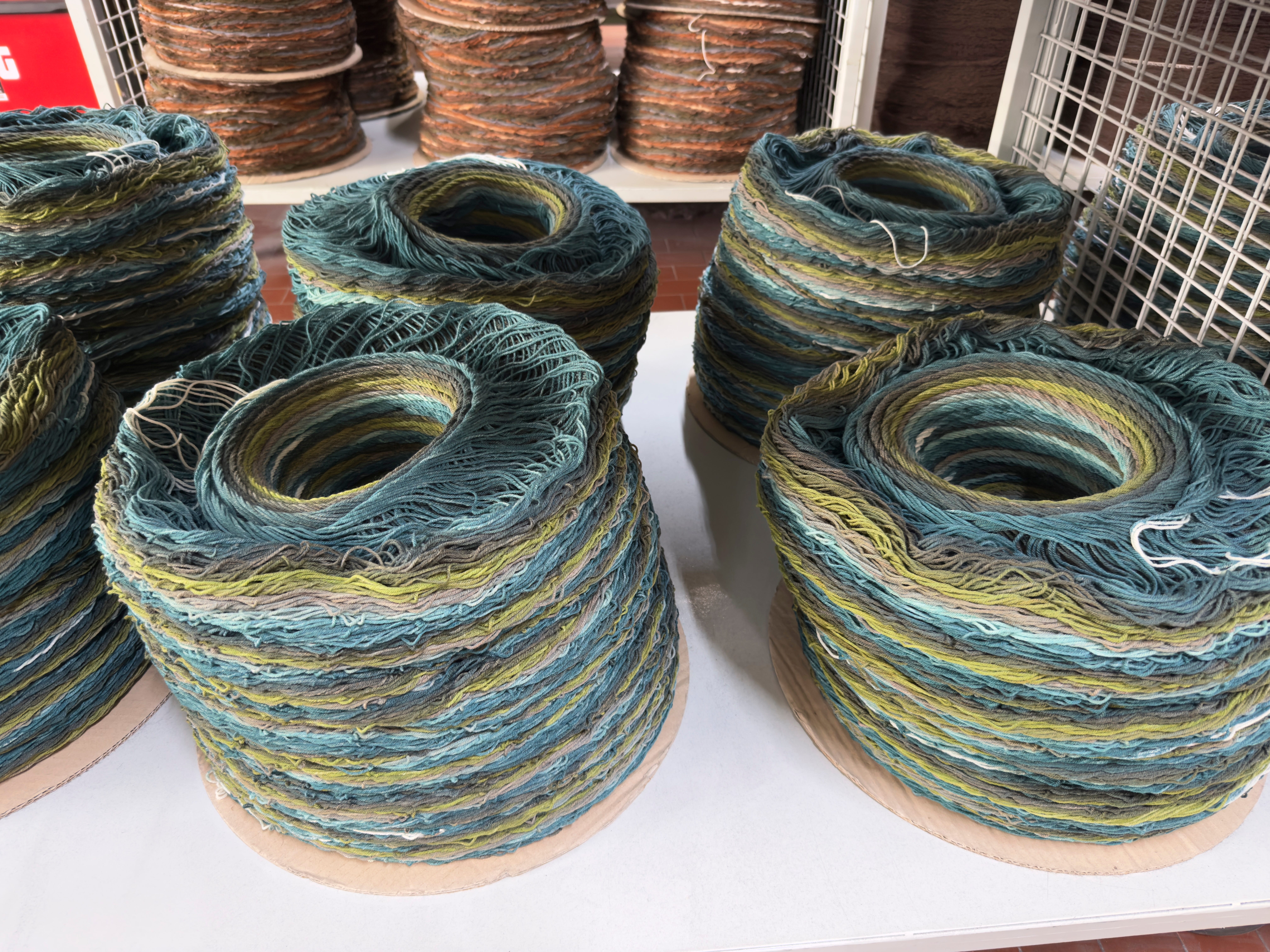
For the past two days, I have been in Biella, a small town in northern Italy known for producing some of the finest yarns and fabrics in the world.
The process starts long before the factory. Wool comes straight from sheep, still full of natural oils and dirt, what they call “greasy wool.” It’s brought to these mountain towns, where cold, clean snowmelt water flows. It’s some of the purest water in the world and helps shape the fabric’s quality.
The wool is washed in water from the river, then processed, spun, woven, and finished by people who have spent a lifetime learning how to do this well. You can see it in their hands. You can hear it in how they talk about the material. Their relationship to the fabric is not only technical. It is attentive. It is practiced. It is, in every sense, a craft.
When they are not talking about weaving, they are talking about the weather.
This year there was almost no snow. The rivers still run, but everyone notices the difference. The water is lower. The temperature has shifted. Climate change is not abstract here. It has entered the work itself.
At the same time, many of the smaller family factories are closing. You can walk along the river and see them. Buildings that once held generations of skill now sit empty. The larger manufacturers remain, but they operate differently. They survive by producing for luxury markets that can absorb the cost.
When you speak with the older artisans, you sense the shift. They do not romanticize their work. They know how demanding it has been. But they speak about what is being lost with a clarity that is difficult to ignore. The younger generation is not taking it up. The machines can produce the fabric. The market rewards speed and volume. The system moves in that direction.
But something is missing.
One man said it best: “These machines can make the fabric, but it has no soul.”
It would be easy to dismiss that as nostalgia. It would be easy to hear it as resistance to change. But standing in those spaces, it feels more serious than that.
It raises a deeper question about what we mean by progress.
We have been trained to measure progress by scale, speed, and efficiency. If something can be made faster, in greater quantity, at lower cost, we assume it is better. If technology replaces human labor, we call it advancement.
That story has shaped the modern world.
It has also narrowed it.
Wendell Berry has argued for decades that an economy organized around efficiency will eventually degrade the very things it depends on. Soil. Community. Craft. Attention. When these are treated as secondary, the system continues to function, but something essential begins to erode.
You can see that erosion here in Biella, not only in the disappearance of small factories, but in the disappearance of a way of creating. A way of paying attention. A way of relating to the material world that requires time, patience, and skill.
Simone Weil wrote that attention is the rarest and purest form of generosity. That kind of attention is embedded in this work. It cannot be automated. It cannot be scaled without being changed. When it disappears, we lose more than a product. We lose a way of being human in the world.
This is where the theological question comes into focus.
If creation is not simply raw material to be used, but something we are in relationship with, then the way we craft things matters. The pace matters. The relationships within the process matter.
But the story of progress rarely accounts for this. It assumes that more, faster, and larger are always better. Those assumptions are not neutral. They carry a vision of the world in which value is measured by output rather than by relationship.
Pope Francis warns in Laudato Si’ that when we treat the world as an object, we lose the capacity to recognize that we belong to it. That loss is both ecological and spiritual.
You can feel that tension here. The remaining factories are impressive. The machines are precise. The output is consistent.
But when you stand with someone who has spent a lifetime learning how to read the wool, how to adjust the process based on the water, how to sense when something is not quite right, you begin to understand what cannot be replaced.
This is not an argument against technology. It is an argument for discernment.
What are we gaining, and what are we losing?
What forms of life are we making possible, and what forms are we allowing to disappear?
We rarely ask those questions because the momentum of the system carries us forward. It tells us this is simply how things work. But it is not inevitable. It is a set of choices. And like all choices, it reveals what we value.
The grief you hear from these artisans is not only about their work. It is about a world that is narrowing its understanding of value. It is about the loss of practices that formed people over time, that required commitment, that connected human skill to the materials of the earth.
That grief is worth listening to because it helps us see more clearly what is at stake.
The question is not whether change will come. It will. The question is whether we will recognize that we have confused growth with goodness, and efficiency with wisdom.
A world can become more productive and less alive at the same time.
If we do not recover a deeper sense of value, we will continue to produce more while experiencing less, and call that success.
We are in this together,
Cameron
A Note from Cameron
I am away for the next two weeks on a trip to Italy. A little work and a little fun. I will do my best to send out meditations, but if I miss some days, don’t worry. I will be back in the swing when I return.
Reflection Questions
Where do you see the effects of “progress” in your own life, and what has it made possible?
What has been lost that you might not have named before?
Where can you choose attention, care, or craft over speed and efficiency?
A Prayer for the Day
A Prayer For Discernment in a World of Speed
Holy One,
we are shaped by the systems we inhabit.

We move quickly. We produce. We adapt.

Help us see clearly what this way of living is doing to us.

Give us the wisdom to discern what is good
and the courage to question what is assumed.

Teach us to value what cannot be measured easily.
To honor the work that forms us.
To care for what is being lost.

Keep us grounded in a way of life
that reflects your care for creation.

Amen.
Spiritual Practice
Slowing the Work of Your Hands
Choose one ordinary task today. Do it more slowly than usual. Pay attention to the material. The texture. The process. Notice where you are tempted to rush. Resist that impulse.
Let the task take the time it needs.
This is not about productivity. It is about recovering attention. And remembering that how we do something shapes who we become.
Upcoming Events That Might Be of Interest…
My team and I launched a new experiment we are calling “The Commons.” It’s an online space centered around communities of practice: groups of people who share a common concern, set of problems, or passion for a topic, and deepen their knowledge and expertise by interacting on an ongoing basis. Join the community here.
May 27, 2026, 12pm ET - FREE WEBINAR - I will be hosting an online experience titled “Reclaiming the Power of Imagination: A live experiential webinar with Jackie Sussman." Jackie, a psychotherapist, author, and leading expert in Eidetic Image Psychology, has spent over forty years helping leaders and individuals unlock creativity, uncover hidden strengths, and move through limiting patterns. During this session, she will lead a live Eidetic process shaped by mythic imagery, offering a direct experience of the work. REGISTER HERE.
On July 19-24, 2026, I’ll be leading a Women’s Wellness Retreat in the Wind River Mountains of Wyoming, and I’d love to extend the invitation to you. We’ll spend five days off the grid, riding horses through wide open landscapes, sharing meals, and creating space to slow down enough to hear ourselves think again. This retreat is about returning to yourself, settling your nervous system, letting go of what you’ve been carrying, and getting clearer about what matters now. The group will be small (no more than 10 women), and we’ll move at a steady, spacious pace, with plenty of room for both conversation and quiet. I hope you’ll consider joining us.
I drafted a Strategic Framework for Congregations as we move into the coming years of increased authoritarianism around the world. If interested, you can download it here.
Fun Things My Friends Are Up To…
I get to work with such amazing, creative people. This section is my way of celebrating them—no paid promotions, just joy in what they’re creating.
My colleague, the amazing Rev. Anna Golladay, is hosting another online training in Protest and Action Chaplaincy. This course offers a framework for providing compassionate, grounded spiritual care during protests, advocacy gatherings, and social movements. Drawing from a variety of faith traditions and critical social justice theory, it equips chaplains, pastors, and spiritual leaders to respond with integrity, purpose, and preparedness. LEARN MORE HERE.
If you are a leader or member of a congregation looking for consulting support in visioning, planning, hiring or staffing, please consider Convergence.
Dear Cameron and Friends,
For a deeper dive on this topic so brilliantly expressed here, you might want to listen to this long and amazing interview with Daniel Schmactenberger on this topic called "A Vision for Betterment" -- https://www.youtube.com/watch?v=tmusbHBKW84
or ,if you prefer reading to listening, this article by Daniel: https://consilienceproject.org/development-in-progress/
blessings on your day.
Even something more simple like picking and eating wild blueberries in the fields as a kid, the blueberries tasted better, juicier and more nourishing….Now, they are mass produced and enhanced but, not the same.