

“The earth is the Lord’s, and all that is in it.” — Psalm 24:1
In addition to the paid work I do in the world, I have the privilege of stewarding ten acres of storied land we call the Common Good Farm. It is an ongoing experiment in regenerative practice: a city girl learning how to listen to soil, a human being trying to remember how to live in right relationship with land.
We keep chickens, eighteen beautiful varieties who bless us and our community with eggs in every shade of brown and green. They scratch and wander and tilt their heads as if considering the mysteries of the universe.
Two weeks ago, that rhythm changed.
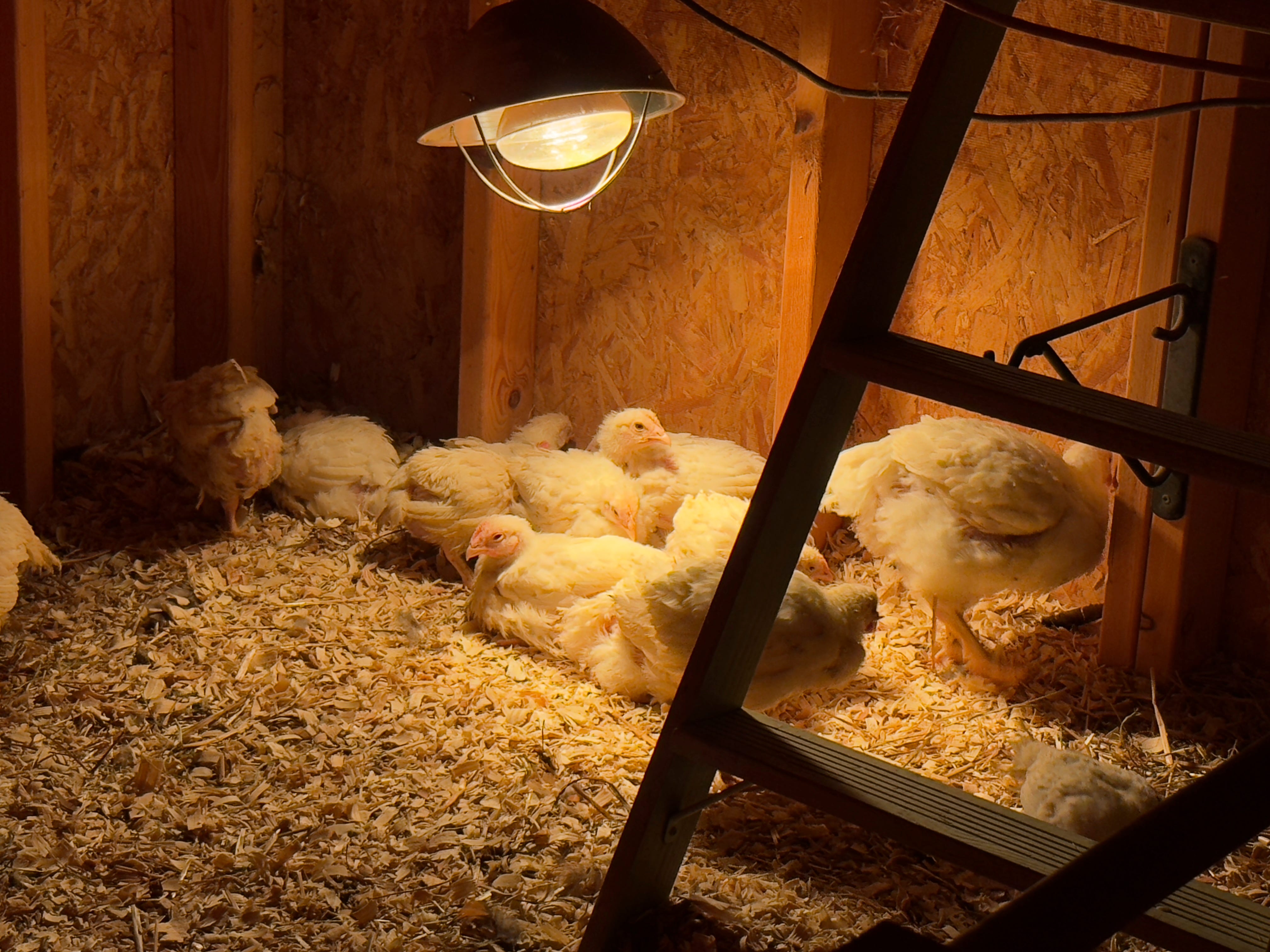
A neighbor was given nearly thirty factory farm chickens from a poultry house in town. He had no way to care for them. Through a story too long to tell here, those birds arrived at our farm.
My flock more than doubled overnight. I was not prepared for what came with them.
These are not birds shaped by sunlight and pasture. They are birds shaped by industrial efficiency. Their genetic lines have been engineered for speed and output. Some cannot walk. Some tremble with neurological damage. Several are not developing properly and will likely die young. Others grew so quickly on steroid-infused feed that their hearts and legs cannot sustain their bodies. Many have bare undersides where feathers never formed because they were raised in cramped conditions.
They drink astonishing amounts of water. They move differently. Their bodies carry the story of confinement.
Caring for them has been sobering.
I have had to look directly at what we have created in the name of efficiency and abundance. I have had to confront the fact that I have participated in this system, even if indirectly. We have treated bodies as units of output. We have shaped animals to fit supply chains rather than shaping supply chains to honor the integrity of animals.
This is not abstract theology. It is feather and bone and breath in my hands.
I have emphasized recently that Genesis declares creation tov meod — very good. Not useful. Not profitable. Good. The goodness is spoken over the whole community of life together.
When I hold one of these factory hens and feel the weakness in her legs, I cannot convince myself that this is the world God dreamed of for us. I see ingenuity without wisdom. Power without restraint. Abundance without reverence.
Wendell Berry reminds us that eating is an agricultural act.1 Our daily choices participate in systems whether we acknowledge it or not. Standing in the chicken run, I feel that truth in my body.
I have never been a heavy meat eater. But this experience has clarified something in me. The cost of cheap protein is not cheap. It is paid in suffering bodies. It is paid in polluted waterways. It is paid in the erosion of our own capacity to recognize other beings as fellow creatures rather than inputs.
Thomas Berry wrote that the universe is a communion of subjects, not a collection of objects.2 When we forget that, almost anything becomes justifiable.
The hens do not accuse me. They eat what I scatter. They lean into the sun when it warms their damaged feathers. Some of them will not survive long. Others may recover enough to scratch the soil alongside the older birds.
But I cannot unsee what I have seen.
This has become a theological reckoning. What does sacred reciprocity actually require? How do we nourish ourselves without turning other lives into expendable inventory? What does dominion mean if it is not restraint, protection, and care?
On the farm, theory dissolves. There is only relationship.
The question before me is not whether I can escape the systems I inhabit. I cannot. The question is how I will live inside them. What will I refuse? What will I change? What will I bless differently?
Abundance without reverence becomes violence.
I have to believe that God grieves that violence because Love does not look away from harm.
The earth is the Lord’s. Not ours to exploit. Not ours to exhaust. Ours to tend.
I am still learning what that means.
We are in this together,
Cameron
Reflection Questions
When have you come face-to-face with the hidden cost of something you consume or benefit from?
What does sacred reciprocity mean in your own daily life — with food, land, animals, labor, or energy?
Where might you be invited to live with more reverence, even if you cannot withdraw completely from the systems you inhabit?
A Prayer for the Day
A Prayer for Living as Community
God of soil and sky,

You declared creation very good.
You entrusted us with tending, not conquering.

Forgive us where efficiency has replaced reverence.
Forgive us where convenience has dulled compassion.

Open our eyes to the lives that sustain our own.
Strengthen us to choose restraint where restraint is needed.
Teach us to live as members of a living community, not masters of it.

Give us courage to change what we can
and humility to grieve what we have broken.

Amen.
Spiritual Practice
Practicing Sacred Reciprocity
Choose one meal and slow it down. Before you eat, pause.
Ask yourself: Who or what made this possible?
What soil, water, labor, or life contributed to this nourishment?
If you eat animal products, take one concrete step toward greater integrity: research the source, support a local regenerative farmer, reduce consumption, or simply let gratitude become awareness.
Reciprocity begins with attention. Attention shapes action.
Upcoming Events That Might Be of Interest…
My team and I launched a new experiment we are calling “The Commons.” It’s an online space centered around communities of practice: groups of people who share a common concern, set of problems, or passion for a topic, and deepen their knowledge and expertise by interacting on an ongoing basis. At the moment, I am leading a book study on Brian McLaren’s book, Life After Doom, on Tuesdays. Join the community here.
March 17, 23, 31 and April 7, 2026, 7-8:30pm ET - Rev. Dr. Matthew Fox and I will be hosting another 4-part series on “Visions for the Common Good.” This series will include sessions with David Abrams, Randy Woodley and Lynne Twist! All sessions are recorded, and you will get the link if you can’t make it. Learn more here.
March 26, 2026, 7–8:30pm ET – FREE WEBINAR - I will be joined by Ruth Dearnley, OBE, Founder and President of Stop the Traffik in London (see her TED Talk), for a critical conversation titled “Stop the Exploitation of Children: Disrupting Modern Slavery at Its Source.” As Board Chair of Stop the Traffik USA, this work is deeply personal to me. We cannot rescue our way out of trafficking; we must prevent exploitation by disrupting the systems and financial flows that profit from vulnerability — and congregations have a vital role to play. Ruth will share how technology is exposing trafficking networks, and Diane will highlight what cities like Philadelphia are learning, including insights related to the World Cup. All who register will receive the recording. Learn more and register here.
I drafted a Strategic Framework for Congregations as we move into the coming years of increased authoritarianism around the world. If interested, you can download it here.
Fun Things My Friends Are Up To…
I get to work with such amazing, creative people. This section is my way of celebrating them—no paid promotions, just joy in what they’re creating.
Science and Nonduality is offering a Community Gathering with Dr. Lyla June, Kaira Jewel Lingo and Rabbi Jessica Rosenberg, facilitated by Rae Abileah on February 26th on how spiritual practice, trauma-aware care, and neighborhood organizing are being woven together as living traditions. Learn more here.
The need for us to persevere and contribute grows ever more challenging as the horror and cruelty escalates, created by leaders with “malevolent incompetence.” Dr. Margaret Wheatley is offering a “Bundle for Good” for shipping within the U.S. She will send you seven copies of Perseverance, and one copy of her book of poems, Opening to the World as It Is. She’s including the poetry book as another means to support you personally. You can learn more here.
The Convergence Music Project is hosting a songwriting event on March 19-21, 2026 in Nashville. No songwriting experience is required, so feel warmly welcome even if you've never written a song before. There will be plenty of content also to further educate, inspire, and develop the gifts of advanced songwriters as well. Learn more.
Millions of people are seeking training in becoming Legal Observers for their communities vulnerable to ICE. Here is a recorded training that is helpful produced by the team at No Kings. If you know of other trainings, please post in the comments below.
The phenomenal team of “Singing Resistance” has gifted all of us a songbook of protest songs that groups are now using across the world. Here is the link. I am marching around my house singing these throughout the day. My dogs are very confused.
If you are a leader or member of a congregation looking for consulting support in visioning, planning, hiring or staffing, please consider Convergence.
Wendell Berry, “The Pleasures of Eating,” in What Are People For? (San Francisco: North Point Press, 1990), 145–152. This was originally published in Harper’s Magazine (1989) before appearing in the book.
Thomas Berry, The Dream of the Earth (San Francisco: Sierra Club Books, 1988), 82.
It is scary what we have and continue to do to our planet.
With regards to the chicks, a good read by Barbara Kingslover, Animals, Vegetable, Miracle. It is eye opening.
Thank you for this. I’ve been eating a vegan diet for 30 years because, like you, once you see it, there’s no going back without suppressing truth. Blessings to you as you continue to journey and write.