

“On the contrary, the members of the body that seem to be weaker are indispensable.” — 1 Corinthians 12:22, NRSVUE
Picture yourself in the cockpit of a P-51 Mustang in 1944, getting ready to deliver the fighter to another military airfield. The engine starts with a deep, unmistakable roar. You check the fuel gauges, review weather reports, and plan a route over hundreds of miles of unfamiliar land. There’s no GPS, no moving map to show nearby airports, and none of the advanced technology that today’s pilots rely on. Instead, you navigate using charts, compass headings, careful calculations, and by spotting landmarks from the air.
The Mustang is a strong, fast aircraft made for combat. Its Merlin engine puts out over a thousand horsepower, and flying it takes real skill and focus. The pilot understands that bad weather, a mechanical issue, or a navigation error could lead to serious trouble.
The person responsible for delivering this military aircraft is a woman.
She wears a uniform and has finished tough Army Air Forces flight training. She’s earned her wings and been ordered to fly military planes across the country. Yet, officially, she’s still considered a civilian. When the war ends, the United States government will not recognize her as a military veteran.
During World War II, over 25,000 women applied to join the Women Airforce Service Pilots, or WASP.1 Only 1,830 were accepted for training, and 1,074 graduated. They flew more than 60 million miles for the U.S. Army Air Forces, ferrying new planes, testing repaired ones, moving people and supplies, teaching pilots, and towing targets for gunnery practice. Their efforts allowed male pilots to serve in combat overseas.
Thirty-eight of these women died while performing their duties. Since they were considered civilian employees, their families did not receive the death benefits or funeral help given to military personnel. When a WASP died in a crash, other pilots sometimes raised money to send her body home. The same government that trusted these women with military planes would not pay to return them to their families.
On December 20, 1944, the program ended. The women were sent home, and many had few chances to keep flying as a career. Some male pilots had become more opposed to women in aviation, worried that women would take the jobs they wanted after the war.
I think about these women as we observe Veterans Day in the US. We honor those who have served in the military, often at great personal cost. But the WASP story makes us think about who is included when we talk about service, and who has had to struggle just to have their work recognized. Their skills were never in question. They proved themselves, often in dangerous situations, and the military relied on them. Still, the institution that needed their abilities was not willing to recognize their service equally.
The barriers were not just about gender. Some Asian American, Latina, and Native American women joined the program, but Black women were left out. Even when women had the flying skills needed, racial prejudice often decided who was accepted.
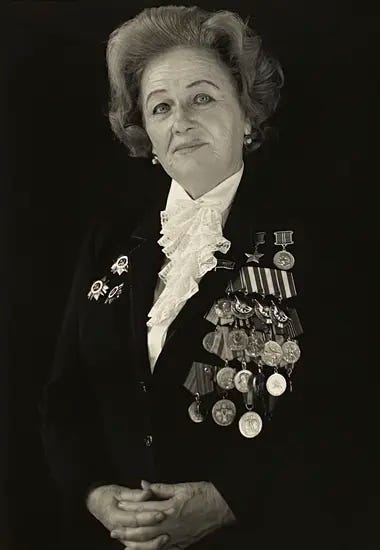
One WASP pilot was a young woman named Anne Noggle. She learned to fly as a teenager and joined the program in 1943. After the war, she kept flying and later became an Air Force officer during the Korean War.
Later in life, Noggle became a photographer. She started taking portraits of women who had flown military planes in World War II, including American WASP and Soviet pilots.2 By then, many years had gone by. The women were older, their faces showing the effects of time. Some wore uniforms that didn’t fit as they once did. Others wore regular clothes, and their expressions showed personalities and experiences that official military photos rarely caught. Noggle knew these women deserved to be seen as they really were, not just remembered as young women standing by airplanes.
In a letter to her fellow pilots, she wrote, “We may not be young any longer but we are very much alive.” I love that sentence.
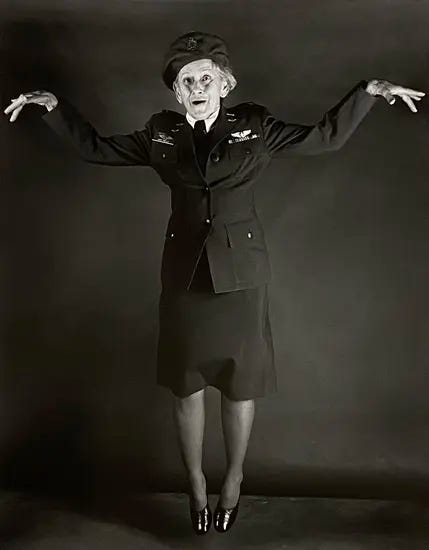
Noggle’s photos captured something that medals and military records could never fully show. These women lived full lives after the war. They grew older, built families and friendships, faced both setbacks and successes, and kept memories of their flying years as part of who they were.
It wasn’t until November 23, 1977, that President Jimmy Carter signed a law giving the WASP recognition for veterans’ benefits. In 2009, Congress gave them the Congressional Gold Medal, which was presented the next year. Even in 2016, new legislation was needed to let their ashes be placed in Arlington National Cemetery’s columbarium.
Over thirty years went by before the country officially recognized their wartime service. Almost seventy years passed before Congress gave them its highest civilian award.3
There’s a passage in Paul’s first letter to the Corinthians that feels especially fitting today. Paul describes the community as a human body with many different parts. He questions the idea that the most visible members are the most important, and reminds his readers that those who seem weaker or less honored are actually essential.
Paul was talking to an early Christian community, but his words challenge a habit that goes far beyond religion. We are very good at creating hierarchies of human value, often based on who has authority, who gets public recognition, and whose work we’ve learned to appreciate.
I notice this in congregations, where some people are praised for their leadership while others quietly keep things running. I see it in organizations that rely on skilled people but have rules that hold them back. Sometimes, we don’t give recognition because we think our usual ways are just the way things should be.
The WASP story shows us that these systems can be deeply unfair.
This Veterans Day, I’m thankful for the women who served in World War II, for the risks they took, and for their determination to keep the truth of their achievements alive. I also remember that honoring military service doesn’t mean we have to romanticize war. Their courage came during a global disaster that cost millions of lives.
I wonder what it felt like for the surviving WASP to finally be recognized by the country they served. Some lived to see it. Others did not. But medals and laws didn’t make their service real. They simply recognized what had always been true. These women earned their wings long before America was ready to honor them.
Maybe the best way to remember them is to look at the people and institutions around us now. Whose skills do we rely on while denying them the place they deserve? Whose work goes unseen because our traditions, rules, or assumptions have taught us to overlook them?
Gratitude is important. But sometimes justice requires us to change the institutions that determine whose service counts.
We are in this together,
Cameron
Reflection Questions
Whose service has shaped your life or community without receiving the recognition it deserves? What might their story reveal about how we assign value to people?
The WASP were trusted to perform dangerous military assignments but denied equal recognition. Where do you see institutions benefiting from people’s abilities while limiting their opportunities or authority?
What would it mean to move beyond expressing gratitude toward changing the conditions that keep capable people from fully contributing their gifts?
A Prayer for the Day
A Prayer For Those Whose Service Was Unseen
God of memory and mercy,
who knows the names forgotten by history
and the courage hidden from public view,

We give thanks for those
who answered the call to serve,
who carried responsibility through danger,
and whose sacrifices were too long unrecognized.

Remember the women who flew,
those who returned to lives beyond the airfields,
and those who never came home.

Forgive the pride that mistakes privilege for merit,
the traditions that silence gifted voices,
and the institutions that receive faithful service
while withholding dignity.

Open our eyes to those we have overlooked.
Give us courage to correct what is unjust,
and wisdom to recognize the gifts
that have always been among us.

May gratitude become justice,
remembrance become responsibility,
and every human life be honored
in the fullness of its worth.

Amen.
Spiritual Practice: Who Is Missing From the Photograph?
Find a photograph that represents a community or institution important to you. It might show a congregational gathering, workplace team, family celebration, school, or historical event.
Spend a few minutes looking carefully at the people pictured. Consider whose presence was considered important enough to document. Who is standing at the center? Who is positioned at the edges? Who might have contributed to making that occasion possible without appearing in the photograph at all?
Now think about the rules, traditions, or assumptions that shaped who could participate and who could lead.
Choose one person whose contribution deserves greater visibility. If possible, learn something about their experience directly from them. Ask what they accomplished, what obstacles they encountered, and what they wish others understood about their work.
Then consider whether your community has practices that continue to overlook or exclude capable people. Identify one change you could help bring about, such as expanding opportunities for leadership, preserving neglected stories, or questioning a policy that unnecessarily limits participation.
Let your act of remembrance make room for someone whose gifts have been waiting to be recognized.
Upcoming Events That Might Be of Interest…
My team and I launched a new experiment we are calling “The Commons.” It’s an online space centered around communities of practice: groups of people who share a common concern, set of problems, or passion for a topic, and deepen their knowledge and expertise by interacting on an ongoing basis. Join the community here.
November 10, 2026 - 12:30 - 1:30pm ET - ONLINE BOOK CLUB - I am hosting a book club where we are reading Fr. Gregory Boyle’s “Cherished Belonging: The Healing Power of Love in Divided Times.” Father Gregory Boyle, founder of Homeboy Industries, has spent decades building community among people whom society has often discarded. In Cherished Belonging, he draws on those relationships and stories to explore what might happen if we stopped sorting people into categories of worthy and unworthy, us and them. Don’t worry if you don’t have time to read the book. We always have incredibly rich conversations. All are welcome. Learn more here.
November 20, 2026, 7-8:45pm ET - I will be joining Jackie Sussman for an online session on practicing eidetics as part of our “Reclaiming the Power of Imagination” monthly series. Eidetic Imagery is a powerful tool for pastors, denominational leaders, coaches, and spiritual directors working with others, and for individuals seeking deeper integration and healing in their own lives. Jackie is a psychotherapist, author, and leading expert in Eidetic Image Psychology, and has spent over forty years helping leaders and individuals unlock creativity, uncover hidden strengths, and move through limiting patterns. During this session, she will lead a live Eidetic process shaped by mythic imagery, offering a direct experience of the work. REGISTER HERE.
December 1, 2026 - 7-8:30pm ET, ONLINE EVENT - Theologian Matthew Fox and I are teaming up again in a series called Journeying with the Mystics. The mystics have always emerged in times of uncertainty. They appear when old certainties are crumbling, when institutions no longer provide easy answers, and when people find themselves longing for a deeper experience of the Sacred. Join us for a 24-session exploration of the teachings of St. John of the Cross, Thomas Merton, Hildegard of Bingen, Kabir and Rumi, Meister Eckhart and more. This is more than a lecture series. It is an invitation into a living spiritual journey. Learn more and REGISTER HERE!
December 5, 2026 - A Way in the Wilderness: An Online Advent Silent Retreat, 9:00 a.m.–4 p.m. ET - I’m delighted to be leading a special Advent retreat with my friends at the Shalem Institute for Spiritual Formation. A Way in the Wilderness is an invitation to step away from the noise and demands of daily life and enter a spacious day of contemplative prayer, sacred reading, Sabbath rest, and silence. Together, we’ll explore the biblical wilderness as a place where new possibilities emerge and discover the peace that comes from recognizing the Sacred’s presence even in uncertain times. There is nothing to accomplish and no experience to manufacture. Just an opportunity to rest, listen, and remember that we do not travel through the wilderness alone. LEARN MORE.
December 8, 2026, 7-8:00pm ET - The holidays can be especially tender when we are carrying grief. Whether we are mourning someone we love, navigating changes in our health or relationships, or grieving the uncertainty of the world around us, this season can bring losses both old and new to the surface. Join us on The Commons for a special one-hour online gathering led by my friend Joy Gaertner, an Advanced Loss & Grief Recovery Specialist. Together, we will create a welcoming space to acknowledge our losses, honor what we carry through meaningful rituals of remembrance, and discover sources of hope for the season ahead. This will be a gentle evening of connection and care, with room for whatever grief you may be holding. The gathering is donation-based, and all are welcome. LEARN MORE.
December 15, 7-8:30pm ET - FREE WEBINAR - I will be joined by Dr. Charissa Mikoski, Assistant Professor of Research and Hartford Institute for Religion Research for a presentation on “The State of American Congregations: What the Latest Data Tell Us.” This webinar explores findings from the 2025 Faith Communities Today survey, including changes in worship attendance, congregational vitality, finances, volunteering, programming, and leadership. It will also examine what more than 24,000 individual attenders tell us about participation and their experiences of congregational life. Together, these findings offer a picture that is neither simply one of decline nor one of revival, but of significant change and uneven recovery. REGISTER HERE.
Fun Things My Friends Are Up To…
I get to work with such amazing, creative people. This section is my way of celebrating them—no paid promotions, just joy in what they’re creating.
Every Monday, 12pm ET - ONLINE WRITING GROUP - My dear friend, Meryl Marshall-Daniels, is leading a writing group open to all. This is a simple and spacious writing circle for people who want time to listen inwardly and put words on the page without overthinking, performing, or polishing. Meryl offers a prompt designed to invite reflection, imagination, and attunement to what is already alive within you. The practice honors writing as a way of listening, of letting images, memories, questions, and insights surface in their own time. Learn more here.
If you are a leader or member of a congregation looking for consulting support in visioning, planning, hiring or staffing, please consider Convergence.
https://www.nationalww2museum.org/war/articles/wasp-women-airforce-service-pilots
https://airandspace.si.edu/stories/editorial/anne-noggle-photo-worldwar-women-pilots
https://www.govinfo.gov/content/pkg/PLAW-111publ40/html/PLAW-111publ40.htm
Thank you for sharing this story, Cameron. So many young people played small but vital parts in all these conflicts. It’s good to reflect on it.
Here’s my blog post for today about my mother’s WW2 service:
https://melaniepwells22.substack.com/p/lest-we-forget
I PRAY THAT THERE WILL BE NO MORE WAR. MY GRANDFATHER GAVE HIS LIFE IN WORLD WAR 1 LEAVING A YOUNG WIFE, AND MOTHER OF THREE YOUNG CHILDREN. HIS BODY IS BURIED OVERSEAS, HIS SPIRIT, WE AS A FAMILY HONOR IT WIYH PRIDE. LET US MAKE PEACE IN OUR HEARTS, OUR FAMILIES, LOCAL COMMUNITIES, AND OUR WORLD. PEACE.