

“Everyone knows the usefulness of what is useful, but few know the usefulness of what is useless.” — Zhuangzi
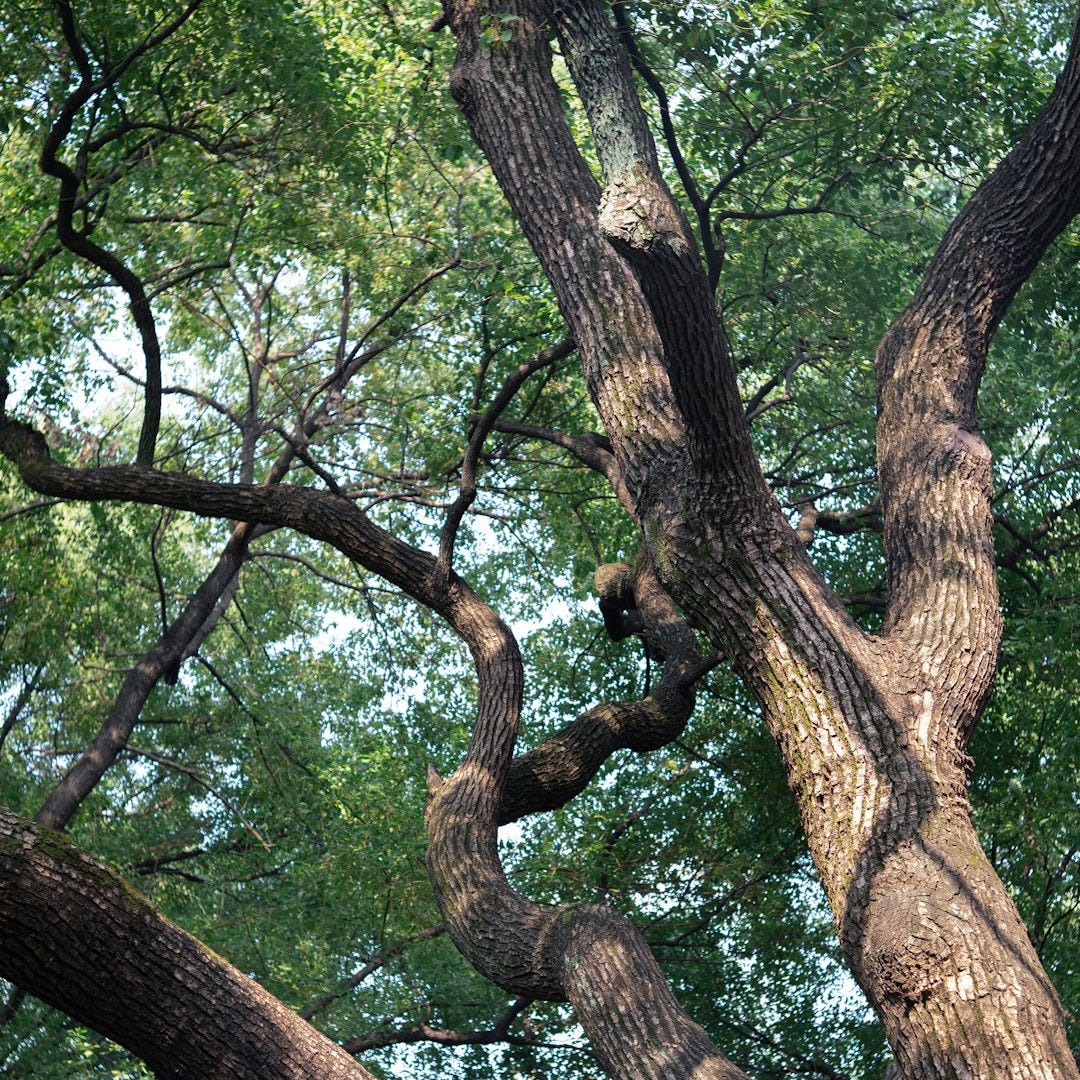
There is an ancient Daoist story about a carpenter who came upon an enormous tree.
The tree was impressive. Its trunk was wide enough for several people to stand beneath it. Its branches stretched out in all directions, forming a canopy big enough to shelter many. It had grown for generations.
But the carpenter barely gave it a second glance. The trunk was twisted and rough. The branches bent in strange ways. The wood was knotted. You couldn’t make a straight beam from it or turn it into fine furniture. Even a coffin maker would have turned it down. The carpenter declared the tree useless and continued on his way.
Later, in one version of the story, the tree appeared to the carpenter in a dream and questioned his judgment. What was he comparing the tree to? Fruit trees and timber trees were seen as valuable because people could use them. Their branches were cut, their fruit picked, and their trunks eventually cut down. Their usefulness shortened their lives.
The old tree had survived because nobody could figure out what to do with it.
So it grew.
And grew.
And grew.
Many generations spent time under its branches. Travelers found shade there. Birds built nests in its canopy. Insects made homes in its bark. Its roots kept the soil in place. Its leaves took in sunlight and released oxygen.
Useless? Zhuangzi was playing with us. He was asking a question that remains uncomfortable more than two thousand years later: Who gets to decide what something is for?
We live in a culture that has a ready answer. Almost everything is measured by its usefulness.
We ask kids what they want to be when they grow up, usually meaning what job they’ll have. Adults often introduce themselves by their jobs. We judge our days by what we get done and our organizations by what they produce. Even hobbies can turn into side jobs, and our free time is supposed to make us healthier or more productive when we go back to work. Somewhere along the way, usefulness became confused with worth.
We use the same thinking with the Earth. A forest is valued for its timber. A mountain is valuable if it has minerals. A river is valuable if it can water crops, make electricity, or carry goods. Land that doesn’t make money is called “undeveloped.”at these things are useless. Maybe our understanding of usefulness has become terribly small.
The old tree shows us a different way to look at things. Its value isn’t about what we can take from it. Its gift is simply being part of a network of life that no spreadsheet could ever measure.
I wonder what would happen if we extended that generosity toward ourselves. You do not have to justify your existence through productivity. You don’t become more important by answering more emails, making more money, gaining more followers, joining another committee, or adding one more task to an already busy life. It might even be spiritually risky to spend our lives trying to be useful to systems we no longer trust.
Perhaps these times require us to become a little more useless.
We might become less useful to an economy that always wants us to buy more. Less useful to algorithms that make money by keeping us upset. Less useful to political groups that want us to fear each other. Less useful to jobs that see exhaustion as dedication. Less useful to cultures that think every quiet moment needs to be filled.
That does not mean withdrawing from the world. The useless tree was doing quite a lot. It was making shade. It was holding soil. It was sheltering birds. It was participating in the slow exchange of carbon, water, sunlight, fungi, insects, roots, and air that makes life possible.
It just wasn’t doing anything the carpenter could sell. Doesn’t that sound…liberating?!?
Many traditions teach that the most important parts of life can’t be measured. Buddhism encourages us to let go instead of always collecting more. The Jewish Sabbath stops work every seventh day and reminds us the world goes on without our effort. Islamic prayer pauses business and activity several times a day so people can remember what matters most. Jesus often left the crowds and their demands to be alone.
Again and again, our traditions break the cycle of always being useful and remind us that living isn’t the same as being productive.
Maybe you need that reminder today. You are allowed to sit beneath a tree without accomplishing anything. You are allowed to make something beautiful that nobody buys. You are allowed to spend an afternoon with someone you love and have nothing to show for it. You can pray without getting an answer, grow tomatoes poorly, sing out of tune, take a nap, watch birds, look at clouds, read poetry, or learn something that will never help your résumé.
You are allowed to be wonderfully inefficient at being human.
And maybe, paradoxically, that is when another kind of usefulness begins to emerge. Someday someone exhausted from trying to survive this strange age may come upon you. They may need somewhere to rest. Because you resisted every demand to turn yourself into lumber, you may still be standing there, gnarled by experience, crooked in interesting places, gloriously difficult to monetize, with branches wide enough to offer them shade.
Maybe Zhuangzi was right.
Perhaps we have spent far too much time learning the usefulness of what is useful.
It may be time to rediscover the sacred usefulness of what the world calls useless.
We are in this together,
Cameron
Reflection Questions
Where have you learned to confuse your productivity with your worth?
What parts of your life have no obvious economic or practical value but make you feel most fully alive?
What might you become less “useful” to so that you can become more available to life?
A Prayer for the Day
A Prayer For The Grace to Be Enough
Holy Mystery,

Release us from the exhausting belief
that we must earn our place in this world.

Teach us the wisdom of trees
that grow without résumés,
rivers that flow without recognition,
and birds that sing without wondering
whether anyone is listening.

Forgive us for the ways we have measured life
only by what can be extracted from it.

Help us recognize the sacred worth
of forests and wetlands,
elders and children,
rest and play,
silence and wonder,
and every life that refuses
to fit neatly into our calculations.

May we become less useful
to everything that diminishes life
and more available
to everything that nourishes it.

Give us courage to grow crooked
when straightness requires becoming
something we were never meant to be.

And when someone weary
finds their way beneath our branches,
may there be room.

Amen.
Spiritual Practice
Waste Some Time
Set aside thirty minutes today and deliberately accomplish nothing useful. Don’t optimize the experience. Don’t track it on your watch. Don’t listen to a podcast that will improve you while you’re doing it. And please don’t turn it into a productivity practice called something horrifying like “strategic restorative downtime.”
Just waste some time.
Sit beneath a tree. Watch birds at a feeder. Lie on the floor with your dog. Drink coffee slowly enough to taste it. Doodle badly. Listen to an entire piece of music without doing anything else. Wander somewhere without trying to reach a destination.
Pay attention to whatever resistance arises. You may hear the internal voice insisting that you should be answering emails, cleaning something, reading something important, or otherwise justifying your continued existence. Thank that voice for its concern.
Then remain gloriously useless.
Afterward, notice what happened. Did anything in you soften? Did you notice something you normally miss? Did time feel different when you stopped trying to extract something from it?
The point is not to become unproductive. There is good work to do in this world, and much of it urgently needs our hands.
The practice is remembering that your life is larger than your usefulness.
For thirty minutes, become the old tree. Make some shade. And let that be enough.
Upcoming Events That Might Be of Interest…
My team and I launched a new experiment we are calling “The Commons.” It’s an online space centered around communities of practice: groups of people who share a common concern, set of problems, or passion for a topic, and deepen their knowledge and expertise by interacting on an ongoing basis. Join the community here.
August 20, 2026, 7-8:45pm ET - I will be joining Jackie Sussman for an online session on practicing eidetics as a part of our “Reclaiming the Power of Imagination” monthly series. Eidetic Imagery is a powerful tool for pastors, denominational leaders, coaches, and spiritual directors working with others, and for individuals seeking deeper integration and healing in their own lives. Jackie is a psychotherapist, author, and leading expert in Eidetic Image Psychology, and has spent over forty years helping leaders and individuals unlock creativity, uncover hidden strengths, and move through limiting patterns. During this session, she will lead a live Eidetic process shaped by mythic imagery, offering a direct experience of the work. REGISTER HERE.
August 25 - September 1, 2026, 12:30-1:30pmET - Book Club in The Commons - FREE - We are reading our next book, “I Eat The Stars” by Sarah Wilson. We will meet each Tuesday for 6 weeks. It’s such great fun. I hope you will be a part. All are welcome! RSVP HERE.
September 8, 2026, 12:30 - 1:30pm ET, ONLINE EVENT with NY Times Best-Selling author and journalist, Sarah Wilson!!! Sarah has just published her latest book I Eat The Stars: How to Live Fully and Beautifully in a Collapsing World. Join us for this one hour conversation where we will talk with Sarah about how we face collapse, how we find beauty and who we can become in these challenging times. Scholarships are available. REGISTER HERE.
September 8, 2026, 7-9pm ET, ONLINE EVENT - I’ll be hosting a powerful online gathering on The Black Madonna: Sacred Wisdom for a World in Crisis with Matthew Fox, Alessandra Belloni, and Christena Cleveland. We will explore the Black Madonna as a symbol of resilience, liberation, sacred feminine wisdom, and healing in a fractured world through conversation, story, music, and spiritual reflection. If you feel drawn toward a deeper encounter with the Divine Feminine and the ancient traditions that continue to nourish movements for justice and wholeness, I hope you’ll join us. Learn more and REGISTER HERE.
September 14, 7-8:30pm ET ONLINE EVENT - I’m delighted to share that Dr. Margaret Wheatley is releasing a newly updated edition of her beloved book Perseverance: A Companion for the Journey this October. Written for those committed to serving the world with compassion in difficult times, the book offers daily wisdom and practical guidance for navigating grief, anger, exhaustion, and uncertainty while remaining rooted in love, courage, and presence. Meg and I will be in conversation to explore what perseverance looks like in this moment of history and how we can sustain ourselves for the long work ahead. I hope you’ll join us for what promises to be a deeply meaningful conversation. REGISTER HERE.
October 6, 2026 - 7-8:30pm ET, ONLINE EVENT - Matthew Fox and I are teaming up again to launch a series called Journeying with the Mystics. The mystics have always emerged in times of uncertainty. They appear when old certainties are crumbling, when institutions no longer provide easy answers, and when people find themselves longing for a deeper experience of the Sacred. Join us for an 18-session exploration of the teachings of St. John of the Cross, Thomas Merton, Hildegard of Bingen, Kabir and Rumi, Meister Eckhart and more. This is more than a lecture series. It is an invitation into a living spiritual journey. REGISTER for the first session HERE!
October 18-21, 2026 - PREACH! 2026 Conference- I’ll be co-hosting PREACH in Minneapolis with Church Anew, a new gathering for preachers, storytellers, worship leaders, and spiritual communicators navigating what it means to speak with clarity, compassion, and courage in a changing world. If you’ve sensed that the preaching moment has changed and are longing for thoughtful community and renewed imagination for this work, I hope you’ll join us.
Fun Things My Friends Are Up To…
I get to work with such amazing, creative people. This section is my way of celebrating them—no paid promotions, just joy in what they’re creating.
I’m delighted to celebrate the upcoming release of Wisdom Church: Abundant Life for Aging Congregations by my colleague, Rev. Dr. Anna Hall. Rather than seeing aging congregations as communities in decline, Anna invites us to recognize them as communities rich with wisdom, purpose, and possibility. Her book offers a hopeful vision for moving beyond anxiety about the future and embracing the unique gifts of older adults as beloved children of God. If your congregation is navigating these questions, this is a resource well worth reading. You can preorder the Kindle edition now, with delivery on August 17: https://www.amazon.com/Wisdom-Church-Abundant-Aging-Congregations-ebook/dp/B0HBXGYTWC
Every Monday, 12pm ET - ONLINE WRITING GROUP - My dear friend, Meryl Marshall-Daniels, is leading a writing group open to all. This is a simple and spacious writing circle for people who want time to listen inwardly and put words on the page without overthinking, performing, or polishing. Meryl offers a prompt designed to invite reflection, imagination, and attunement to what is already alive within you. The practice honors writing as a way of listening, of letting images, memories, questions, and insights surface in their own time. Learn more here.
If you are a leader or member of a congregation looking for consulting support in visioning, planning, hiring or staffing, please consider Convergence.
Oh, Cameron, how can you create these beautiful meditations so often!!! I marvel at the variety of sacred. texts you know to use in your writing. Blessings on your very useful life!!
Adding to the gratitude already expressed here — thank you, Cameron!
Kurt Vonnegut, when asked why we are here used to get a kick out of saying that he asked his wise son “the doctor” about it. His wise son the doctor replied: “dad, we are here to help each other through whatever this is.”
And Vonnegut also loved to say — with a grin — “we are here to fart around”.
The tree does indeed teach us both lessons about who we are and why we are here.