

“I am making this covenant, with its oath, not only with you who stand here with us today before the Lord our God, but also with those who are not here with us today.” — Deuteronomy 29:14–15, adapted from NRSVUE
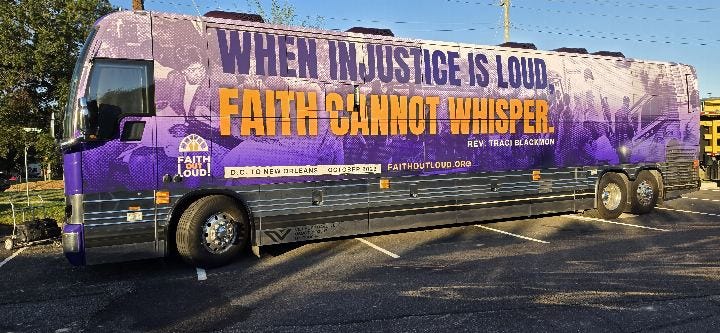
On May 4, 1961, thirteen people got on two buses in Washington, D.C., bound for New Orleans. Seven were Black and six were white. Most were young, some just out of their teens, and they set out to do something that should have been normal. They wanted to travel together through the American South, using interstate buses and terminals without being separated by race.1
The Supreme Court had already ruled that segregation in interstate transportation was illegal. But throughout the South, those rulings were often ignored. The Freedom Riders wanted to see if the federal government would enforce the law when local officials would not.
They knew the trip would be dangerous. They trained in nonviolent resistance and got ready for the chance they might be arrested or attacked. Still, I wonder what they felt as the buses left Washington. They were leaving behind their familiar lives and heading toward places where people had already threatened to stop them. They never finished the journey to New Orleans by bus.
On May 14, near Anniston, Alabama, a white mob attacked one of the buses, slashed its tires, and chased it out of town. When the bus stopped, they threw a firebomb inside. The passengers got out through smoke and flames, only to be attacked again outside.2 In Birmingham, riders on the second bus were beaten by white attackers while police did nothing to protect them.
The violence was meant to stop the Freedom Rides. Instead, more activists joined in, including students who knew that letting the attacks end the journey would let violent opponents decide who could use their rights.
Hundreds of people eventually took part. Many were arrested and put in jail. Their persistence pushed federal authorities to enforce desegregation in interstate transportation. Sixty-five years later, people are getting back on the bus.
This week, a group of civil rights leaders, faith communities, artists, original Freedom Riders, and their descendants is retracing that historic route.3 The Ride 2026 started in Washington on October 17 and will reach New Orleans on October 28, just before the American midterm elections. Along the way, they are visiting historic churches, Black colleges, civil rights landmarks, and communities where the fight for equal citizenship still goes on.
My good friend Rev. Traci Blackmon is one of the organizers. Traci has spent much of her ministry supporting communities facing racial injustice, and I am moved to see her helping bring this history into the present.
At the opening event in Washington, she reminded everyone that laws do not enforce themselves. She talked about freedom as a chain linking ancestors and descendants, and the responsibility each generation has to keep that chain strong.
I’ve been thinking about that image ever since. We often tell civil rights history as a series of victories. We remember the court decisions, the laws, the speeches, and the moments when barriers finally fell. Looking back, it can seem like progress was bound to happen.
But the people on those buses in 1961 had no guarantee that their courage would make a difference. They knew the law was on their side, but they also knew it might not protect them when the mob showed up. They had to decide if the chance for a more just future was worth the risk of trying to make it happen.
The Hebrew scriptures offer a strong way to understand that responsibility. In Deuteronomy 29, Moses speaks to the people of Israel as they get ready to renew their covenant. He says the covenant includes those present and those not there that day. The promise goes beyond the people gathered, tying future generations to obligations they will inherit.
This idea comes from a Jewish view of covenant, where a people is formed through shared memory, responsibility, and faithfulness over generations. It does not mean descendants must repeat everything their ancestors did. It recognizes that one generation’s choices shape the world the next will live in.
I wonder if the Freedom Riders understood something like this. They took on the unfinished work of people who had fought against slavery, segregation, racial violence, and exclusion long before 1961.4 Their courage opened new possibilities for those who came after them. Now, another generation is traveling the same roads, asking what still needs to be done.
This is an American story, but its meaning goes far beyond the United States. Around the world, people have worked to make freedom and equality real. South Africans organized against apartheid. Women in many countries fought for the right to vote and take part in public life. Indigenous communities still defend their lands, languages, and political rights. People under military governments have risked jail to demand fair leadership.
These histories are different, and we should respect their unique situations. Still, they show us something about the link between freedom and responsibility. Rights won through great sacrifice can become weak if those who inherit them think they will last on their own.
I think this is especially important as Americans face another election with deep uncertainty about our democracy. Many people worry about whether the rules for voting will be applied fairly and if election results will be respected. These concerns deserve real attention, as does the work of those who run elections honestly.
But the deeper lesson of the Freedom Rides goes beyond any one election. The original riders knew that a legal promise matters only when people are willing to make it real for others. Their courage showed the gap between the rights Americans had on paper and what they faced in real life.
Every generation that inherits freedoms won by others faces the same question. Are we willing to protect those freedoms when it gets hard? Can we see the people who are still left out of promises we think have already been kept? Will we take responsibility for the world our children and grandchildren will live in?
There is something especially moving about where this week’s journey ends. The original Freedom Riders planned to reach New Orleans by bus, but violence stopped them from finishing the trip. The new riders are heading to the city they never reached, carrying the memories of those who faced the attacks and the hopes of people still working for equal rights.
When they arrive today, they will finish a journey that began sixty-five years ago. That arrival is worth celebrating. It will also remind us that the work those buses stand for continues wherever people are denied the dignity, protection, or participation their societies have promised.
I am grateful for Traci and everyone making this journey. I am grateful for the original riders who took risks most of us can hardly imagine. And I am grateful for people around the world who keep doing the patient, dangerous, and often tiring work of making freedom real.
The road from Washington to New Orleans has an end point. The bigger journey toward justice does not have such a clear finish.
Maybe that’s why we need to keep telling these stories. We have inherited more than the freedoms earlier generations won. We have also inherited their unfinished promises, and the responsibility to carry them further than they could.
We are in this together,
Cameron
Reflection Questions
What freedoms or opportunities do you enjoy today because someone before you accepted personal risks or made sacrifices you may never fully understand?
The Freedom Riders challenged the distance between rights promised by law and rights actually experienced in daily life. Where do you see a similar distance in your own community or country today?
What unfinished promise of justice do you feel responsible for carrying forward, and what might faithfulness to that responsibility look like in your life?
A Prayer for the Day
A Prayer For Those Who Carry the Journey Forward
Generous Creator,

We give thanks for those
who traveled dangerous roads
so that others might live more freely.

For the courage of those
who faced hatred without surrendering
their commitment to human dignity.

For the generations whose sacrifices
have opened possibilities
they would never live to see.

Help us remember
that the freedoms we inherit
were often purchased at great cost.

Give us wisdom to recognize
the injustices that remain,
courage to confront them,
and patience for the long work
of building a more just world.

May we honor our ancestors
through the lives we choose to live,
and leave those who come after us
a world more generous
than the one we received.

Amen.
Spiritual Practice: Walk a Mile for Someone Else
The Freedom Riders understood that justice sometimes requires us to leave the places where we are comfortable and travel toward places where our presence might make a difference.
Today, take a walk of about a mile, if you are physically able. Before you begin, think of a person or community whose struggle for freedom or dignity has shaped your life. It might be someone who resisted racial injustice, defended religious freedom, challenged an oppressive government, or worked to protect people who were excluded.
As you walk, imagine the courage it took for that person to begin their journey without knowing how it would end. Consider what they risked, what they hoped for, and what they were unable to accomplish in their lifetime.
At the halfway point, stop for a moment. Look back at the distance you have traveled. Give thanks for those whose courage has brought us this far.
Then turn toward the road ahead.
For the remainder of your walk, consider one injustice in your community that you have grown accustomed to seeing. What would it mean to become less comfortable with its continued existence? Who is already working to address it, and how might you join them?
When you finish, choose one concrete action you can take this week to support that work.
The Freedom Riders remind us that we do not have to see the end of the road before we begin traveling it. Sometimes our responsibility is simply to carry the journey farther than those who came before us were able to go.
Upcoming Events That Might Be of Interest…
My team and I launched a new experiment we are calling “The Commons.” It’s an online space centered around communities of practice: groups of people who share a common concern, set of problems, or passion for a topic, and deepen their knowledge and expertise by interacting on an ongoing basis. Join the community here.
November 3, 2026 - 12:30 - 1:30pm ET - ONLINE BOOK CLUB - I am hosting a book club where we are reading Fr. Gregory Boyle’s “Cherished Belonging: The Healing Power of Love in Divided Times.” Father Gregory Boyle, founder of Homeboy Industries, has spent decades building community among people whom society has often discarded. In Cherished Belonging, he draws on those relationships and stories to explore what might happen if we stopped sorting people into categories of worthy and unworthy, us and them. Don’t worry if you don’t have time to read the book. We always have incredibly rich conversations. All are welcome. Learn more here.
November 4, 2026 - 7-8:30pm ET, ONLINE EVENT - Theologian Matthew Fox and I are teaming up again in a series called Journeying with the Mystics. The mystics have always emerged in times of uncertainty. They appear when old certainties are crumbling, when institutions no longer provide easy answers, and when people find themselves longing for a deeper experience of the Sacred. Join us for a 24-session exploration of the teachings of St. John of the Cross, Thomas Merton, Hildegard of Bingen, Kabir and Rumi, Meister Eckhart and more. This is more than a lecture series. It is an invitation into a living spiritual journey. Learn more and REGISTER HERE!
November 10, 7-8:30pm ET - I’ll be joined by theologian, writer, and professor Dr. Debra Rienstra for a special ONLINE conversation on Refugia Faith. In ecology, refugia are small places where life survives amid disruption, pockets of resilience from which life can eventually regenerate and spread. Debra invites us to consider what this might mean spiritually in an age of climate instability, political turmoil, institutional decline, and profound uncertainty. What if our congregations, communities, relationships, and even our own lives could become refugia, places where courage, compassion, beauty, wisdom, and possibility are protected and cultivated for whatever comes next? I hope you’ll join us for this timely and deeply hopeful conversation. REGISTER HERE!
November 19, 2026, 7-8:45pm ET - I will be joining Jackie Sussman for an online session on practicing eidetics as part of our “Reclaiming the Power of Imagination” monthly series. Eidetic Imagery is a powerful tool for pastors, denominational leaders, coaches, and spiritual directors working with others, and for individuals seeking deeper integration and healing in their own lives. Jackie is a psychotherapist, author, and leading expert in Eidetic Image Psychology, and has spent over forty years helping leaders and individuals unlock creativity, uncover hidden strengths, and move through limiting patterns. During this session, she will lead a live Eidetic process shaped by mythic imagery, offering a direct experience of the work. REGISTER HERE.
December 8, 2026, 7-8:00pm ET - The holidays can be especially tender when we are carrying grief. Whether we are mourning someone we love, navigating changes in our health or relationships, or grieving the uncertainty of the world around us, this season can bring losses both old and new to the surface. Join us on The Commons for a special one-hour online gathering led by my friend Joy Gaertner, an Advanced Loss & Grief Recovery Specialist. Together, we will create a welcoming space to acknowledge our losses, honor what we carry through meaningful rituals of remembrance, and discover sources of hope for the season ahead. This will be a gentle evening of connection and care, with room for whatever grief you may be holding. The gathering is donation-based, and all are welcome. LEARN MORE HERE.
December 15, 7-8:30pm ET - FREE WEBINAR - I will be joined by Dr. Charissa Mikoski, Assistant Professor of Research and Hartford Institute for Religion Research for a presentation on “The State of American Congregations: What the Latest Data Tell Us.” This webinar explores findings from the 2025 Faith Communities Today survey, including changes in worship attendance, congregational vitality, finances, volunteering, programming, and leadership. It will also examine what more than 24,000 individual attenders tell us about participation and their experiences of congregational life. Together, these findings offer a picture that is neither simply one of decline nor one of revival, but of significant change and uneven recovery. REGISTER HERE.
Fun Things My Friends Are Up To…
I get to work with such amazing, creative people. This section is my way of celebrating them—no paid promotions, just joy in what they’re creating.
Happening NOW - The Ride 2026: Carrying the Legacy of the Freedom Riders Forward - Sixty-five years after the original Freedom Riders boarded buses to challenge segregation in the American South, a new generation is retracing their historic journey. My dear friend, Rev. Traci Blackmon, is joining Rev. Dr. Michael Waters, Pastor Doug Pagitt, original Freedom Riders and their descendants, and a remarkable coalition of faith and civil rights organizations for The Ride 2026. Traveling from Washington, D.C., to New Orleans, October 17–28, they are visiting historic civil rights sites, churches, and communities to honor the courage of those who came before us while encouraging civic participation and protecting voting rights today. At a time when so many Americans are worried about the future of our democracy, I am deeply grateful for these friends who are putting their faith into action. Please follow their extraordinary journey, celebrate their work, and consider supporting the effort.
Every Monday, 12pm ET - ONLINE WRITING GROUP - My dear friend, Meryl Marshall-Daniels, is leading a writing group open to all. This is a simple and spacious writing circle for people who want time to listen inwardly and put words on the page without overthinking, performing, or polishing. Meryl offers a prompt designed to invite reflection, imagination, and attunement to what is already alive within you. The practice honors writing as a way of listening, of letting images, memories, questions, and insights surface in their own time. Learn more here.
If you are a leader or member of a congregation looking for consulting support in visioning, planning, hiring or staffing, please consider Convergence.
https://www.core-online.org/
https://www.nps.gov/frri/index.htm
https://nmaahc.si.edu/
This week will be the most dangerous time since the Freedom Riders. This time it’s not just Blacks, it’s America itself…
Thank you for all the vital work you are doing! It is so encouraging in these discouraging times!