

“Take care of him, and when I come back, I will repay you whatever more you spend.” — Luke 10:35, NRSVUE
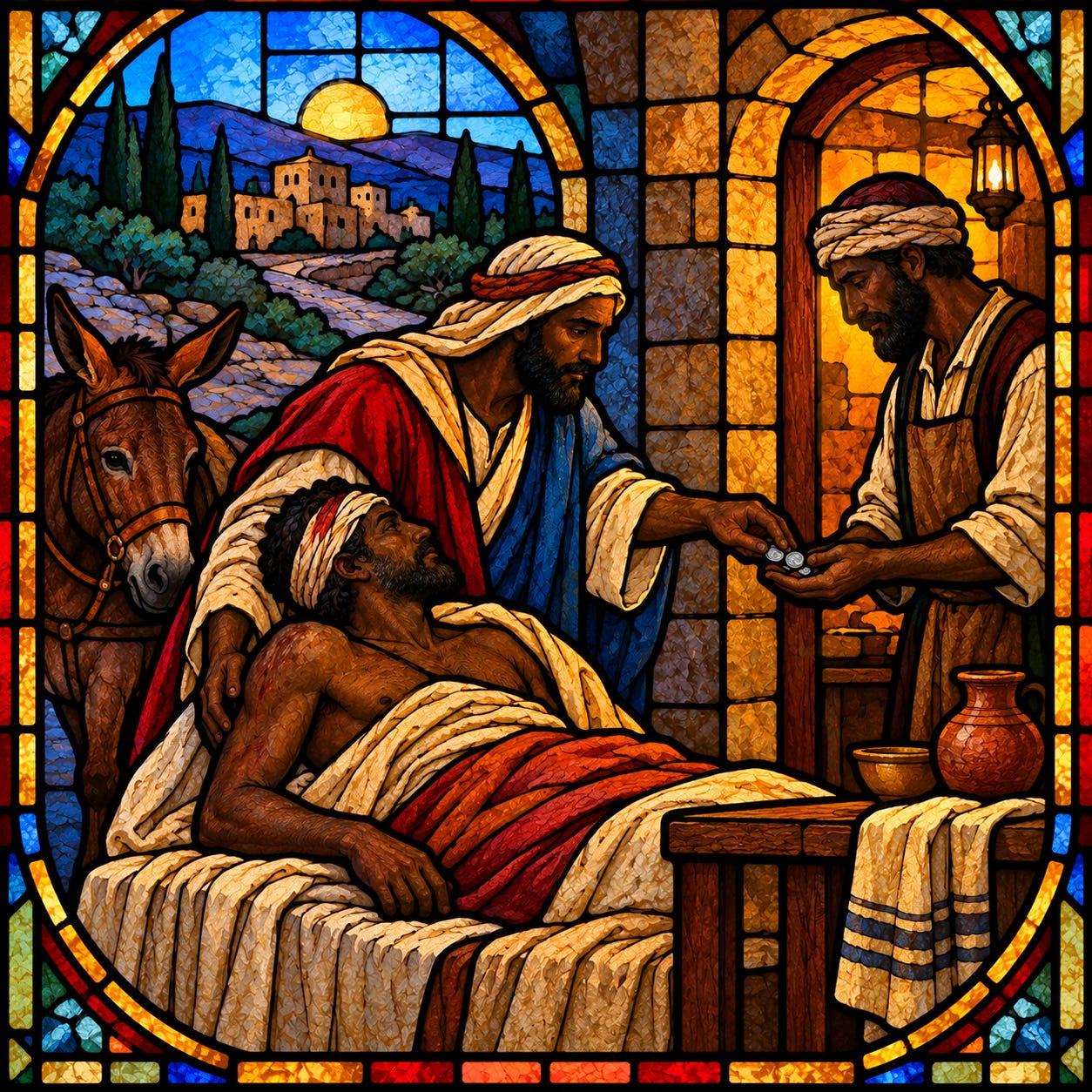
Most of us know the story of the Good Samaritan. Jesus tells of a traveler who is attacked by robbers, beaten, and left beside the road between Jerusalem and Jericho. A priest comes along and passes him. Then a Levite does the same. Finally, a Samaritan sees the wounded man and stops.
The Samaritan treats his wounds with oil and wine, helps him onto his animal, and brings him to an inn. He stays with him overnight. We’ve heard this story so often that we know its meaning before Jesus even finishes. We’re meant to be like the Samaritan, ready to pause our lives to help someone in need.
There’s someone else in this story we rarely notice. The next morning, the Samaritan departs. The injured traveler is still healing, so someone else must look after him. Meals need to be made, wounds cared for, bedding changed, and other needs met. The Samaritan gives the innkeeper two denarii, asks him to care for the man, and promises to cover any extra costs when he returns.
We know very little about the innkeeper. Jesus doesn’t mention his name, if he had a family, or what else he was responsible for. We also don’t know if the traveler recovered or how long he stayed at the inn. Still, the story shows that the Samaritan’s compassion went beyond the rescue itself. He understood that recovery would take someone else’s time and effort, so he made sure resources were provided for that care.
Today, October 29, is the United Nations’ International Day of Care and Support. It’s a time to recognize the huge amount of work that goes into caring for people, work that makes almost every other part of life possible.
All over the world, hundreds of millions of people work in the care economy. They look after children, older adults, people with disabilities, and those who are sick or healing from injuries. Many are nurses, home health aides, childcare workers, nursing assistants, domestic workers, and other professionals whose work is vital to their communities. Millions more care for others without pay, often while juggling jobs and their own responsibilities.
Much of this work is done by women, and much of it is still poorly paid or not recognized in the economy. The International Labor Organization has shown just how much paid and unpaid care work there is, and how tough the conditions can be for many caregivers.1 I wonder why we’ve gotten so used to relying on work that we often don’t value enough.
Think about what happens when someone comes home from the hospital. We celebrate the successful surgery, the skilled doctors, and the moment the patient is finally discharged. But recovery might take weeks or months of everyday care. Someone has to help with medications, make meals, change dressings, do laundry, arrange rides, and notice when something seems off.
Sometimes that person is a paid professional. Other times, it’s a spouse who is also aging, an adult child balancing a career, or a parent who has already spent years caring for others.
Caring for others can be deeply meaningful. But it can also be tiring, physically hard, and emotionally complex. Even people who love each other can feel overwhelmed by the daily work of keeping someone safe and comfortable. Paid caregivers might spend their careers protecting others’ dignity while struggling to pay for housing, healthcare, or childcare for their own families. It’s troubling when a society relies on this kind of work but leaves so many caregivers without enough support.
The part about the two denarii in Jesus’ story has started to feel more important to me. The Samaritan doesn’t expect the innkeeper to work for free just because he’s being compassionate. He gives money and promises to pay more if needed. The story doesn’t say if this was enough for all the care needed, and we shouldn’t judge it by today’s job standards. Still, Jesus makes it clear that caring for someone takes resources.
We often talk about compassion as something that comes from the heart. We admire people who are generous, patient, and willing to give up things for others. Those qualities matter a lot. But ongoing care also needs time, money, skill, physical strength, and chances to rest. If we praise caregivers without thinking about their working conditions, our gratitude can end up asking them to give even more.
I see this in congregational life as well. Churches depend upon an extraordinary amount of caregiving. Someone visits the hospital, prepares the funeral meal, organizes rides, remembers who has been absent, checks on an aging member, or makes sure the children are safe. Often, these acts of service are beautiful expressions of love and belonging.
But I’ve also seen churches where the same few people take on these jobs year after year. Their generosity becomes so reliable that others stop noticing how much they do. Over time, what started as a gift turns into an expectation. And when those caregivers get tired, they might feel guilty for needing help themselves.
I wonder how many communities would be different if we noticed the people who stay after everyone else has left.
This question goes far beyond churches or religious groups. Every society has to decide how care work will be shared, supported, and kept going. These choices affect pay, working conditions, family leave, healthcare, disability services, and how much time people have to care for their loved ones.
These choices also show how we think about human dignity. None of us goes through life completely on our own. We all start as babies who need care to survive. Many of us will face illness, disability, or aging that makes us depend on others. Even when we’re healthy, we rely on many people whose work makes daily life possible.
The innkeeper shows us that compassion needs to be organized so it lasts beyond the moment when we feel moved to help. I think about the people who have stood by me during hard times, and those who keep caring for people I love. Some have done things I never saw or fully understood. They’ve given hours of their lives that they can’t get back. I’m grateful for their kindness. But I’m also more aware that gratitude by itself isn’t enough.
Today, as we mark the International Day of Care and Support, maybe we should think about what it would look like to build communities where caregivers are cared for too.2 Where their work is respected, their needs matter, and the job of supporting vulnerable people doesn’t always fall on those least able to handle it.
The Samaritan stopped on the road. His compassion saved a wounded traveler from being left alone. But the story went on after he left, because someone else was willing to stay.
Jesus made sure we heard about that person too.
We are in this together,
Cameron
Reflection Questions
Who has provided the quiet, sustained care that made a difference in your life? What sacrifices might they have made that you did not fully recognize at the time?
Where do you see caregivers being expected to give more of themselves than is sustainable? How might our assumptions about love, service, or duty contribute to those expectations?
What would need to change in your family, congregation, workplace, or wider community for caregiving to become a responsibility that is genuinely shared and supported?
A Prayer for the Day
A Prayer For For Those Who Stay
Holy One,

We give thanks for those who remain beside us when the difficult work of healing begins, for the hands that prepare meals, tend wounds, offer comfort, and help us through the ordinary hours of our lives.

Remember those who care for others while carrying burdens of their own. Those who are exhausted, whose bodies ache, whose work goes unnoticed, and who wonder how much longer they can continue.

May they receive the care they so generously offer. May their labor be honored with fair compensation, adequate rest, and the support they need to live with dignity.

Teach us to recognize the people upon whom our lives depend, and give us the wisdom to build communities where care is shared rather than silently expected.

May no one be left to carry the work of love alone.

Amen.
Spiritual Practice: The Cost of Care
Find two coins and place them on a table in front of you. Remember the two denarii the Samaritan left with the innkeeper. They represented his recognition that caring for an injured stranger would require time, labor, and resources.
Hold the coins in your hands for a moment. Think about the people whose care makes your life possible. Some may be family members or friends. Others may be people you hardly know: the aide who helps an elderly neighbor get dressed, the childcare worker who spends her days nurturing children, or the person who cleans a hospital room after everyone else has gone home.
Now consider what their care costs them. Think about the hours they give, the demands placed upon their bodies, and the responsibilities waiting for them when their workday ends. Consider how often we depend upon their generosity without asking whether they have enough support themselves.
Place the coins back on the table and ask yourself: What am I willing to contribute so that the people who care for others can also live well?
Before the week ends, turn that question into one practical commitment. You might contribute to a respite-care fund, help a family share caregiving expenses, advocate for fair compensation, or take responsibility for a task that has fallen too heavily upon someone else.
Keep the coins somewhere visible for a few days as a reminder that compassion requires more than appreciation. The Samaritan understood that the innkeeper’s willingness to care deserved material support.
Love may inspire the work of care, but love should never become an excuse for expecting someone to do that work without the support they need.
Upcoming Events That Might Be of Interest…
My team and I launched a new experiment we are calling “The Commons.” It’s an online space centered around communities of practice: groups of people who share a common concern, set of problems, or passion for a topic, and deepen their knowledge and expertise by interacting on an ongoing basis. Join the community here.
November 3, 2026 - 12:30 - 1:30pm ET - ONLINE BOOK CLUB - I am hosting a book club where we are reading Fr. Gregory Boyle’s “Cherished Belonging: The Healing Power of Love in Divided Times.” Father Gregory Boyle, founder of Homeboy Industries, has spent decades building community among people whom society has often discarded. In Cherished Belonging, he draws on those relationships and stories to explore what might happen if we stopped sorting people into categories of worthy and unworthy, us and them. Don’t worry if you don’t have time to read the book. We always have incredibly rich conversations. All are welcome. Learn more here.
November 4, 2026 - 7-8:30pm ET, ONLINE EVENT - Theologian Matthew Fox and I are teaming up again in a series called Journeying with the Mystics. The mystics have always emerged in times of uncertainty. They appear when old certainties are crumbling, when institutions no longer provide easy answers, and when people find themselves longing for a deeper experience of the Sacred. Join us for a 24-session exploration of the teachings of St. John of the Cross, Thomas Merton, Hildegard of Bingen, Kabir and Rumi, Meister Eckhart and more. This is more than a lecture series. It is an invitation into a living spiritual journey. Learn more and REGISTER HERE!
November 10, 7-8:30pm ET - I’ll be joined by theologian, writer, and professor Dr. Debra Rienstra for a special ONLINE conversation on Refugia Faith. In ecology, refugia are small places where life survives amid disruption, pockets of resilience from which life can eventually regenerate and spread. Debra invites us to consider what this might mean spiritually in an age of climate instability, political turmoil, institutional decline, and profound uncertainty. What if our congregations, communities, relationships, and even our own lives could become refugia, places where courage, compassion, beauty, wisdom, and possibility are protected and cultivated for whatever comes next? I hope you’ll join us for this timely and deeply hopeful conversation. REGISTER HERE!
November 19, 2026, 7-8:45pm ET - I will be joining Jackie Sussman for an online session on practicing eidetics as part of our “Reclaiming the Power of Imagination” monthly series. Eidetic Imagery is a powerful tool for pastors, denominational leaders, coaches, and spiritual directors working with others, and for individuals seeking deeper integration and healing in their own lives. Jackie is a psychotherapist, author, and leading expert in Eidetic Image Psychology, and has spent over forty years helping leaders and individuals unlock creativity, uncover hidden strengths, and move through limiting patterns. During this session, she will lead a live Eidetic process shaped by mythic imagery, offering a direct experience of the work. REGISTER HERE.
December 8, 2026, 7-8:00pm ET - The holidays can be especially tender when we are carrying grief. Whether we are mourning someone we love, navigating changes in our health or relationships, or grieving the uncertainty of the world around us, this season can bring losses both old and new to the surface. Join us on The Commons for a special one-hour online gathering led by my friend Joy Gaertner, an Advanced Loss & Grief Recovery Specialist. Together, we will create a welcoming space to acknowledge our losses, honor what we carry through meaningful rituals of remembrance, and discover sources of hope for the season ahead. This will be a gentle evening of connection and care, with room for whatever grief you may be holding. The gathering is donation-based, and all are welcome. LEARN MORE HERE.
December 15, 7-8:30pm ET - FREE WEBINAR - I will be joined by Dr. Charissa Mikoski, Assistant Professor of Research and Hartford Institute for Religion Research for a presentation on “The State of American Congregations: What the Latest Data Tell Us.” This webinar explores findings from the 2025 Faith Communities Today survey, including changes in worship attendance, congregational vitality, finances, volunteering, programming, and leadership. It will also examine what more than 24,000 individual attenders tell us about participation and their experiences of congregational life. Together, these findings offer a picture that is neither simply one of decline nor one of revival, but of significant change and uneven recovery. REGISTER HERE.
Fun Things My Friends Are Up To…
I get to work with such amazing, creative people. This section is my way of celebrating them—no paid promotions, just joy in what they’re creating.
Happening NOW - The Ride 2026: Carrying the Legacy of the Freedom Riders Forward - Sixty-five years after the original Freedom Riders boarded buses to challenge segregation in the American South, a new generation is retracing their historic journey. My dear friend, Rev. Traci Blackmon, is joining Rev. Dr. Michael Waters, Pastor Doug Pagitt, original Freedom Riders and their descendants, and a remarkable coalition of faith and civil rights organizations for The Ride 2026. Traveling from Washington, D.C., to New Orleans, October 17–28, they are visiting historic civil rights sites, churches, and communities to honor the courage of those who came before us while encouraging civic participation and protecting voting rights today. At a time when so many Americans are worried about the future of our democracy, I am deeply grateful for these friends who are putting their faith into action. Please follow their extraordinary journey, celebrate their work, and consider supporting the effort.
Every Monday, 12pm ET - ONLINE WRITING GROUP - My dear friend, Meryl Marshall-Daniels, is leading a writing group open to all. This is a simple and spacious writing circle for people who want time to listen inwardly and put words on the page without overthinking, performing, or polishing. Meryl offers a prompt designed to invite reflection, imagination, and attunement to what is already alive within you. The practice honors writing as a way of listening, of letting images, memories, questions, and insights surface in their own time. Learn more here.
If you are a leader or member of a congregation looking for consulting support in visioning, planning, hiring or staffing, please consider Convergence.
https://www.ilo.org/sites/default/files/2024-10/Migrant%20Workers%20in%20the%20Care%20Economy_Note_2024_Final.pdf
https://www.ilo.org/resource/news/unpaid-care-work-prevents-708-million-women-participating-labour-market
Thank you, Rev. Cameron. Personally, this is my favorite parable in the Bible. As you know, just a couple of chapters back, the Samaritans refuse to let Jesus pass through their territory, prompting James and John -- a couple of thunder sticks -- to recommend nuking the whole village. Imagine their surprise when Jesu picks a Samaritan as the paragon of compassion! I love that! But you know what? After all the times I've read and prayed this parable, I've given scant thought to the innkeeper. But now I will, another layer of compassion to think about!