

“Do not neglect to show hospitality to strangers, for by doing that some have entertained angels without knowing it.” — Hebrews 13:2, NRSVUE
Rabbi Pinchas Shapiro of Koretz had a problem that some people might secretly wish for. People would not leave him alone.
Pinchas was an important Hasidic teacher in the eighteenth century, a disciple of the Baal Shem Tov, and a deeply thoughtful man. People came to him all the time. They wanted advice, asked for prayers and blessings, and brought him their problems.
The problem was that Pinchas wanted time to pray, to study, and to have some peace and quiet.
Eventually, as the Hasidic story goes, he became so frustrated by all the interruptions that he prayed and asked God to make people stop liking him. It seems God has a sense of humor, because the prayer worked. People stopped coming.
At last, Pinchas got what he wanted. There were no knocks at the door, no problems needing his attention, and no conversations taking up the hours he wanted to spend studying. He could focus on prayer and contemplation without anyone interrupting.
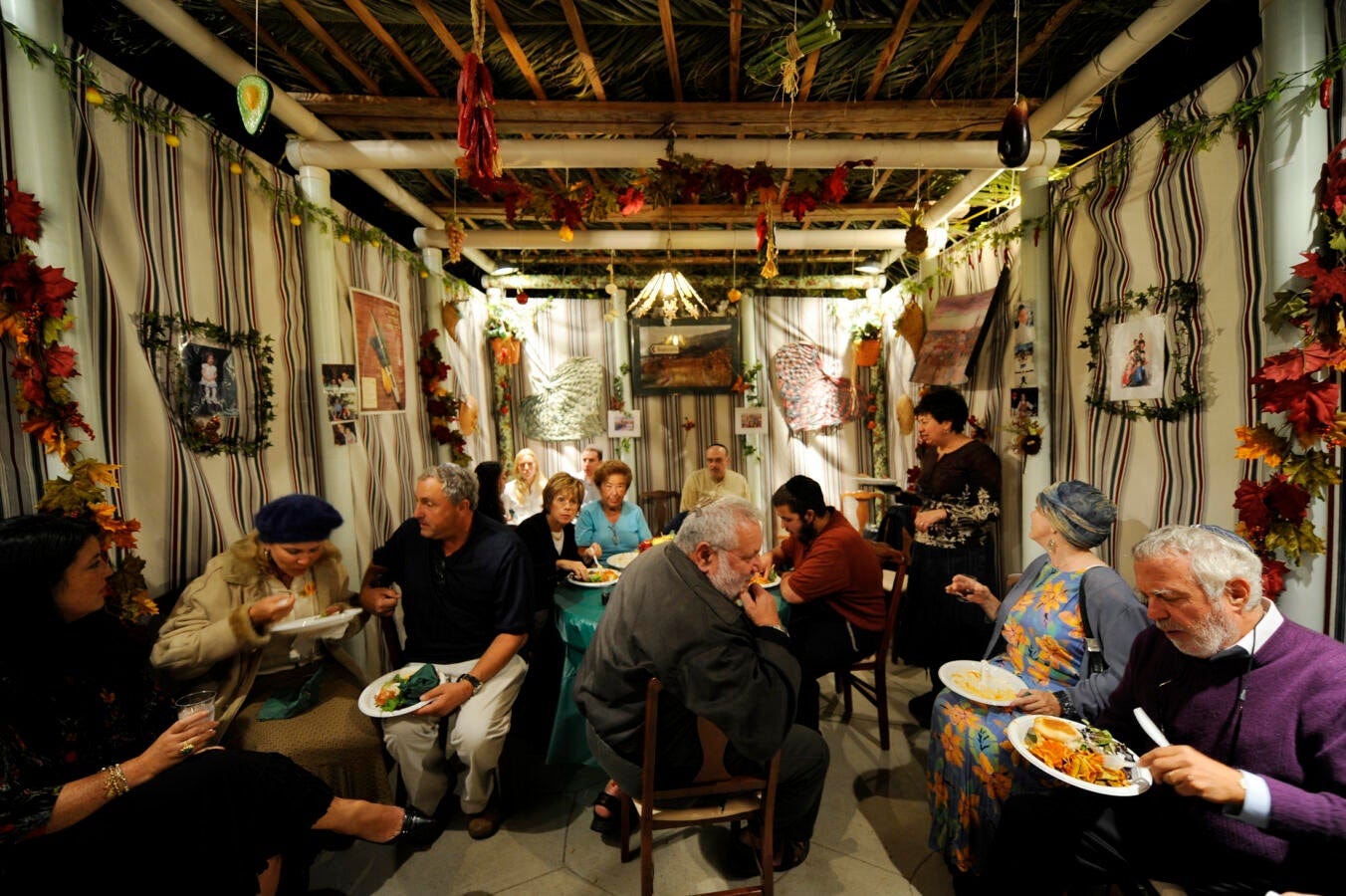
Then Sukkot arrived. Sukkot is a major Jewish festival (happening this week in the Jewish tradition),1 a harvest celebration when people build temporary shelters called sukkot. They eat, pray, celebrate, and welcome guests under these fragile roofs.
On the first night of the festival, Pinchas went to synagogue, hoping to find someone to invite home for dinner. No one wanted to join him. His prayer had worked too well. So Pinchas went back to his sukkah alone.
This is where the story becomes both strange and beautiful. In Jewish mystical tradition, there are the ushpizin, seven spiritual guests who are symbolically welcomed into the sukkah during the festival: Abraham, Isaac, Jacob, Moses, Aaron, Joseph, and David.2
On the first night, Abraham is welcomed. Pinchas began the traditional invitation, and Abraham appeared. But Abraham would not come inside. Pinchas was heartbroken and asked what he had done wrong.
The answer in the Hasidic story was simple. Abraham stands for chesed, or loving-kindness. In Genesis, he is known for his hospitality, sitting at his tent’s entrance and looking for strangers to welcome.3 Abraham would not sit at a table without guests.
I love this story because Pinchas finally created the perfect setting for spiritual practice, but God seemed to be waiting outside.
Sometimes I imagine how spiritually centered I could be if the world just stopped interrupting me. If the phone didn’t ring, emails didn’t arrive, nobody needed anything, the animals stayed healthy, the staff solved their own problems, and the news paused its crises for twenty minutes.
Then I could pray. Then I could meditate. Maybe then I could become truly compassionate.
Pinchas shows us the irony. Sometimes, the people who interrupt our spiritual lives are the sacred teachers.
The Zohar, which inspired the practice of ushpizin, teaches that welcoming spiritual guests into the sukkah should go hand in hand with generosity toward people who are poor. Hospitality in spirit alone is not enough.4
The great 12th-century Jewish rabbi and philosopher Maimonides was even more direct.5 When writing about the joy of Jewish festivals, he says that if someone eats and drinks only with their own family while shutting out strangers, orphans, widows, the poor, and the distressed, they are not truly practicing the joy of the commandment. He calls this only “the joy of the gut.” It seems spiritual teachers have been frustrated with exclusive dinner parties for a long time.
The lesson is clear. You cannot welcome the spirit of Abraham while turning away the people Abraham would welcome.
This does not mean that solitude is selfish. Pinchas needed time to reflect, and so do we. Every serious spiritual tradition understands that people sometimes need to step away from the noise to listen to what is happening inside.
Jesus went into the wilderness. The Buddha sat under the Bodhi tree. Muhammad withdrew to the cave of Hira. Jewish mystics practiced deep prayer and contemplation. Solitude can restore us, but its value is also seen in what happens when we come back.
If my prayer makes me less patient with the person at the door, something is wrong. If meditation makes me peaceful only until someone needs me, maybe I have just learned to be peaceful when no one interrupts me.
Sukkot gives us a beautiful example of another way. For a week, people leave the safety of their sturdy homes and live in shelters that are meant to be fragile. The walls are temporary, the roof lets in the natural world, and the line between inside and outside becomes thin. Then, people are invited in.
Maybe holiness needs walls that let things in. Boundaries are important. So are solitude and rest. We cannot be available to everyone all the time without running out of energy. But there is a difference between a boundary and a barricade.
Pinchas eventually realized what his perfect solitude had cost him. He prayed to have his old life back, and soon people started knocking again.
I imagine his prayer life became much less efficient. Maybe it also became more holy.
Sometimes a knock at the door is just an interruption. And sometimes, Abraham is waiting on the other side.
We are in this together,
Cameron
Reflection Questions
What interruptions in your life have you been treating as obstacles that might actually be invitations into relationship?
Does your spiritual practice make you more available, patient, and loving toward other people? What happens when your peace gets interrupted?
Where in your life do you need a healthy boundary, and where might a boundary have quietly become a barricade?
A Prayer for the Day
A Prayer For When Love Knocks
Holy Mystery,

Meet us in the quiet,
and meet us in the interruption.

Give us solitude that restores
rather than separates,
prayer that opens our hearts
rather than closes our doors.

When someone needs a place at the table,
make room in us.

When love arrives inconveniently,
help us recognize its face.

Keep our walls porous enough
for grace to enter
and our doors open enough
for someone else to follow.

May we discover the Sacred
in the silence we seek
and in the knock we did not expect.

Amen.
Spiritual Practice: Leave An Empty Chair
Put an empty chair somewhere you’ll see it today. If you have dinner at a table, leave one seat open on purpose.
Let this chair stand for someone you still have space for in your life.
Take your time before deciding who that person might be.
Maybe the chair is for someone you’ve been too busy to call. It could be for the neighbor you only wave to, someone new at your congregation, a colleague who seems lonely, or a friend going through a tough time.
The chair might even be for someone who has passed away. In Sukkot’s tradition of ushpizin, hospitality is wide enough to include those whose lives still touch ours across generations.
Take a moment with the empty chair and ask yourself, “Who have I made space for lately?”
Then turn the question into action. Invite someone for coffee. Make that call. Stay a bit longer after a meeting. Ask someone how they’re doing and give them time to answer honestly.
You don’t have to be available all the time. Pinchas needed solitude, and that was fine. The problem started when he made his spiritual life so private that no one else could join him.
At the end of your day, take another look at the chair. Maybe holiness is simply leaving some space for whoever might come.
Upcoming Events That Might Be of Interest…
My team and I launched a new experiment we are calling “The Commons.” It’s an online space centered around communities of practice: groups of people who share a common concern, set of problems, or passion for a topic, and deepen their knowledge and expertise by interacting on an ongoing basis. Join the community here.
September 29, 2026 - 12:30 - 1:30pm ET - FREE ONLINE BOOK CLUB - We are starting our next book in The Commons. For the next 5 weeks will we read Fr. Gregory Boyle’s, “Cherished Belonging: The Healing Power of Love in Divided Times.” Father Gregory Boyle, founder of Homeboy Industries, has spent decades building community among people whom society has often discarded. In Cherished Belonging, he draws on those relationships and stories to explore what might happen if we stopped sorting people into categories of worthy and unworthy, us and them. Don’t worry if you don’t have time to read the book. We always have incredibly rich conversations. All are welcome. RSVP Here.
October 6, 2026 - 7-8:30pm ET, ONLINE EVENT - Matthew Fox and I are teaming up again to launch a series called Journeying with the Mystics. The mystics have always emerged in times of uncertainty. They appear when old certainties are crumbling, when institutions no longer provide easy answers, and when people find themselves longing for a deeper experience of the Sacred. Join us for an 18-session exploration of the teachings of St. John of the Cross, Thomas Merton, Hildegard of Bingen, Kabir and Rumi, Meister Eckhart and more. This is more than a lecture series. It is an invitation into a living spiritual journey. REGISTER for the first session HERE!
October 15, 2026, 7-8:45pm ET - I will be joining Jackie Sussman for an online session on practicing eidetics as a part of our “Reclaiming the Power of Imagination” monthly series. Eidetic Imagery is a powerful tool for pastors, denominational leaders, coaches, and spiritual directors working with others, and for individuals seeking deeper integration and healing in their own lives. Jackie is a psychotherapist, author, and leading expert in Eidetic Image Psychology, and has spent over forty years helping leaders and individuals unlock creativity, uncover hidden strengths, and move through limiting patterns. During this session, she will lead a live Eidetic process shaped by mythic imagery, offering a direct experience of the work. REGISTER HERE.
October 18-21, 2026 - PREACH! 2026 Conference- I’ll be co-hosting PREACH in Minneapolis with Church Anew, a new gathering for preachers, storytellers, worship leaders, and spiritual communicators navigating what it means to speak with clarity, compassion, and courage in a changing world. If you’ve sensed that the preaching moment has changed and are longing for thoughtful community and renewed imagination for this work, I hope you’ll join us.
November 10, 7-8:30pm ET - I’ll be joined by theologian, writer, and professor Dr. Debra Rienstra for a special ONLINE conversation on Refugia Faith. In ecology, refugia are small places where life survives amid disruption, pockets of resilience from which life can eventually regenerate and spread. Debra invites us to consider what this might mean spiritually in an age of climate instability, political turmoil, institutional decline, and profound uncertainty. What if our congregations, communities, relationships, and even our own lives could become refugia, places where courage, compassion, beauty, wisdom, and possibility are protected and cultivated for whatever comes next? I hope you’ll join us for this timely and deeply hopeful conversation. REGISTER HERE!
December 15, 7-8:30pm ET - FREE WEBINAR - I will be joined by Dr. Charissa Mikoski, Assistant Professor of Research and Hartford Institute for Religion Research for a presentation on “The State of American Congregations: What the Latest Data Tell Us.” This webinar explores findings from the 2025 Faith Communities Today survey, including changes in worship attendance, congregational vitality, finances, volunteering, programming, and leadership. It will also examine what more than 24,000 individual attenders tell us about participation and their experiences of congregational life. Together, these findings offer a picture that is neither simply one of decline nor one of revival, but of significant change and uneven recovery. REGISTER HERE.
Fun Things My Friends Are Up To…
I get to work with such amazing, creative people. This section is my way of celebrating them—no paid promotions, just joy in what they’re creating.
The Convergence Music Project has scheduled the fall conference on October 7-10, 2026 in Louisville, Kentucky. We will sing new community songs created specifically for this time in our history and explore together how the songs we sing in worship (and beyond) can empower and encourage us as we live out the biblical call to “do justice, love kindness, and walk humbly with our God.” Learn more here.
Every Monday, 12pm ET - ONLINE WRITING GROUP - My dear friend, Meryl Marshall-Daniels, is leading a writing group open to all. This is a simple and spacious writing circle for people who want time to listen inwardly and put words on the page without overthinking, performing, or polishing. Meryl offers a prompt designed to invite reflection, imagination, and attunement to what is already alive within you. The practice honors writing as a way of listening, of letting images, memories, questions, and insights surface in their own time. Learn more here.
If you are a leader or member of a congregation looking for consulting support in visioning, planning, hiring or staffing, please consider Convergence.
https://www.myjewishlearning.com/article/sukkot-101/
https://www.sefaria.org/Zohar.3.103b
Genesis 18:1–8
https://www.sefaria.org/Zohar.3.103b
Maimonides, Mishneh Torah, Hilchot Yom Tov 6:18: https://www.sefaria.org/Mishneh_Torah%2C_Rest_on_a_Holiday.6.18
Oh, Rev. Cameron! This is all so beautiful, so necessary, and so true. Saint Benedict in his Rule urges us to treat all visitors as if they were Christ. Easier said than done, of course, but that's where prayer comes in. We pray to become patient, kind, gentle, compassionate, and joyful -- the fruits of the Spirit. At funeral services, sometimes we need to laugh so that we can cry. In our spiritual life, sometimes we need solitude to love the multitude. Amen!