

“Listen; your brother’s blood is crying out to me from the ground!” — Genesis 4:10, NRSVUE
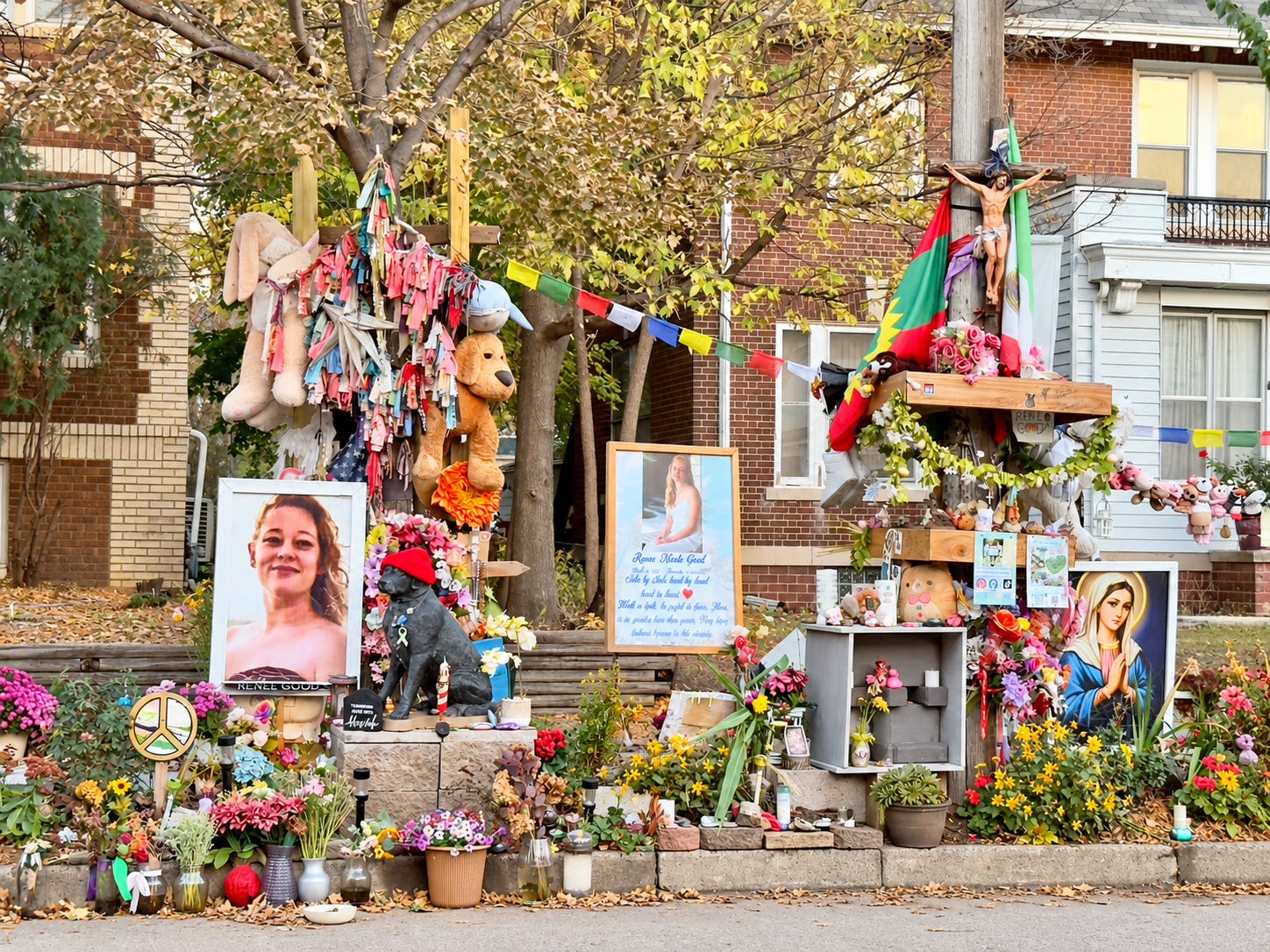
Yesterday, I stood where Renée Good was murdered.1 People had left photos, flowers, handwritten notes, and small tokens to honor her memory. It was just a regular street in Minneapolis, the kind people drive every day to work or school. Now, though, it is also a place marked by her violent death, where the community gathers because her absence is now part of their lives.
After that, I went less than two miles to where Alex Pretti was killed.2 There was another memorial, another ordinary street turned into a special place because an innocent man died there. I stood there for a while, trying to take it all in.
I have been to places like these before. On a previous trip to Minneapolis, I visited the spot where George Floyd died under a police officer’s knee. In Ferguson, Missouri, I stood where Michael Brown was shot by a police officer.
I never intended to make a pilgrimage to places where people have been killed by those entrusted with the authority of the state. Yet somehow, over the years, I have found myself standing in one after another.
I am becoming deeply weary of this terrible geography. I am tired of seeing regular streets turned into memorials. I am tired of meeting people whose lives have been changed forever by violence. It saddens me to know I will likely visit more places like this in the future.
Something is deeply wrong in a society that keeps making new locations for this kind of grief.
This week, I have listened to people in Minneapolis talk about what they are going through during the federal immigration raids. They shared stories of neighbors too scared to leave their homes, children learning to recognize the sound of warning whistles, and families planning their lives around the fear that someone they love could be taken away.
I have also heard amazing stories of courage. People who never saw themselves as activists started delivering groceries, going with neighbors to appointments, recording encounters with federal agents, and building support networks. They found a sense of solidarity they didn’t know they had. Their courage inspires me, though I wish they had never needed to find it in these situations.
I keep thinking of the words “war zone,” even though these are neighborhoods where people should be living safe lives. Children should be riding their bikes. Families should be out walking their dogs. People should go to work without worrying if they will make it home. Instead, some of these streets have become places where neighbors come together to grieve.
The Hebrew scriptures tell an old story that feels especially fitting here. In Genesis, Cain kills his brother Abel. When God confronts Cain, he asks: “Where is your brother Abel?”
Cain replies, “Am I my brother’s keeper?”
God then says something remarkable: “Listen; your brother’s blood is crying out to me from the ground.” In this story, the earth itself becomes a witness.
Abel’s life was taken, but the violence did not end with him. Something lingers in the place where he died, asking to be recognized.
I thought about this today as I stood at those memorials. The people caring for them are doing something timeless. They refuse to let a place of death fade into anonymity. They leave reminders because love needs a place to go when the person is gone. Maybe they come back because it feels like the ground itself asks someone to bear witness.
There is another part of Cain’s story that bothers me. God’s question is aimed at the one who did the harm, but it also speaks to all of us, even now.
Where is your brother? Where is your sister? What responsibility do you have for people whose lives are at risk because of the power others hold over them?
I have been thinking about these questions as I meet people in Minneapolis who have organized to protect their neighbors. They are answering Cain’s question through their actions. They have become their neighbors’ keepers, sometimes risking their own safety. They refuse to believe that someone else’s suffering is not their problem.
There is something both beautiful and heartbreaking about this. I wish we lived in a world where this kind of courage was not needed. I wish children could blow whistles just for fun. I wish people could walk their streets without fear. I wish the places where I have mourned were remembered for the lives lived there, not for the violence that ended them. But wishing cannot change what has already happened.
I do not know how many more places like this I will visit in my life. I hope there will be none. But I worry that somewhere, right now, another family is living an ordinary day that will soon become their worst. Another neighborhood will become a place of mourning. Another community will have to come together around a loss that should never have happened.
I am thankful for the courage I have seen in Minneapolis. I have met people whose love for their neighbors is both strong and practical, people willing to risk their own safety to protect others. Their courage gives me hope, even though I cannot forget what it has cost them.
I keep thinking about the words from Genesis, about Abel’s blood crying out from the ground. That old story recognizes that violence leaves something behind that cannot be buried or forgotten. The ground becomes a witness to what happened, and those who are still here must decide how to respond to that knowledge.
Today, I stood on two more spots that hold these memories. I felt the sadness of lives cut short and the tiredness that comes from knowing how many places like this already exist. I thought about the people who will come in the days ahead, bringing their grief to these same streets.
I want to live in a country where the places we visit to remember each other are places where people lived good, ordinary lives, not places where those lives were taken by violence.
I want us to stop turning the places where we harm each other into sacred ground.
We are in this together,
Cameron
Reflection Questions
Have you ever stood in a place where violence or tragedy occurred and felt the weight of what happened there? How did being physically present change your understanding?
What have you learned from people who have responded to violence or injustice by organizing to protect and care for their neighbors?
How do we remain open to grief and moral responsibility when repeated exposure to violence leaves us exhausted? What helps you resist becoming numb?
A Prayer for the Day
A Prayer: The Ground Remembers
Holy One,

You hear the blood
that cries out from the earth,
the grief that lingers
where a life was taken.

Receive all whose lives
were ended by violence.

Hold their families
in the tenderness of your love,
and comfort the communities
who carry their absence.

Give courage to those
who stand beside the vulnerable,
and protection to those
who risk themselves for others.

Do not let our weariness
become indifference,
or our grief harden into despair.

Teach us to cherish the living
with the same devotion
we bring to remembering the dead.

May the streets of our cities
become places of belonging again,
where children can play without fear
and neighbors can live in peace.

Amen.
Spiritual Practice: A Place Worth Remembering
Today, find a place that holds meaning for you because of someone who lived there. It might be a childhood home, a park where you spent time with someone you loved, a neighborhood where you formed important friendships, or a place where you experienced kindness that changed your life.
If possible, visit that place. Otherwise, sit quietly and bring it to mind.
Remember the ordinary life that unfolded there. Think about the conversations, laughter, meals, friendships, and small acts of care that gave the place its meaning.
Now consider the memorials in Minneapolis and the communities that continue tending them. Those memorials exist because people are trying to preserve the memory of lives that mattered far beyond the circumstances of their deaths.
Spend a few moments remembering someone whose life has made your world more humane. Let your gratitude for that person deepen your awareness of the lives around you now.
Before the day ends, offer one concrete act of care to someone in your community. Check on a neighbor, spend time with someone who feels isolated, or offer practical support to a person facing uncertainty.
The practice is to honor the dead by becoming more attentive to the living.
Upcoming Events That Might Be of Interest…
My team and I launched a new experiment we are calling “The Commons.” It’s an online space centered around communities of practice: groups of people who share a common concern, set of problems, or passion for a topic, and deepen their knowledge and expertise by interacting on an ongoing basis. Join the community here.
October 27, 2026 - 12:30 - 1:30pm ET - ONLINE BOOK CLUB - I am hosting a book club where we are reading Fr. Gregory Boyle’s “Cherished Belonging: The Healing Power of Love in Divided Times.” Father Gregory Boyle, founder of Homeboy Industries, has spent decades building community among people whom society has often discarded. In Cherished Belonging, he draws on those relationships and stories to explore what might happen if we stopped sorting people into categories of worthy and unworthy, us and them. Don’t worry if you don’t have time to read the book. We always have incredibly rich conversations. All are welcome. RSVP Here.
November 4, 2026 - 7-8:30pm ET, ONLINE EVENT - Theologian Matthew Fox and I are teaming up again in a series called Journeying with the Mystics. The mystics have always emerged in times of uncertainty. They appear when old certainties are crumbling, when institutions no longer provide easy answers, and when people find themselves longing for a deeper experience of the Sacred. Join us for a 24-session exploration of the teachings of St. John of the Cross, Thomas Merton, Hildegard of Bingen, Kabir and Rumi, Meister Eckhart and more. This is more than a lecture series. It is an invitation into a living spiritual journey. Learn more and REGISTER HERE!
November 10, 7-8:30pm ET - I’ll be joined by theologian, writer, and professor Dr. Debra Rienstra for a special ONLINE conversation on Refugia Faith. In ecology, refugia are small places where life survives amid disruption, pockets of resilience from which life can eventually regenerate and spread. Debra invites us to consider what this might mean spiritually in an age of climate instability, political turmoil, institutional decline, and profound uncertainty. What if our congregations, communities, relationships, and even our own lives could become refugia, places where courage, compassion, beauty, wisdom, and possibility are protected and cultivated for whatever comes next? I hope you’ll join us for this timely and deeply hopeful conversation. REGISTER HERE!
November 19, 2026, 7-8:45pm ET - I will be joining Jackie Sussman for an online session on practicing eidetics as part of our “Reclaiming the Power of Imagination” monthly series. Eidetic Imagery is a powerful tool for pastors, denominational leaders, coaches, and spiritual directors working with others, and for individuals seeking deeper integration and healing in their own lives. Jackie is a psychotherapist, author, and leading expert in Eidetic Image Psychology, and has spent over forty years helping leaders and individuals unlock creativity, uncover hidden strengths, and move through limiting patterns. During this session, she will lead a live Eidetic process shaped by mythic imagery, offering a direct experience of the work. REGISTER HERE.
December 15, 7-8:30pm ET - FREE WEBINAR - I will be joined by Dr. Charissa Mikoski, Assistant Professor of Research and Hartford Institute for Religion Research for a presentation on “The State of American Congregations: What the Latest Data Tell Us.” This webinar explores findings from the 2025 Faith Communities Today survey, including changes in worship attendance, congregational vitality, finances, volunteering, programming, and leadership. It will also examine what more than 24,000 individual attenders tell us about participation and their experiences of congregational life. Together, these findings offer a picture that is neither simply one of decline nor one of revival, but of significant change and uneven recovery. REGISTER HERE.
Fun Things My Friends Are Up To…
I get to work with such amazing, creative people. This section is my way of celebrating them—no paid promotions, just joy in what they’re creating.
Every Monday, 12pm ET - ONLINE WRITING GROUP - My dear friend, Meryl Marshall-Daniels, is leading a writing group open to all. This is a simple and spacious writing circle for people who want time to listen inwardly and put words on the page without overthinking, performing, or polishing. Meryl offers a prompt designed to invite reflection, imagination, and attunement to what is already alive within you. The practice honors writing as a way of listening, of letting images, memories, questions, and insights surface in their own time. Learn more here.
If you are a leader or member of a congregation looking for consulting support in visioning, planning, hiring or staffing, please consider Convergence.
https://www.fox9.com/news/minneapolis-ice-shooting-renee-goods-death-homicide-hennepin-medical-examiner-jan-23
https://19thnews.org/2026/01/alex-pretti-minneapolis-ice-shooting/
I hear you, and such was our experience in South Africa in the darkest days of the the death throes of apartheid. So many places cried out from the violence and pain that the ground held. The Celtic view is that we can bless the ground where pain is held, and banish captive spirits, heal the place, and make it a sacred space where the veil between here and hereafter thins for those coming after. It is well worth organising walks for peace around those areas, and in the spots where the violence happened, with prayers and healing rituals used. The Celts had CAIM or circling prayers, and I am sure in your part of the world that you can draw on first nation input on that kind of thing. In Europe, some of the pain goes back centuries, but can still be healed. I was personally involved in some of this work in places in France where horrrible things happened, some even in church buildings, and the sensed spiritual darkness lingering, could be freed up and released, and the area cleansed. Blessings on your work, dear Cameron. 🙏
While reading your essays of the last two days, I realize how similar the chronic Black American experience is to that of the current immigrant experience. I am a white male who has lived a life filled with successes and rewards at most every turn. However, I have a Black male friend from college who struggled through his childhood and adult life because of racism and it’s its associated fears despite his obvious talents and remarkable courage. Injustice and its effects are ever present in our society and world. We would do well to allow ourselves to “see” the obvious and respond with compassion and courage.