

“Do not repay anyone evil for evil, but take thought for what is noble in the sight of all.… Do not be overcome by evil, but overcome evil with good.” —Romans 12:17, 21
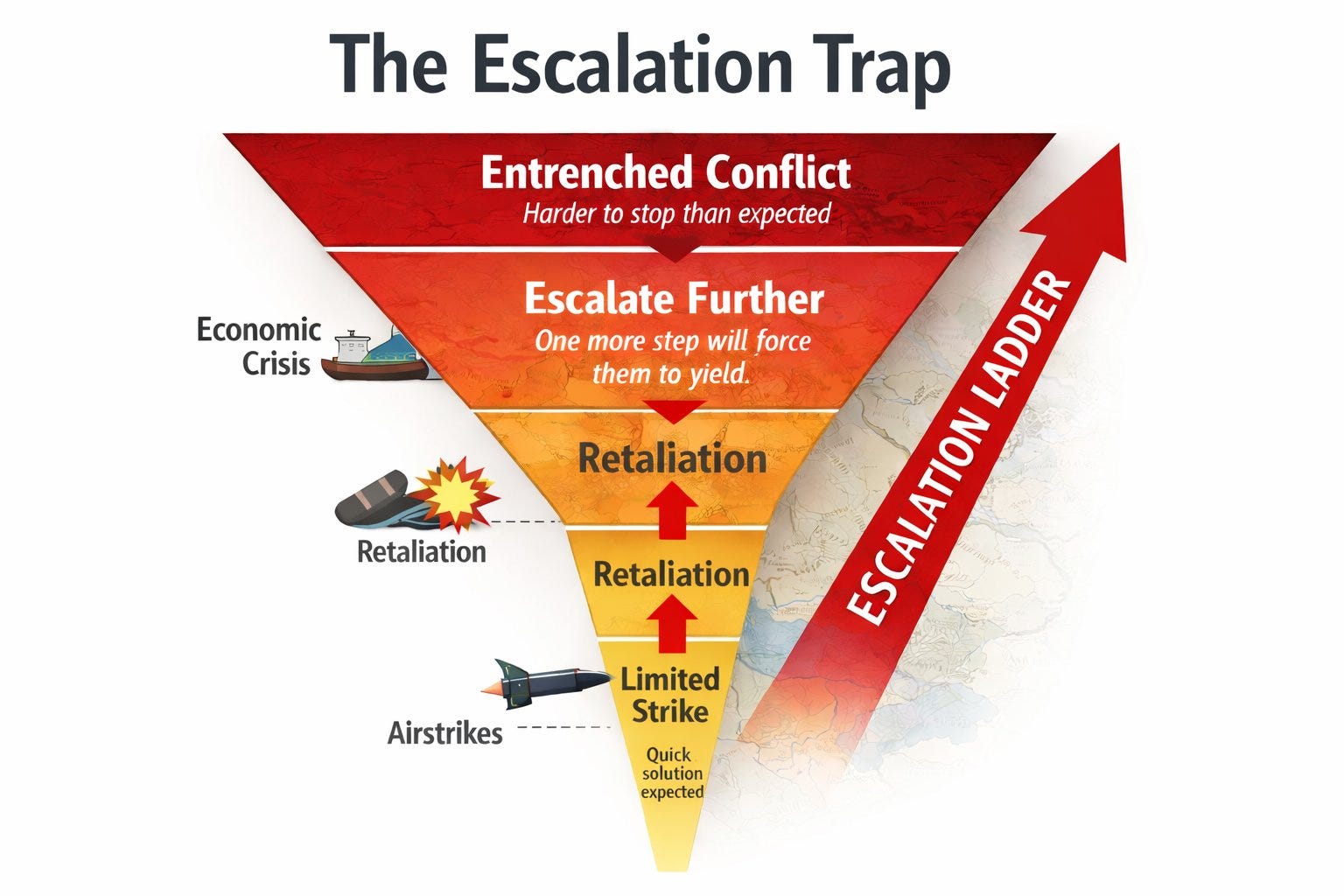
I have long paid attention to Robert Pape, a political scientist at the University of Chicago who has spent years studying air power, terrorism, and modern warfare. In his latest comments on Iran (link below),1 he said the United States was caught in an “escalation trap.”
Most of us already understand what this phrase means. The current war began on February 28, when the United States and Israel launched strikes across Iran. Iran responded by attacking Israel and U.S.-allied Gulf states. Since then, bombings and retaliation have spread across the region, hitting civilian areas and key infrastructure. Millions of people have been forced to leave their homes.
The Strait of Hormuz has now become one of the main areas of confrontation in the conflict. About one in every five parts of the world’s oil supply normally goes through that narrow strait. Traffic involving tankers has at times been brought to a halt. Merchant ships have been the target of attacks. Insurance rates and the prices of energy have gone up. Each disruption spreads out via higher prices for petrol, food, fertilizer, electricity and transport. The impact now reaches people who are a long way from the Persian Gulf, in particular those who are already in a vulnerable position. The Dallas Federal Reserve Bank calculated that a prolonged closure resulting in the removal of nearly 20 percent of global oil supplies could cause a sharp increase in oil prices and lead to a decrease in global economic growth. It seems we are nearly there.
The United States and Iran are at this time holding back some of their attacks as they once again attempt to reopen the Strait and avoid another phase of hostilities. This pause is important but is also fragile. Both governments still threaten to carry out renewed military operations. Each side thinks that increased pressure might eventually persuade the other to give in. Every act of coercion is then used as a reason for another.
A “forever war” starts like this.
It almost never starts with leaders declaring that they intend to fight forever; instead, it starts with guarantees that the aims will be limited, the targets exact, and the time frame short. After that, the first strategy fails to achieve the result it had promised. The act of retaliating brings about fresh threats. These new threats in turn call for new deployments. And with casualties come pressures to show that the losses had not been wasted. Leaders who earlier had promised to exercise restraint then fear that showing restraint would appear to be weak.
The original question—’What are we trying to accomplish?’—eventually disappears and is replaced by another: ‘After what they did to us, how can we possibly stop now?’
That is the situation which Pape outlines. That is the trap.
Tactical missions can succeed even if the overall strategy fails. Bombs hit their targets, ships are stopped, and military sites are destroyed. Still, each of these successes pulls the countries deeper into a conflict that neither can control. The war then creates its own goals, political motives, and reasons to keep going.
The theologian Walter Wink referred to these forces as “the Powers”.2 Although humans set up institutions and systems, over time these acquire their own spirit. They influence the moral imagination of the people within them by telling them which choices are realistic, which losses are acceptable and which futures are impossible.
Violence is one of these powers; we can choose to use it once, but if we continue to supply it with fuel, then violence will start to make choices on our behalf.
Philosopher René Girard also observed the same pattern in humans’ tendency to imitate and retaliate.3 Desire spreads through imitation just as aggression does. One side attacks because the other has done so first. Each of them considers itself to be in reply rather than the one who started it. Each views its own violence as necessary and the other’s as evidence of evil. The cycle can go on for many generations since every individual has a wound which seems to give them permission.
We can see this pattern at work in our own lives: when someone says a harsh thing, another harsh response follows. Once a betrayal has taken place, it gives others the right to betray us as well. If someone hurts us, we start to plan the future in light of that injury. Eventually, we cease to wonder what might heal the situation and instead ask what would be considered fair. The injury then becomes the focal point of the relationship.
The Apostle Paul realized how great this danger was. “Do not let evil overcome you,” he said, “but respond to evil with good.”4
He was addressing those who lived under an empire kept going by violence. His remarks were not a sentimental plea meant to win people over; rather, he was cautioning them that resistance to evil can take on the form of another kind of captivity if evil shapes the nature of our response.
This is the spiritual struggle we now face. Can we express our sorrow about what has occurred without giving up the future to resentment? Can we seek justice without letting vengeance determine it? Can political leaders, after having invested so much power and national pride in moving towards it, retreat from the edge? Can ordinary citizens resist the idea that to question escalation is to show weakness?
It takes courage to break off the current course of action. One person has to bear the political consequences of coming to a halt. One person has to picture a future that goes beyond the next military reply. One person has to recall that restraint is still an option, even if retaliation seems certain.
It is relevant for nations, for congregations and for families; it is relevant for every human heart which carries an old injury over into a new day.
Violence restricts the future until a retaliatory response seems certain.
Love expands the future so that another option becomes conceivable.
Each generation receives from earlier times unfinished tales of fear, revenge, and resentment. We are not given the injuries that we inherit, but we do decide whether or not those injuries will go on to write the next chapter.
It seems we have some discernment work to do.
We are in this together,
Cameron
Reflection Questions
Where has retaliation begun to feel inevitable in your life?
What wound or grievance has started organizing your imagination?
What would it mean to interrupt the momentum before it chooses for you?
A Prayer for the Day
A Prayer For Life Beyond Escalation
God of mercy, we pray for the people of Iran, Israel, and every nation now living beneath the shadow of this war. Protect those in danger. Comfort those who grieve. Strengthen those caring for the wounded, the displaced, and the afraid.

Give courage to political leaders who can step back from escalation. Free them from pride, vengeance, and the fear of appearing weak. Restore their capacity to imagine a future beyond the next strike.

Show us where violence has entered our own hearts. Help us recognize the moment when pain becomes permission to cause more pain. Guard our moral imagination. Teach us the difficult courage of restraint, repair, and peace.

Amen.
Spiritual Practice
Today, notice one conflict in which you are rehearsing your next response. Before you send the message, make the accusation, or strengthen the grievance, pause.
Ask yourself: “Am I choosing this response freely, or has the injury begun choosing for me?”
Take one action that interrupts the momentum. You might wait before responding, tell the truth without accusation, acknowledge your own part, or pray for the humanity of the person you have made into an enemy.
Leave room for a future that yesterday’s wound could not imagine.
Upcoming Events That Might Be of Interest…
My team and I launched a new experiment we are calling “The Commons.” It’s an online space centered around communities of practice: groups of people who share a common concern, set of problems, or passion for a topic, and deepen their knowledge and expertise by interacting on an ongoing basis. Join the community here.
July 28 - September 1, 2026, 12:30-1:30pmET - Book Club in The Commons - FREE - We are reading our next book, “I Eat The Stars” by Sarah Wilson. We will meet each Tuesday for 6 weeks. It’s such great fun. I hope you will be a part. All are welcome! RSVP HERE.
August 6, 2026, 7-8pm ET - FREE EVENT - Join me in conversation with Rev. Natalia Terfa about her new book, “It All Counts: Finding God Beyond the Boundaries.” What if the moments you’ve been taught don’t “count” spiritually are actually where God is waiting to be found? Many of us were handed a version of faith that divided life into sacred and secular, holy and ordinary, faithful and doubtful. But what if those boundaries were never real? Whether you’ve left church, stayed in it, or find yourself somewhere in between, this conversation will offer fresh language for a faith that is expansive, embodied, and deeply human. REGISTER HERE.
September 8, 2026, 7-9pm ET, ONLINE EVENT - I’ll be hosting a powerful online gathering on The Black Madonna: Sacred Wisdom for a World in Crisis with Matthew Fox, Alessandra Belloni, and Christena Cleveland. We will explore the Black Madonna as a symbol of resilience, liberation, sacred feminine wisdom, and healing in a fractured world through conversation, story, music, and spiritual reflection. If you feel drawn toward a deeper encounter with the Divine Feminine and the ancient traditions that continue to nourish movements for justice and wholeness, I hope you’ll join us. Learn more and REGISTER HERE.
October 6, 2026 - 7-8:30pm ET, ONLINE EVENT - Matthew Fox and I are teaming up again to launch a series called Journeying with the Mystics. The mystics have always emerged in times of uncertainty. They appear when old certainties are crumbling, when institutions no longer provide easy answers, and when people find themselves longing for a deeper experience of the Sacred. Join us for an 18-session exploration of the teachings of St. John of the Cross, Thomas Merton, Hildegard of Bingen, Kabir and Rumi, Meister Eckhart and more. This is more than a lecture series. It is an invitation into a living spiritual journey. REGISTRATION COMING SOON!
October 18-21, 2026 - PREACH! 2026 Conference- I’ll be co-hosting PREACH in Minneapolis with Church Anew, a new gathering for preachers, storytellers, worship leaders, and spiritual communicators navigating what it means to speak with clarity, compassion, and courage in a changing world. If you’ve sensed that the preaching moment has changed and are longing for thoughtful community and renewed imagination for this work, I hope you’ll join us.
I drafted a Strategic Framework for Congregations as we move into the coming years of increased authoritarianism around the world. If interested, you can download it here.
Fun Things My Friends Are Up To…
I get to work with such amazing, creative people. This section is my way of celebrating them—no paid promotions, just joy in what they’re creating.
Dr. Timothy Snyder, the author of On Tyranny, has publicly released the first lecture of a ten-lecture course he taught at the University of Toronto this past year. The course is called “Hitler and Stalin Today.” He is offering this as a public resource for students, researchers, and anyone interested in understanding the relationship between history and contemporary democracy. Follow his posts here or watch on YouTube.
July 29, 2026, 12pm ET - ONLINE WRITING GROUP - My dear friend, Meryl Marshall-Daniels, is leading a writing group open to all. This is a simple and spacious writing circle for people who want time to listen inwardly and put words on the page without overthinking, performing, or polishing. Meryl offers a prompt designed to invite reflection, imagination, and attunement to what is already alive within you. The practice honors writing as a way of listening, of letting images, memories, questions, and insights surface in their own time. Learn more here.
My friends over at Spiritual Wanderlust have some of the coolest classes. One I am particularly drawn to is their Celtic Spirituality School where you get to learn from people like John Philip Newell, Ilia Delio, Carl McColman, Sharon Blackie, and more. Read more about their program.
If you are a leader or member of a congregation looking for consulting support in visioning, planning, hiring or staffing, please consider Convergence.
Walter Wink, The Powers That Be: Theology for a New Millennium (New York: Doubleday, 1998)
René Girard, Battling to the End: Conversations with Benoît Chantre, trans. Mary Baker (East Lansing: Michigan State University Press, 2009)
Romans 12:17, 21 (NRSVUE)
Unfortunately, this will continue, at least, as long as Trump is president. The world is moving on and by passing the United States, however, until America and the world deal with this cancer, the disease will get worse. And just getting rid of Trump won’t solve the problem……
Thank you for this powerful piece. May we all look toward love so our options open up and life is honored