

“Lord, make me an instrument of your peace.” — Francis of Assisi
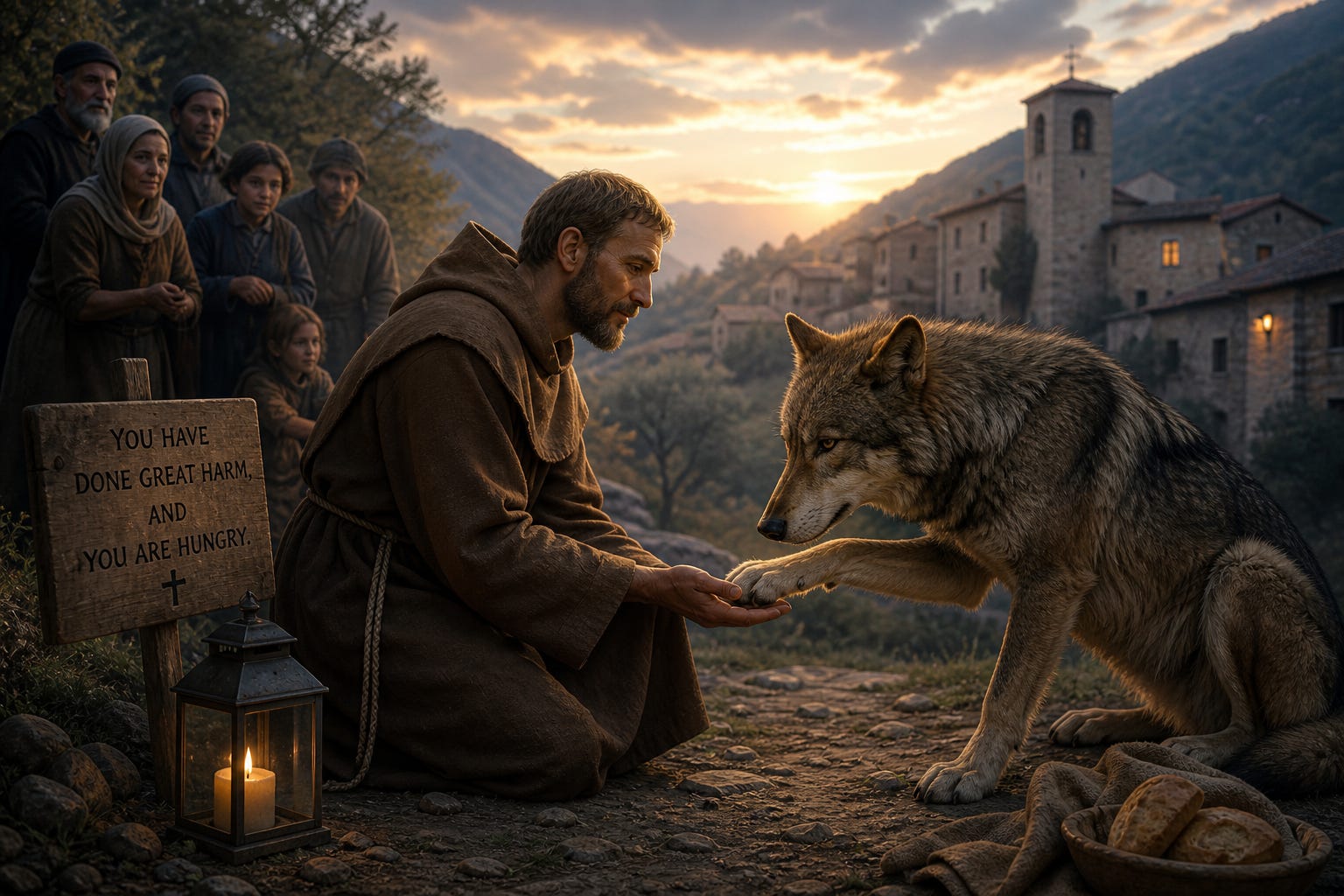
There is a story told about St. Francis of Assisi…
A wolf began coming down from the hills into the small Italian town of Gubbio. At first, it took animals, but soon it started attacking people. People stopped going out. The roads were empty, doors stayed shut, and parents kept their children close. The town shrank into fear.
The people thought they knew what to do. The wolf had to be killed. That is how these stories usually end: find the threat, get rid of it, and bring back order.
But Francis… Francis didn’t follow the script.
One morning, while the town was still lost in fear, Francis walked past the last house, through the fields, and into the hills where the wolf was said to be. He carried no weapon, wore no armor. He just brought himself.
When the wolf came closer, Francis could see it clearly. Its ribs stuck out under its skin. Its teeth were bared. Its body showed both danger and anguish. There was no doubt about what could happen next.
Francis didn’t run. Instead, he spoke. He called it “Brother Wolf.” And then he said what was true but being ignored by everyone else:
“You have done great harm,” he said to the wolf, “and you are hungry.”
Francis didn’t deny or excuse the violence, but he didn’t not stop there. He looked deeper to see what is behind it.
Then Francis goes back to the town and tells them what they do not want to hear. If the wolf is starving, they are part of the problem too. If they want the violence to stop, they must change how they relate to what they fear. They will have to feed the wolf.
The story says, upon hearing Francis’ words, the wolf lowered its head. It placed its paw in Francis’ hand. A covenant was made between the townspeople and the wolf, and for the remaining lifetime of the wolf, they lived in peace.1
I do not know if this happened. But I recognize the world it describes.
Today, something has entered the center of our lives, much like the wolf. We see it in our politics, in public life, and in how we talk to each other. It appears as justified anger, constant fear, systems that hurt the vulnerable, and leaders who make it worse.
We already know how to react to this. We are being taught to respond this way. We name the enemy, use harsher words, pick a side, and get ready to fight.
There are moments when resistance is necessary. There are moments when harm must be named clearly and confronted without hesitation. The story does not ask us to pretend otherwise.
But it does ask something more difficult.
First, it asks us to see clearly. It ask us to see past the caricatures, the slogans, the easiest version of our opponents to dismiss, to the deeper forces at work: fear, dislocation, economic anxiety, loss of identity, perceived cultural erasure. These are not excuses for harmful policies or rhetoric, but they are part of the ecosystem that fuels them. If we ignore that, we will keep fighting symptoms and miss the source.
Second, “feeding the wolf” means refusing to become the wolf ourselves. The temptation right now is strong to mirror contempt with contempt, dehumanization with dehumanization, power plays with power plays. But once that happens, we’ve already lost something essential. The story insists that how we respond matters as much as what we oppose.
Third, it asks us to take responsibility for the conditions we are part of shaping. That’s the hardest turn in the story. Francis doesn’t just confront the wolf; he confronts the town. In our moment, that might look like asking uncomfortable questions:
Where have institutions failed people in ways that made them vulnerable to authoritarian narratives?
Where have the political or cultural ideologies of “left” and “right” dismissed or overlooked legitimate grievances?
Where has economic inequality created desperation that gets redirected into anger?
Again, this is not about blame-sharing to dilute responsibility. It’s about understanding the full field so that change is actually possible.
And then there is the most difficult piece: what does it actually mean to “feed” in a concrete way?
It might look like:
Supporting policies that materially improve people’s lives across divides—healthcare, wages, education—so fear has less room to grow.
Creating local spaces where people who would never otherwise meet can actually encounter one another as human beings, not abstractions.
Investing in forms of storytelling, community life, and spiritual formation that rebuild a sense of belonging that isn’t rooted in exclusion.
Practicing a kind of truth-telling that is both unflinching and non-dehumanizing.
None of this replaces resistance. In fact, it strengthens it. You can oppose harmful policies, protect vulnerable communities, and still refuse to reduce people to enemies beyond redemption.
If we’re honest, this is much harder than “kill the wolf.” It takes longer. It doesn’t offer the same immediate sense of victory. And it requires us to stay in relationship with a reality we would often rather reject outright.
But the story suggests something worth sitting with: violence doesn’t end simply because we defeat what we fear. Sometimes it ends because we transform the conditions that keep producing it.
What would it cost us, not just politically, but personally, to live that way right now?
We are in this together,
Cameron
Reflection Questions
Where do you feel the presence of “the wolf” in your life right now?
What fear is shaping your responses more than you would like to admit?
What would it mean to stay present long enough to see more clearly what is actually happening?
A Prayer for the Day
A Prayer For Staying Human
Spirit of Love,
we are learning how to live with fear.

It meets us in the news,
in our conversations,
in our own bodies.

Do not let fear decide who we become.

Give us the courage to see clearly.
To name harm without turning away.
To remain human in the presence of what feels dangerous.

And where there is hunger beneath the violence,
show us what we cannot yet see.

Amen.
Spiritual Practice
One Step Closer
Today, notice where your instinct is to pull back, shut down, or label something as an enemy.
Pause.
Do not force yourself into false understanding. Simply stay present a moment longer than you usually would.
Ask yourself:
What am I actually seeing?
What am I assuming?
What might I be missing?
Take one small step closer in awareness. This is how fear begins to loosen its grip.
Upcoming Events That Might Be of Interest…
My team and I launched a new experiment we are calling “The Commons.” It’s an online space centered around communities of practice: groups of people who share a common concern, set of problems, or passion for a topic, and deepen their knowledge and expertise by interacting on an ongoing basis. Join the community here.
May 11, 2026, 7-8pm ET - “Art as Resistance” on the Commons. My dear friend Rev. Shawna Bowman and their colleague Rev. Anna Kendig Flores are offering an incredible online experience of engaging creatively around the role of the artist in movements for social justice and human rights. In this session they will be exploring collective power, and Shawna will demonstrate creating art with wheat paste (whatever that is…I will be learning with you). I hope you can attend. It’s free and such a gift to your spirit. Register here.
May 27, 2026, 12pm ET - FREE WEBINAR - I will be hosting an online experience titled “Reclaiming the Power of Imagination: A live experiential webinar with Jackie Sussman." Jackie, a psychotherapist, author, and leading expert in Eidetic Image Psychology, has spent over forty years helping leaders and individuals unlock creativity, uncover hidden strengths, and move through limiting patterns. During this session, she will lead a live Eidetic process shaped by mythic imagery, offering a direct experience of the work. REGISTER HERE.
I drafted a Strategic Framework for Congregations as we move into the coming years of increased authoritarianism around the world. If interested, you can download it here.
Fun Things My Friends Are Up To…
I get to work with such amazing, creative people. This section is my way of celebrating them—no paid promotions, just joy in what they’re creating.
EcoAmerica and Blessed Tomorrow have created a Climate Film Series to ground climate action in faith within communities. Each 20-minute video comes with a FREE discussion toolkit featuring scripture, prayer, reflection questions, and practical actions you can take right away. Watch the series. https://blessedtomorrow.org/faith-climate-film-series/
My colleagues at The Hartford Institute for Religion Research released new findings Friday showing American congregations have made measurable gains since the pandemic — but the picture is complicated. The report, “Signs of Rebound Amid Uneven Recovery: The Changing Congregational Landscape,” draws on a national survey of 7,453 congregations conducted between September and December 2025.
The team over at Political Research Associates are hosting a webinar titled, “Challenging the Christian Right: Rifts & Strategies.” It will be on May 14 at 1pm ET. You can register here.
If you are a leader or member of a congregation looking for consulting support in visioning, planning, hiring or staffing, please consider Convergence.
The Little Flowers of Saint Francis, a 14th-century collection of stories about Francis and his companions.
Hey Cameron…I’m reading At Work In The Ruins (Douglas Hine) right now and this meditation aligns with the case he presents about how individuals and communities outsource decision (and safety) making. Indigenous peoples (&Saint Francis) offer another way. Thanks friend 🙏❤️
Wow. You always give me much to ponder. Thank you.