

“Bear one another’s burdens, and in this way you will fulfill the law of Christ.” — Galatians 6:2, NRSVUE
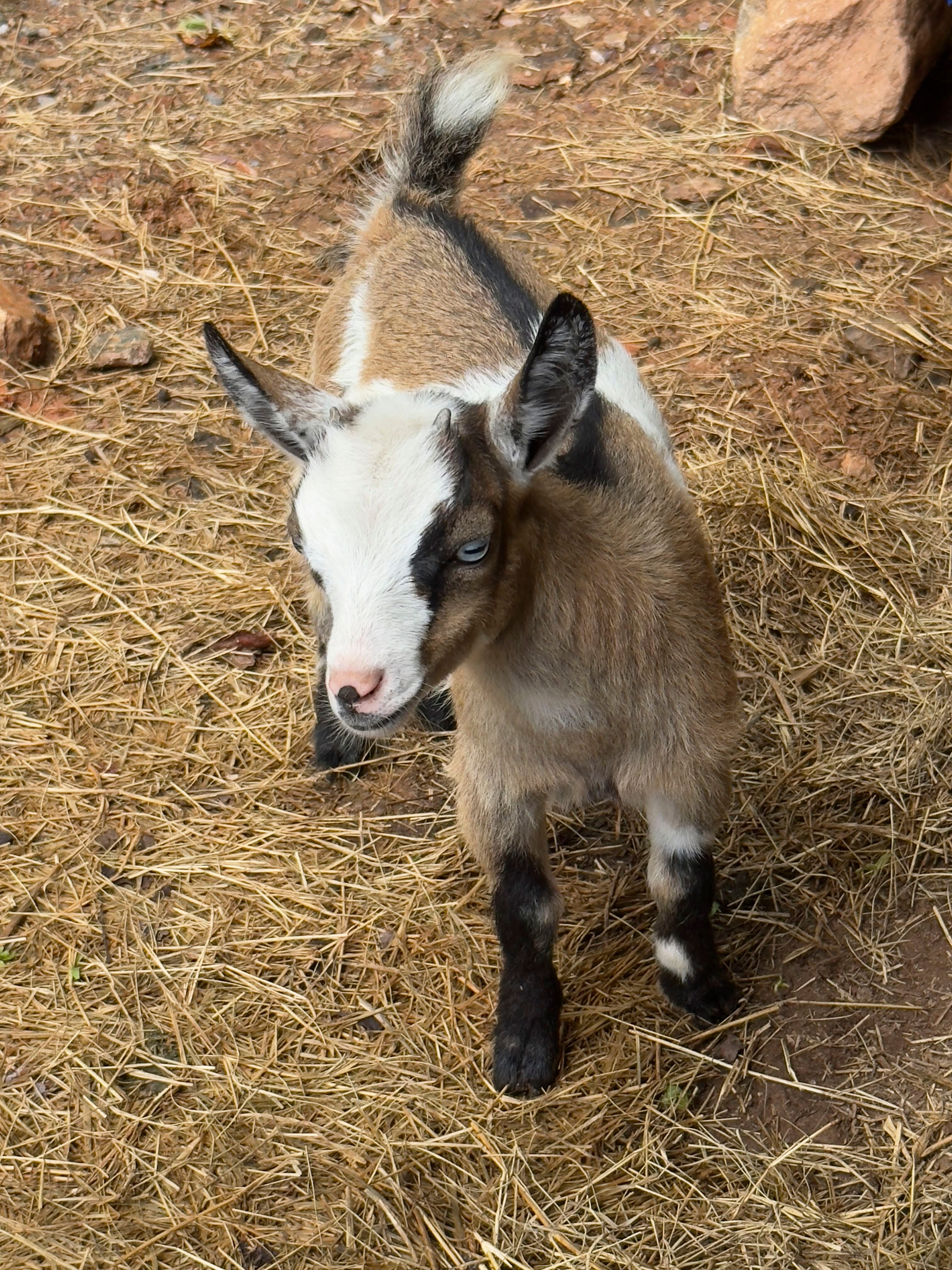
We have welcomed four baby goats to Common Good Farm this season, which means that I have spent considerably more time than I ever anticipated thinking about goat poop.
I don’t recall ever considering this in any career planning I did.
I now have opinions about hay, minerals, parasites, bloat, hooves, fencing, and the astonishing ability of a very small goat to break into the chicken coop and eat all the chicken feed. Farming has expanded my theological education in unexpected directions.
Our newest goat, Grace, is ten weeks old and arrived with a cough. At first, I just kept an eye on her. She ate, played, breathed normally, and acted like any baby goat. But the cough didn’t go away, and soon she sounded congested. I began to worry about pneumonia.
So I called our veterinarian. We live in a small town in Alabama, and I asked whether there was any chance he could work us into his schedule sometime the following week.
Dr. Yarbrough called me back: “I’ll be there in twenty minutes.”
Twenty minutes later, his truck pulled into our driveway. He listened to Grace’s lungs and agreed she sounded pretty rough. He gave her an antibiotic, and now we wait to see how she does. If she’s not much better by Wednesday, we’ll figure out what to do next.
But Dr. Yarbrough didn’t leave right after treating her. He checked on the other goats and pointed out things I hadn’t known to watch for. He showed me how to spot early signs of mineral deficiencies and parasites. We talked about deworming, which is something goat owners feel strongly about. He prefers not to do it routinely, but only when it’s needed. Most of all, I felt like I had a partner in caring for these little lives we’ve been gifted.
As I get older, I’m more and more drawn to a way of life that gives people enough time and space to care for each other. It was almost surprising to call someone with a problem and hear, “I’ll be there in twenty minutes.” No AI bot. No online scheduling. No six-week wait.
Instead, there was a sick animal, a worried farmer, and a veterinarian who had time to help.
I know that’s not always possible, even here. I don’t want to make rural life sound perfect. Small towns can be lonely and face economic challenges. Rural hospitals are closing. Farmers have a hard time. People often drive far for specialized care. The local grocery store still sells many things shipped from far away.
But living here keeps reminding me how people lived for most of history. We relied on people we knew. Food came from farms down the road. Farmer Jack grew the tomatoes. Mr. Craig could fix the tractors. Someone knew which field flooded after heavy rain. Someone noticed if an elderly neighbor hadn’t picked up her mail. People stopped to talk, not because it interrupted life, but because it was part of life.
I wonder if one of the big losses of modern life is how we’ve squeezed out that kind of extra space. We’re incredibly efficient now. We can get almost anything delivered by tomorrow. We can talk to people anywhere in the world instantly. We can plan our days down to fifteen-minute blocks and move from one thing to the next with amazing precision.
But when every bit of time is filled, efficiency comes with a hidden cost. Caring for others needs extra space. You can’t plan when a goat gets sick, a child needs to talk, a neighbor’s car won’t start, a friend hears bad news, or someone you love suddenly needs you. Living things need help when they need it.
Maybe that’s why the natural world has taught me so much. A farm doesn’t follow my calendar. Rain comes when it comes. Seeds sprout in their own time. Animals get sick on days that aren’t convenient. Seasons don’t check my schedule. Life keeps interrupting with more life.
There’s an old African idea called ubuntu: a person becomes a person through others. “I am because we are.” The phrase can sound sentimental out of context, but its real meaning is challenging. People thrive through relationships. My well-being is tied to the web of connections that support me.
The farm is teaching us something similar. We’re not meant to be totally self-sufficient. I can’t keep Grace healthy on my own. I need Dr. Yarbrough. He needs farmers who care for their animals. The goats need good soil and food. The soil needs rain, microbes, roots, decay, and time. And in the middle of all that, I’m still learning how little we can do alone.
Maybe this is what I’m looking for as I get older. I want a life with enough space to care. Enough space to notice when something’s wrong. Enough space to visit someone. Enough space to grow food and share it. Enough space for conversations that run long. Enough space for living things to be inconvenient.
More and more, I think those interruptions aren’t obstacles to life. They are life itself.
Maybe you want this, too.
For now, little Grace is back with the herd. I’m keeping a close eye on her and hoping the medicine helps. I’m grateful for a veterinarian who showed up just twenty minutes after I called.
There are many ways to measure what makes a good life. One of them might be: When someone needs you, do you have enough space in your life to respond?
We are in this together,
Cameron
Reflection Questions
Where has your life become so tightly scheduled or efficient that another person’s need easily feels like an intrusion?
Who are the people whose knowledge, generosity, and availability make it possible for you to care for the lives entrusted to you?
What would you need to change in order to create a little more room in your life for relationship, interruption, and care?
A Prayer for the Day
A Prayer To Make Room in Us
Holy One,

Thank you for the lives
entrusted to our care.

For neighbors who show up,
for hands that know how to help,
for wisdom shared freely,
and for those who make room
when we need them.

Slow us enough to notice
when another life needs tending.

Loosen our devotion
to efficiency and hurry.

Give us days spacious enough
for an unexpected visit,
a worried friend,
a sick animal,
a conversation that runs long.

May we become people
with enough room in our lives
for love to interrupt us.

Amen.
Spiritual Practice: Leave Some Room
Today, deliberately leave thirty minutes unscheduled. Don’t immediately decide what you will do with it. That would rather defeat the purpose. Let the time remain available.
If someone needs you, use it for them. If nobody does, sit outside. Call someone you have been meaning to call. Walk slowly. Talk to a neighbor. Spend time with an animal. Notice something growing.
The practice is not really about thirty minutes. It is about noticing what happens inside you when time is not already spoken for.
Many of us have become so accustomed to maximizing our days that unallocated time feels wasteful. Yet relationships need precisely this kind of space. People rarely need us at the most convenient moment. Animals certainly don’t. Grief, illness, friendship, weather, gardens, children, neighbors, and love all have terrible respect for calendars.
At the end of the day, ask yourself whether anything entered that open space that would otherwise have been crowded out.
Then consider whether your life might need a little more room like that.
Upcoming Events That Might Be of Interest…
My team and I launched a new experiment we are calling “The Commons.” It’s an online space centered around communities of practice: groups of people who share a common concern, set of problems, or passion for a topic, and deepen their knowledge and expertise by interacting on an ongoing basis. Join the community here.
September 29, 2026 - 12:30 - 1:30pm ET - FREE ONLINE BOOK CLUB - We are starting our next book in The Commons. For the next 5 weeks will we read Fr. Gregory Boyle’s, “Cherished Belonging: The Healing Power of Love in Divided Times.” Father Gregory Boyle, founder of Homeboy Industries, has spent decades building community among people whom society has often discarded. In Cherished Belonging, he draws on those relationships and stories to explore what might happen if we stopped sorting people into categories of worthy and unworthy, us and them. Don’t worry if you don’t have time to read the book. We always have incredibly rich conversations. All are welcome. RSVP Here.
October 6, 2026 - 7-8:30pm ET, ONLINE EVENT - Matthew Fox and I are teaming up again to launch a series called Journeying with the Mystics. The mystics have always emerged in times of uncertainty. They appear when old certainties are crumbling, when institutions no longer provide easy answers, and when people find themselves longing for a deeper experience of the Sacred. Join us for an 18-session exploration of the teachings of St. John of the Cross, Thomas Merton, Hildegard of Bingen, Kabir and Rumi, Meister Eckhart and more. This is more than a lecture series. It is an invitation into a living spiritual journey. REGISTER for the first session HERE!
October 15, 2026, 7-8:45pm ET - I will be joining Jackie Sussman for an online session on practicing eidetics as a part of our “Reclaiming the Power of Imagination” monthly series. Eidetic Imagery is a powerful tool for pastors, denominational leaders, coaches, and spiritual directors working with others, and for individuals seeking deeper integration and healing in their own lives. Jackie is a psychotherapist, author, and leading expert in Eidetic Image Psychology, and has spent over forty years helping leaders and individuals unlock creativity, uncover hidden strengths, and move through limiting patterns. During this session, she will lead a live Eidetic process shaped by mythic imagery, offering a direct experience of the work. REGISTER HERE.
October 18-21, 2026 - PREACH! 2026 Conference- I’ll be co-hosting PREACH in Minneapolis with Church Anew, a new gathering for preachers, storytellers, worship leaders, and spiritual communicators navigating what it means to speak with clarity, compassion, and courage in a changing world. If you’ve sensed that the preaching moment has changed and are longing for thoughtful community and renewed imagination for this work, I hope you’ll join us.
November 10, 7-8:30pm ET - I’ll be joined by theologian, writer, and professor Dr. Debra Rienstra for a special ONLINE conversation on Refugia Faith. In ecology, refugia are small places where life survives amid disruption, pockets of resilience from which life can eventually regenerate and spread. Debra invites us to consider what this might mean spiritually in an age of climate instability, political turmoil, institutional decline, and profound uncertainty. What if our congregations, communities, relationships, and even our own lives could become refugia, places where courage, compassion, beauty, wisdom, and possibility are protected and cultivated for whatever comes next? I hope you’ll join us for this timely and deeply hopeful conversation. REGISTER HERE!
December 15, 7-8:30pm ET - FREE WEBINAR - I will be joined by Dr. Charissa Mikoski, Assistant Professor of Research and Hartford Institute for Religion Research for a presentation on “The State of American Congregations: What the Latest Data Tell Us.” This webinar explores findings from the 2025 Faith Communities Today survey, including changes in worship attendance, congregational vitality, finances, volunteering, programming, and leadership. It will also examine what more than 24,000 individual attenders tell us about participation and their experiences of congregational life. Together, these findings offer a picture that is neither simply one of decline nor one of revival, but of significant change and uneven recovery. REGISTER HERE.
Fun Things My Friends Are Up To…
I get to work with such amazing, creative people. This section is my way of celebrating them—no paid promotions, just joy in what they’re creating.
The Convergence Music Project has scheduled the fall conference on October 7-10, 2026 in Louisville, Kentucky. We will sing new community songs created specifically for this time in our history and explore together how the songs we sing in worship (and beyond) can empower and encourage us as we live out the biblical call to “do justice, love kindness, and walk humbly with our God.” Learn more here.
Every Monday, 12pm ET - ONLINE WRITING GROUP - My dear friend, Meryl Marshall-Daniels, is leading a writing group open to all. This is a simple and spacious writing circle for people who want time to listen inwardly and put words on the page without overthinking, performing, or polishing. Meryl offers a prompt designed to invite reflection, imagination, and attunement to what is already alive within you. The practice honors writing as a way of listening, of letting images, memories, questions, and insights surface in their own time. Learn more here.
If you are a leader or member of a congregation looking for consulting support in visioning, planning, hiring or staffing, please consider Convergence.
Thanks, Cameron, for this reminder to value community, and understand our web of connection to each other, whether it is online, in our local community, or as a global species within the cosmos. I am so blessed by living in a rural community in France where we all look out for each other on multiple levels, and across cultural and language differences, using modern technology to keep each other informed, or ask for help. And then I have my holiday community in the country of my birth, South Africa, where the whole village keeps contact and each other informed about power outages, water issues, a snake that needs removing, whether anyone else is struggling with internet connection, and a myriad of other daily issues that we face. If course, I am also blessed with my membership of your online community, the Commons, as well as my spiritual home, the dispersed and online Northumbria Community, which gives me a Way for Living, and a daily rhythm to nourish body, mind and spirit, and values space to be. I think you touch on something here of great importance to us all in our bid to, not only survive, but thrive, in this changing world. I feel it's really important that we all create and find community in whatever ways we can, in our particular contexts, to strengthen the bonds that used to be known and experienced, and are now insidiously under threat.